

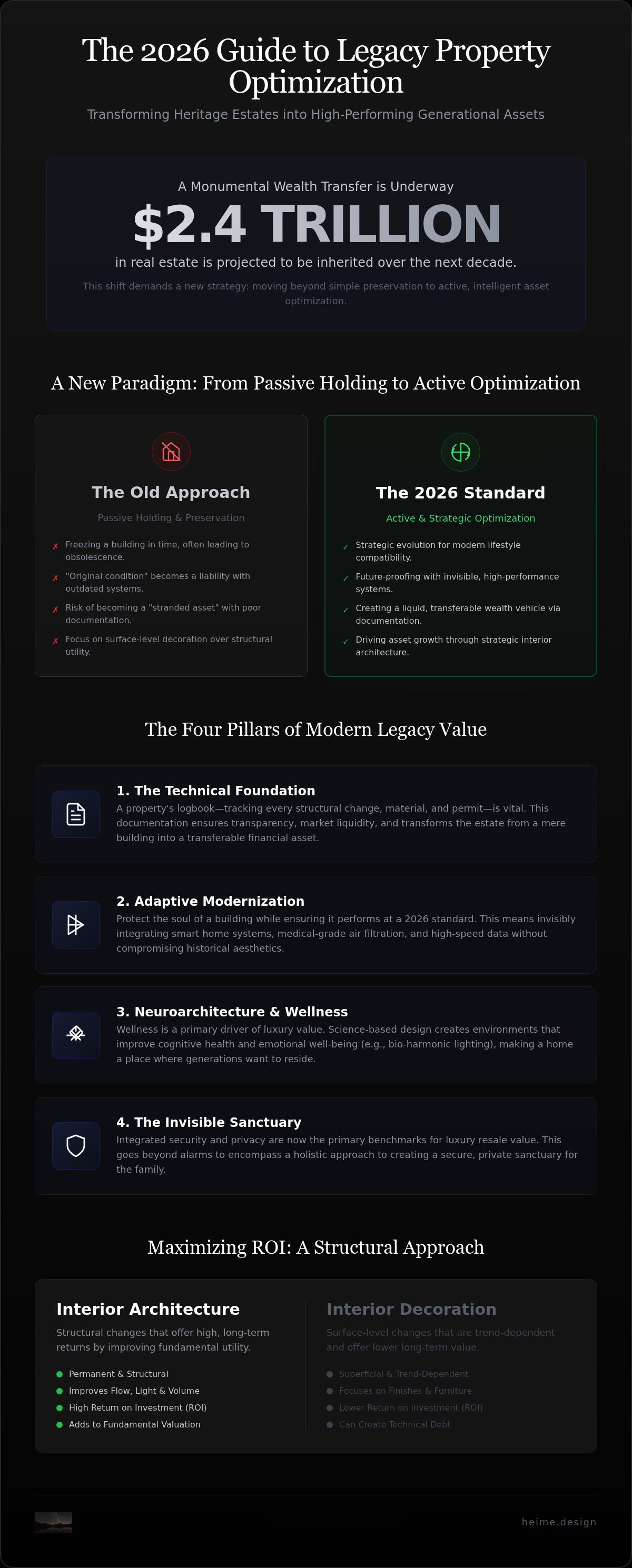
An estimated $2.4 trillion in real estate is expected to be inherited over the next decade. This massive shift puts a spotlight on how families manage their most valuable assets. You might feel the tension between honoring a home's heritage and the need for modern functionality. It's a common concern. True legacy property value preservation isn't about freezing a building in time; it's about strategic evolution.
You deserve a home that functions for your current lifestyle while securing its future market appeal. We understand the fear that a modern renovation might devalue historical features. This guide shows you how intentional interior architecture and precise design choices protect the generational value of high-end estates. We'll preview 2026 trends in estate optimization, including neuroarchitecture and technical compliance. Discover how to transform a heritage property into a secure, private sanctuary that serves your family for decades.
Key Takeaways
- Shift from passive property holding to active optimization. Learn how modern lifestyle compatibility drives long-term asset growth.
- Use technical design documentation as a property logbook. This step is vital for legacy property value preservation and future market appeal.
- Transform underutilized spaces into high-value wellness zones. Modernize heritage features while maintaining the estate’s historical integrity.
- Implement the "Invisible Sanctuary" concept. Discover why integrated security and privacy are now the primary benchmarks for luxury resale value.
- Navigate cross-border renovations with turnkey project management. Ensure precision and compliance for estates in Spain and across Europe.
Defining Legacy Property Value Preservation in the Modern Era
Legacy property value preservation is no longer just about keeping a roof over a family estate. It's the precise intersection of architectural integrity and modern lifestyle compatibility. In 2026, high-net-worth investors have shifted their focus. Passive holding is out. Active optimization is the new standard for high-value residential assets. A property that doesn't evolve eventually loses its relevance. This isn't just a design choice; it's a financial strategy.
Family Offices now oversee physical estate transformations as part of a broader wealth management plan. They recognize that a property's market value depends heavily on technical documentation and compliance. Without a clear logbook of upgrades and legal permits, even the most beautiful villa can become a "stranded asset." Precision in documentation ensures that the estate remains a liquid and transferable wealth vehicle for the next generation.
The 2026 Shift: Asset Performance vs. Heritage
"Original condition" is often a polite term for obsolete in the luxury market. If a home can't support high-speed data, medical-grade air filtration, or bio-harmonic lighting, its market appeal drops. When applying Historic preservation principles, the goal is to protect the soul of the building while ensuring it performs at a 2026 standard. Upgrading core systems like HVAC and smart home integration must be done invisibly. This preserves the aesthetic while meeting modern expectations. Ultimately, legacy preservation is the maintenance of emotional and financial equity over time.
The Economic Impact of Strategic Interior Architecture
Interior architecture is structural and permanent. It's about flow, light, and volume. This differs from decoration, which is surface-level and trend-dependent. Strategic architectural changes offer a higher ROI because they improve the fundamental utility of the space. Professional project management provides a safeguard against costly renovation errors. It ensures that every change adds to the valuation rather than creating a technical debt. Beyond the walls, high-end furniture selection acts as a portable asset class. These pieces retain value and can be moved between properties, making them a smart component of a diversified estate portfolio.
The Architectural Foundation of Generational Asset Growth
Generational growth for a luxury estate isn't accidental. It requires a technical foundation that goes beyond aesthetics. High-net-worth owners often view real estate as a static asset, but in 2026, value is dynamic. Professional legacy property value preservation relies on a detailed technical logbook. This documentation tracks every structural change, material specification, and system upgrade. It provides future owners with a clear blueprint of the property's quality and maintenance history. Without it, the estate loses transparency and market liquidity.
Multi-property owners face unique challenges when managing assets across different countries. Maintaining a consistent standard of quality requires international project management interior design. This centralized oversight ensures that a villa in Marbella meets the same rigorous standards as a penthouse in Warsaw. Bridging the gap between local Spanish architecture licensing and international design expectations is a specialized task. It requires a team that understands both the creative vision and the technical constraints of local building codes.
Future-proofing an estate involves adaptive interior architecture. Flexible floor plans allow a home to evolve as the family grows or changes. This strategy aligns with principles of sustainable preservation and smart growth. By designing spaces that can be repurposed without major demolition, you protect the building's shell while updating its function. This approach reduces long-term costs and ensures the property remains habitable for decades. If you are planning a cross-border renovation, our bespoke interior architecture services can help align your vision with local technical requirements.
Neuroarchitecture: Designing for Long-Term Desirability
Wellness is a primary driver of luxury property value in 2026. Neuroarchitecture uses science-based design to create environments that improve cognitive health and emotional well-being. These cognitive-friendly spaces increase the "stickiness" of a family home, making it a place where multiple generations want to reside. Integrated lighting design is a key component. It enhances architectural details while regulating circadian rhythms. This focus on human-centric design ensures the home remains desirable and functional as the owners age.
Technical Compliance and Licensing as Value Protectors
Unpermitted renovations are a significant risk in European markets. In Spain, non-compliant work can lead to heavy fines or difficulties during a future sale. Technical drawings are essential value protectors. They prove that every renovation meets local safety and zoning laws. Coordinating with local architects ensures generational legal safety. This technical precision safeguards the estate's legacy property value preservation by eliminating legal liabilities for the next generation of owners. Accurate documentation is the ultimate gift of clarity for your heirs.
Adaptive Reuse: Modernizing Heritage Properties Without Diluting Value
A heritage property shouldn't feel like a time capsule. It must function for a 2026 digital lifestyle while retaining its soul. This balance is the core of legacy property value preservation. High-net-worth owners often struggle with thick stone walls that block connectivity or ornate ceilings that hide outdated wiring. Solving these friction points without visible intrusion is essential. We focus on integrating high-speed infrastructure behind historic finishes. This ensures the home remains a functional asset for the next generation.
Adaptive reuse is the most effective strategy for this evolution. It promotes the sustainable preservation of historic buildings by giving them new, high-value purposes. Underutilized spaces like damp cellars or dusty attics offer the greatest potential for growth. A basement can become a climate-controlled wine gallery or a secure vault. An attic might serve as a private cinema or a wellness sanctuary. These transformations increase the property's usable square meters without altering its historic footprint.
The "Invisible Tech" trend is leading this shift. Smart home integration now hides behind period aesthetics. We use invisible speakers behind plaster and climate controls tucked inside bespoke millwork. For international investors, managing these complex renovations from abroad is a major pain point. Turnkey solutions bridge this gap. You receive a finished, modern home without the stress of cross-border site supervision. We handle the technical documentation and local coordination so the design vision remains intact.
Heritage Estate Renovation: The Modern Classic
Preserving artisanal craftsmanship is vital for long-term value. We pair original woodworking with high-performance materials to improve insulation and durability. Bespoke furniture also plays a role. It honors the property's unique history while providing contemporary comfort. Adaptive reuse prevents heritage properties from becoming stagnant museums by ensuring they remain vibrant, liveable spaces.
Wellness and SPA Integration in Legacy Estates
The "private resort" model is a growing trend for family compounds. Owners now expect boutique hotel-standard suites within their private residences. This includes steam rooms, cold plunges, and dedicated treatment areas. We ensure wellness design aligns with the overall property architecture. A modern sauna shouldn't feel like an afterthought in a 19th-century villa. It should feel like a natural, luxury extension of the home's existing story.
Security and Privacy as the New Benchmarks of Property Value
Security has moved from a technical checklist to a primary driver of luxury property valuation. In 2026, high-net-worth buyers prioritize safety as much as location. A property without integrated, modern security is often viewed as a liability. This shift makes advanced protection a core pillar of legacy property value preservation. Buyers aren't just looking for cameras; they want a residence that functions as a secure, private sanctuary from the ground up. Privacy is now a measurable asset.
The modern standard is secure luxury interior design, often called the "Invisible Sanctuary." This approach ensures that protection doesn't compromise the home’s aesthetic harmony. High-value estates require architectural shielding that feels natural. Privacy-first landscaping uses topography and strategic planting to block sightlines without creating a fortress-like appearance. These choices protect the residents while enhancing the property's long-term market appeal. If you are looking to upgrade your estate's protection, our secure luxury interior design services provide a seamless blend of safety and sophistication.
A secure estate must also address digital threats. Cyber-security integration is now essential for the modern smart-manor. We design systems that protect both physical entry points and data networks. This dual-layered approach is vital because 61% of households now own security cameras, but few have integrated them into a professional-grade architecture. True value lies in the seamless coordination of physical and digital barriers.
The Invisible Sanctuary: Security Meets Aesthetics
Protection is most effective when it's hidden. We use hardened structures that appear as standard high-end interior architecture. Reinforced walls and ballistic-rated glass are integrated into the design so they remain undetectable. Secure lighting acts as both a design element and a perimeter control tool. These features provide peace of mind without turning a beautiful home into a visible bunker. It's about quiet confidence and intentionality.
Safe Rooms and Secure Suites for Legacy Homes
Modern safe zones are multi-functional. A library or a primary suite can double as a secure shelter with the right technical specifications. This ensures that every square meter of the home remains usable and elegant. These areas typically include:
- Advanced ventilation and independent air filtration systems.
- Hidden communication hubs for emergency contact.
- Discreet entry and egress points for VIP residents.
HEIMÉ: Orchestrating Legacy Transformations Across Borders
Managing a high-end estate from another continent shouldn't be a source of friction. HEIMÉ bridges the gap between a sophisticated design vision and complex technical execution. We specialize in turnkey project management for owners who cannot be on-site. Whether your asset is in Poland, Spain, or elsewhere in Europe, we provide a localized presence with international standards. This ensures that every detail aligns with the original intent while meeting strict local requirements. Effective legacy property value preservation starts with a team that understands these cross-border complexities.
Cross-border coordination is our core strength. We handle the intricacies of Spanish building permits and manage relationships with local contractors. This removes the burden from the owner. We act as the technical safeguard for your investment. Minimalist precision is at the heart of our work. By focusing on essential quality and streamlined processes, we ensure maximal generational value. This integrated approach is the final step in legacy property value preservation.
Multilingual Project Coordination for Global Investors
Cultural and linguistic barriers often derail high-stakes renovations. Our multilingual team eliminates these risks. We standardize technical documentation across different European jurisdictions. This creates a clear, universal language for the project. You gain a single point of contact for architects, contractors, and licensing authorities. This centralized oversight prevents the miscommunications that lead to budget overruns or delays in Spanish permit coordination. We ensure the process is as refined as the final result.
The HEIMÉ Legacy Audit: Assessing Physical Asset Potential
Every property has hidden potential for value growth. The HEIMÉ Legacy Audit evaluates your physical asset through the lens of strategic design. We identify opportunities for adaptive reuse, security integration, and neuroarchitectural improvements. Our tailored solutions serve family offices and UHNW estate managers who require precision and discretion. We don't just design spaces; we curate long-term wealth. Our goal is to transform your property into a high-performing asset that stands the test of time.
Start your legacy transformation with a professional design consultation. We help you define the path from an aging estate to a modern, high-performance sanctuary. Our process is linear and logical. We move you quickly from initial inquiry to action. Every word and every choice serves a specific purpose. Let us protect the generational value of your most important residential assets.
Securing Your Generational Asset for 2026 and Beyond
Luxury real estate in 2026 requires more than maintenance; it demands active asset optimization. Technical documentation and adaptive architecture are the true foundations of legacy property value preservation. By integrating invisible security and wellness-focused neuroarchitecture, you ensure your estate remains a private sanctuary. These strategic choices protect your financial equity while enhancing your family's modern lifestyle. A home should evolve as your needs change.
Managing these transformations across borders requires a partner who understands the stakes. HEIMÉ offers specialized expertise in UHNW and Family Office estate management. We are experts in cross-border project coordination for Poland and Spain, handling every technical detail with precision. Our award-winning focus on neuroarchitecture and secure luxury ensures your home is both beautiful and resilient. We bridge the gap between complex regulations and your design vision so you don't have to.
Your property is ready for its next chapter. Secure your estate’s future with HEIMÉ’s Legacy Design services. Let's build a lasting legacy together. We look forward to helping you protect what matters most for the decades ahead.
Frequently Asked Questions
What is the difference between property maintenance and legacy value preservation?
Maintenance is reactive and focuses on keeping a building in its current state. Legacy property value preservation is proactive and strategic. It ensures the home remains relevant for future generations by integrating modern lifestyle needs, such as high-speed infrastructure and wellness zones. While maintenance fixes a roof, preservation optimizes the entire asset for long-term growth.
How does neuroarchitecture specifically increase the value of a luxury estate?
Neuroarchitecture uses science-based design to improve the cognitive health and emotional well-being of the residents. These features make a home more desirable and "sticky" for families. In the 2026 market, buyers prioritize homes that promote longevity and mental clarity. This human-centric approach turns a residence into a high-performing asset that commands a premium price.
Can I modernize a heritage property in Spain without losing its historical status?
Yes, you can modernize through adaptive reuse and invisible tech integration. The process involves hiding modern infrastructure behind period finishes to maintain the property’s soul. We coordinate with local architects to ensure all renovations comply with Spanish building permits and heritage laws. This protects the building's history while making it functional for a digital lifestyle.
What are the essential technical documents needed for legacy property transfers?
You need a comprehensive technical logbook that includes updated floor plans and technical design documentation. Proof of compliance with local regulations, such as Spanish building permit records, is also vital. These documents provide transparency for future owners and protect the estate's market liquidity. Clear records ensure that legacy property value preservation is maintained during the transfer process.
How do I integrate high-level security into a luxury home without it looking like a fortress?
We use the "Invisible Sanctuary" concept to blend protection with high-end aesthetics. This includes ballistic-rated glass and reinforced walls that appear as standard architectural features. Privacy-first landscaping and secure lighting provide perimeter control without visible barriers. The result is a home that feels like a peaceful retreat while offering absolute safety for its residents.
Why is interior architecture more effective for value preservation than standard interior design?
Interior architecture focuses on the permanent structural elements of a home, such as light, volume, and flow. Standard interior design often deals with transient trends like furniture and color palettes. Because architecture addresses the fundamental shell and utility of the building, it has a much larger impact on the property’s long-term valuation. It’s an investment in the building itself.
How does HEIMÉ manage luxury renovations for clients living in different countries?
We provide turnkey project management and cross-border coordination for international owners. Our multilingual team acts as your representative on-site in Poland, Spain, and across Europe. We handle the technical documentation, licensing, and site supervision from start to finish. This streamlined process ensures your design vision is executed perfectly even when you aren't there to oversee the work.
What is adaptive reuse in the context of high-end residential estates?
Adaptive reuse involves repurposing underutilized areas of a home for new, high-value functions. Common examples include transforming a damp cellar into a professional-grade wellness spa or an attic into a secure home office. This strategy increases the usable square meters of the property without changing its historic footprint. It’s a vital tool for keeping legacy estates functional and valuable.


