

Can you successfully manage a high-end structural renovation in Spain while living abroad? The dream of a Mediterranean retreat often meets the reality of local bureaucracy. Technical permit delays are a common hurdle. Achieving world-class interior design for expats Spain requires more than an eye for aesthetics. It demands a precise understanding of Spanish building codes and architectural licensing.
You seek a home that balances international luxury with local charm. We understand that distance management and language barriers create friction. This guide provides the clarity to master the 2026 renovation landscape. We'll show you how to navigate turnkey management and technical documentation without the typical stress.
Expect a detailed look at current market conditions. We'll cover luxury fit-out costs reaching upwards of €2,500 per square meter. Through heime.design, we'll explore how to ensure legal compliance, manage local contractors, and implement wellness-focused design principles. Your path to a seamless Spanish property transformation starts here.
Key Takeaways
- Bridge international luxury standards with local regulations to master interior design for expats Spain.
- Secure legal compliance by navigating the Spanish building permit hierarchy with the help of an Arquitecto Técnico.
- Reduce project friction through turnkey management, ensuring a single point of contact from initial concept to completion.
- Maintain total control from abroad using digital-first workflows and immersive VR design walkthroughs.
- Optimize mental wellbeing by integrating neuroarchitecture principles tailored specifically to the Spanish climate.
Why is interior design for expats in Spain uniquely complex?
Renovating a property in Spain is a rewarding but intricate process. For the international owner, the challenge lies in the intersection of high-end aesthetics and rigid local regulations. It's rarely just about choosing a color palette. It's about ensuring your vision survives the journey through Spanish bureaucracy. Achieving successful interior design for expats Spain means balancing your personal style with the technical requirements of local municipalities.
The cultural gap often surprises new owners. Construction timelines and communication styles in Spain differ from those in Northern Europe or North America. A "mañana" attitude isn't necessarily about laziness; it's often a reflection of a different logistical pace and regulatory wait times. High-value projects require a partner who speaks the language of local contractors and the language of international luxury. This bridge is essential for maintaining quality control from a distance.
The role of interior architecture vs. simple decoration
In the Spanish market, the distinction between a decorator and an interior architect is critical. Simple decoration involves furniture and surface finishes. However, luxury renovations often involve structural changes that respect the history of Spanish architecture. If you plan to move walls, update plumbing, or change the layout, you are performing interior architecture. This requires formal oversight.
Spanish law is strict about structural integrity. Every significant change must be documented. Our technical design documentation services provide the necessary blueprint for these changes. This documentation isn't just for the builders; it's for the authorities. It ensures that every aspect of the renovation complies with the Código Técnico de la Edificación. Without these professional drawings, your project lacks a legal foundation.
Common pitfalls for international property owners
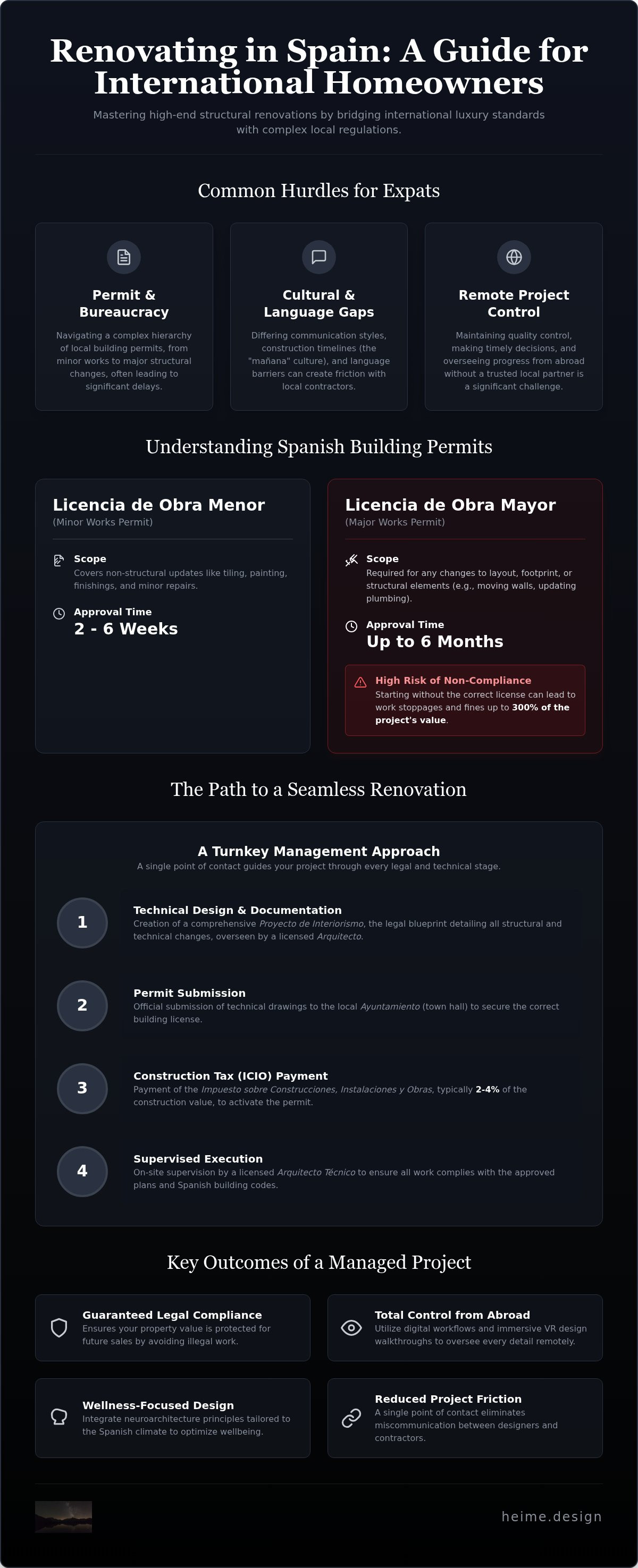
Permit classification is a frequent trap. Many owners assume all interior work falls under a Licencia de Obra Menor. While these minor permits are approved in 2 to 6 weeks, they only cover non-structural updates like tiling. Any change to the footprint or structural elements requires a Licencia de Obra Mayor. This can take up to 6 months for approval. Starting without the right license can lead to work stoppage orders and fines ranging from 2,580 zł to 300% of the project value.
Another risk is the lack of technical compliance. If a renovation isn't properly licensed, it can create massive hurdles during a future property sale. Buyers in the luxury segment perform deep due diligence. Any illegal work found can lead to a collapsed deal or a forced price reduction. Investing in professional coordination ensures your property remains a liquid, high-value asset for years to come.
What are the essential building permits and architecture licenses in Spain?
Understanding the permit hierarchy is the first step toward a successful property transformation. In the 2026 Spanish market, regulations remain localized and strictly enforced. Every project requires a specific legal framework. For high-end interior design for expats Spain, this means navigating municipal requirements before the first hammer swings. Failure to do so risks fines that can reach 300% of your project's value.
You will need more than just a designer. A major renovation requires an Arquitecto to create the project and an Arquitecto Técnico (also known as an Aparejador) to supervise the execution. These professionals are registered with the official body for architects in Spain. They ensure your renovation respects heritage laws and safety standards. This technical oversight is a legal mandate for structural changes, not an optional luxury.
Obtaining the license: A step-by-step process
The path to legal compliance is linear and logical. It begins with the Proyecto de Interiorismo. This comprehensive document details every technical change. Once finalized, your team submits these drawings to the local Ayuntamiento (town hall). Approval times vary. Minor works usually take 2 to 6 weeks. Major structural changes can take up to 6 months.
The final step involves the Impuesto sobre Construcciones, Instalaciones y Obras (ICIO). This construction tax typically ranges from 2% to 4% of the construction value. Once paid, your license is active. We recommend starting this process early to avoid delays in your move-in date.
Technical design documentation for Spanish permits
Technical drawings are the language of Spanish authorities. They require precision. These documents prove your renovation meets modern safety and European energy efficiency standards. A professional interior designer coordinates directly with Spanish architects to translate your vision into these required formats. This ensures your high-end aesthetic doesn't clash with local building codes.
Accurate documentation also protects your investment. It provides a clear record of work for future valuations. If you are feeling overwhelmed by these requirements, our team specializes in Architecture Licensing Services to streamline the entire process. We act as your technical bridge, ensuring every detail meets both your standards and Spanish law.
Turnkey project management vs. local contractor hiring
Choosing how to execute your renovation is as important as the design itself. Many owners consider hiring individual local contractors to save on upfront costs. However, this often leads to a "distance tax." This hidden cost includes the time, travel, and stress of managing a project from thousands of kilometers away. For high-end interior design for expats Spain, the turnkey model is the standard for a reason. It provides a single point of responsibility from the initial concept to the final handover.
Hiring individual contractors often results in "finger-pointing" when delays occur. The plumber blames the tiler, and the tiler blames the architect. Without a central manager, the owner becomes the mediator. This is nearly impossible to do effectively from abroad. A turnkey service absorbs these conflicts, ensuring that the only thing you experience is the progress of your home.
The benefits of a single point of contact
Managing a construction site in Spain requires constant dialogue. Language barriers can lead to costly errors in material selection or structural execution. A turnkey partner eliminates this friction. They act as a multilingual bridge between you and the local workforce. Our team communicates in English, Spanish, and Polish to ensure total clarity.
For UHNW clients and family offices, this means streamlined reporting and centralized accountability. You don't need to chase five different tradespeople. You have one team ensuring the budget and timeline stay on track. This model protects your time, allowing you to focus on high-level decisions rather than daily logistical hurdles.
Site supervision and quality control
Quality in luxury builds is found in the details. Regular site visits are non-negotiable in the Spanish environment to catch deviations early. Effective international project management interior design ensures that local execution meets global standards. This includes managing custom furniture installations and inspecting material deliveries before they are installed.
Beyond structural integrity, modern luxury focuses on the inhabitant's experience. We integrate neurodesign for wellness and comfort into our supervision process. This ensures that lighting, airflow, and spatial flow align with scientific principles for well-being. Turnkey management isn't just a service; it's an insurance policy for your property's value. It transforms a complex logistical puzzle into a predictable, high-quality result.
How to manage luxury renovations in Spain from abroad
Distance is the greatest challenge for international property owners. Managing a project from Warsaw or London requires a shift toward digital transparency. You cannot rely on verbal agreements or occasional site visits. Success depends on a structured, digital-first workflow. This ensures that interior design for expats Spain remains a controlled, predictable process regardless of your physical location. It's about replacing physical presence with high-definition data.
Setting realistic milestones is the foundation of cross-border management. We divide the project into clear phases: technical documentation, structural work, first-fix installations, and final finishes. Each phase has a hard deadline and a corresponding payment schedule. This keeps the project moving and ensures you only pay for verified progress. It's a logical, transparent way to build trust over thousands of kilometers.
Leveraging technology for remote oversight
We use cloud-based project management tools to provide real-time updates. You receive high-definition photography and video reports every week. These aren't just for show. They allow you to inspect the placement of electrical points and the quality of tile joints from your laptop. Virtual reality (VR) walkthroughs are equally essential. They allow you to experience the spatial flow and lighting before any materials are purchased. This reduces the need for expensive, last-minute changes.
Material selection no longer requires a flight to the Mediterranean. We provide physical sample boards delivered directly to your door. You can touch the stone and see the wood grain in your own light. This is paired with high-resolution digital renders to show how those materials look in the context of your specific Spanish property. It's a tactile and visual bridge that ensures no surprises on move-in day.
Legal and financial safeguards for expats
Financial management is a common source of anxiety. In Spain, you must understand the VAT (IVA) implications. A reduced rate of 10% often applies to renovations of a main residence if the property is over two years old and material costs don't exceed 40% of the total budget. We help you navigate these tax nuances to optimize your investment. This prevents large, unnecessary outlays and keeps your budget focused on quality.
Owner liability is a serious risk in the Spanish construction sector. You must ensure all site workers are legally registered with the Seguridad Social. If a contractor fails to do this, the property owner can be held liable for accidents or unpaid contributions. We verify these registrations as part of our oversight. Additionally, major structural works are protected by the Seguro Decenal. This is a mandatory 10-year warranty that secures your investment against structural defects. If you're ready to start your project with a secure, digital-first approach, explore our Bespoke Interior Design and Project Management services. We handle the technicalities so you can focus on the vision.
Designing for wellness: Neuroarchitecture in the Spanish climate
Neuroarchitecture is the science of how our built environment influences our mental well-being. It's a core component of sophisticated interior design for expats Spain. We don't just create beautiful rooms. We design spaces that reduce stress and improve cognitive function. This scientific approach is essential when adapting to a new environment. A luxury home should be a sanctuary for your nervous system.
Adapting to the Spanish climate requires technical precision. The sun is a powerful design element, but it can also be a source of thermal stress. We use natural materials like cooling stone and sustainable wood to balance the heat. The integration of indoor and outdoor living is a deliberate wellness strategy. By blurring these boundaries, we foster a constant connection to nature. This biophilic approach is proven to lower cortisol levels and enhance daily comfort.
Lighting design for Spanish high-end interiors
Lighting is a critical factor in Mediterranean wellness. We manage the intense sun through a combination of technical shading and architectural glass. Circadian lighting solutions are standard for our luxury villa projects. These systems mimic the natural progression of daylight, supporting your sleep-wake cycle and overall health. It's about creating an atmosphere where natural light and artificial systems work in harmony. This ensures your home feels vibrant at noon and restorative at midnight.
The heime.design approach to bespoke interior architecture
Our philosophy follows a "less is more" minimalist aesthetic. We prioritize quality over quantity. Every material and furniture piece is selected to support a healthy, intentional lifestyle. We bridge the gap between international UHNW expectations and the realities of Spanish execution. The team at heime.design ensures that the technical documentation discussed in previous sections translates into a flawless physical reality.
The journey from permit coordination to your first night in the home is a linear process. We manage the final installations and quality checks with meticulous care. Your transition to a life in Spain should be effortless. We deliver a finished space that reflects your aesthetic standards and supports your long-term well-being. This is the ultimate goal of a truly turnkey luxury renovation.
Transforming Your Spanish Property Into a Lasting Legacy
A successful renovation in Spain is a balance of technical precision and aesthetic vision. You've seen that mastering the building permit hierarchy and choosing a turnkey management model are the most effective ways to avoid the "distance tax." By prioritizing interior design for expats Spain that integrates neuroarchitecture and wellness, you create a home that supports both your lifestyle and your property's long-term value.
Managing high-value UHNW estate transformations from abroad doesn't have to be a source of friction. Our multilingual team acts as your dedicated bridge to local authorities and contractors. We specialize in Spanish building permit coordination, ensuring every structural change is legally compliant and executed to international standards. This structured approach allows you to focus on the excitement of your new Mediterranean life while we handle the complexities on the ground.
Secure your Spanish property investment with heime.design’s expert design and management services. Your dream of a seamless, high-end property transformation is within reach. We look forward to helping you build something exceptional.
Frequently Asked Questions
Do I need a building permit for a kitchen renovation in Spain?
Yes, a kitchen renovation typically requires a Licencia de Obra Menor. Even if you aren't moving walls, updating plumbing and electrical systems falls under this minor works category. If the layout changes or structural elements are touched, you may need a major works permit. Local town halls enforce these rules to ensure all installations meet modern safety standards.
How long does it typically take to get a building license in Spain?
Timelines depend on the complexity of the project and the specific municipality. A Licencia de Obra Menor for surface-level updates usually takes 2 to 6 weeks. For structural changes requiring a Licencia de Obra Mayor, expect a wait of 2 to 6 months. Early submission of technical documentation is essential to keep your 2026 move-in date on track.
Can I hire an international interior designer for my Spanish property?
You can hire an international studio, but they must coordinate with a registered Spanish architect for legal compliance. Local authorities require technical drawings that follow specific building codes. Our studio bridges this gap by providing high-end interior design for expats Spain alongside the necessary architecture licensing services. This ensures your international aesthetic is backed by local legal standards.
What is the difference between Obra Mayor and Obra Menor?
The distinction lies in the project's structural impact. Obra Menor covers small, non-structural changes like tiling, painting, or bathroom updates. Obra Mayor is required for structural alterations, extensions, or changes to the building's footprint. Major works require a formal project signed by an architect, while minor works involve a simpler administrative process and lower municipal fees.
Is it possible to manage a Spanish renovation entirely from abroad?
Yes, managing a renovation remotely is highly effective through a turnkey project management model. We use digital-first workflows, including weekly video reports and VR walkthroughs, to keep you informed. This eliminates the need for frequent travel. A dedicated project manager handles local contractors and site supervision, ensuring that the execution matches your design standards without requiring your physical presence.
What technical documentation is required for a luxury villa refit?
A luxury refit requires a comprehensive Proyecto de Interiorismo. This document includes detailed floor plans, electrical and plumbing layouts, and exact material specifications. For structural work, you also need an architect's project and a health and safety study. These technical drawings serve as the legal basis for your permit application and provide the execution blueprint for your construction team.
How does neuroarchitecture improve the value of my Spanish estate?
Neuroarchitecture uses science-based design to enhance well-being and cognitive function. By optimizing natural light, airflow, and spatial flow, these homes offer a superior living experience. In the luxury market, properties that prioritize mental health and comfort are increasingly desirable. This modern approach distinguishes your estate from traditional builds, increasing its market appeal and long-term investment value.
Why is a multilingual project manager essential for expats in Spain?
A multilingual manager eliminates the friction caused by language barriers and cultural differences. They ensure that your specific requirements are accurately translated to local tradespeople. This prevents costly misunderstandings regarding materials or finish quality. By acting as a technical bridge, they provide the clear communication necessary to manage complex, high-value renovations across borders successfully.


