

What if better home lighting depended less on a special bulb and more on when, where, and how you use light? Circadian rhythm lighting design for homes starts with that broader view. It considers daylight, daily routines, room function, and the atmosphere you want to create.
It’s understandable to wonder how brightness, colour temperature, and timing fit together, or to assume a circadian approach means replacing every fixture or installing a complex automated system. In practice, you can start by reviewing the lighting you have, then make changes that suit your household and routine.
This guide explains which lighting choices matter throughout the day and how to plan them for different rooms. You’ll explore practical layers for ambient light, focused tasks, and softer evening scenes, while keeping visual comfort and style in view. You’ll also learn when lighting design or smart-home controls may help coordinate fixtures and schedules. The aim is a home that feels considered from morning to night, not a technical setup that asks you to manage every detail.
Key Takeaways
- Plan lighting around what each room needs you to see and do, rather than relying on one setting throughout the day.
- With circadian rhythm lighting design for homes, timing, light quality, and intensity work together, but there’s no single schedule that suits every household.
- Compare fixed, smart, and circadian-aware lighting to decide how much daily adjustment and control flexibility your home actually needs.
- Map household routines and daylight first, then choose room-specific fixtures and layers for bedrooms, kitchens, living areas, and workspaces.
- Coordinating lighting with architecture, finishes, and controls can create a more cohesive home, but it calls for clear planning and installation decisions.
What Circadian Rhythm Lighting Design Means in a Home
Circadian rhythm lighting design for homes considers light quality, intensity, and timing across daily routines. In practice, it means planning light for visibility and comfort while taking account of when and how each space is used. It doesn’t promise to reset a body clock or treat a health condition.
The light people experience comes from daylight and electric sources. Window orientation, weather, season, glazing, and shading all affect daylight indoors. Lamps and fixtures add another layer. Together, these sources shape the light reaching a person’s eyes, not just a room’s appearance or a bulb’s specifications. The overview of Light effects on circadian rhythm explains how light received through the eyes can influence circadian timing. Its effects depend on factors such as timing, intensity, duration, and individual context.
How the body responds to light across the day
Light-sensitive cells in the eye help convey information about the surrounding light environment to the body’s internal timing system. This is one reason the same light may be experienced differently depending on when it reaches the eyes and for how long. It doesn’t mean one lighting plan will produce the same response for everyone.
Lighting professionals may refer to melanopic equivalent daylight illuminance (melanopic EDI), a measure that describes light’s potential to stimulate melanopsin-sensitive pathways, expressed against a daylight reference. The CIE S 026 system provides a framework for measuring these effects. Melanopic EDI is a technical way to describe light, not a personal health score or a universal target for every room.
Why a circadian approach is not just a colour-temperature setting
Correlated colour temperature, usually shown in kelvins, describes whether light appears warmer or cooler. It doesn’t tell you how much light reaches the eye. That also depends on the source’s output, distance, direction, and how light is distributed through the space.
Glare, contrast, and exposure duration matter too. A bright source in the line of sight can feel uncomfortable, while a well-placed task light can make reading or food preparation easier without flooding the whole room. Daylight access and household routines vary, so a setting that works in one home may not suit another.
Circadian-aware lighting design coordinates timing, intensity, direction, and daily use. Choosing warm or cool bulbs alone does not. That wider view is the foundation of circadian rhythm lighting design for homes.
How Daylight, Brightness, and Timing Shape Home Lighting
Light at home changes through the day. Sunlight shifts with window orientation, season, weather, and shading. Electric lighting fills in when daylight is limited or a task needs more focused illumination. The result is a changing mix, shaped by what the room is used for and where people spend time in it.
Light’s timing and the amount reaching your eyes matter alongside how warm or cool it looks. For further background on light exposure, see this reference on daylight and light exposure. At home, aim to make light useful and comfortable for the activity at hand. Avoid treating a rigid schedule as a rule that suits everyone.
Planning daytime light without sacrificing visual comfort
Use daylight where it helps, while checking how it behaves in the room. Direct sun can create glare on a screen, reduce privacy, or add unwanted heat. Sheer window coverings, adjustable shading, and a desk positioned away from reflections may help balance brightness and comfort.
Daylight changes over time. Observe the room in the morning, later in the day, and under cloudy conditions before deciding that a space is consistently bright. In deeper rooms or areas far from windows, layer electric light for different needs: general illumination for moving around, task lighting for reading or preparation, and softer accent light where appropriate.
Creating a gentler transition into evening
As evening routines begin, locally controlled light can help shift the atmosphere without leaving practical tasks in the dark. A dimmed lamp near a seat, for example, can provide comfortable reading light while keeping the rest of a living area subdued. Warmer-toned light is one option for a quieter mood. It isn’t a guaranteed sleep intervention.
Dimmers and scene controls can make adjustments simpler, but they’re optional. Check that the chosen lamps, fixtures, and controls work together, and consider whether household members will find the settings easy to use. A considered residential lighting design can help coordinate daylight, fixtures, and controls with the room’s materials and everyday use. Circadian rhythm lighting design for homes works best when decisions respond to the actual space, not a preset timetable.
Circadian Lighting Compared with Standard and Smart Lighting
These approaches differ in purpose, not just technology. Standard lighting provides illumination. Smart lighting adds flexible controls. Circadian-aware design considers how light is used across rooms and routines, then selects fixtures and controls to suit that plan. Smart features can help, but automation alone doesn’t make a lighting scheme circadian-aware.
What smart controls can and cannot do
Schedules can change settings at chosen times; dimmers adjust output; scenes group settings for activities; sensors can respond to presence or daylight. Each is a tool, not a complete design strategy. A preset may be inconvenient if it clashes with household routines, and a sensor won’t solve glare or poor fixture placement. Before specifying devices, check wiring, control requirements, and compatibility across the intended system.
When a simple lighting plan may be enough
Automation isn’t essential for every home. Separate ambient, task, and accent lights can let someone brighten a kitchen worktop while keeping the rest of the room comfortable. A bedroom might need a reliable switch and a dimmer rather than scheduled changes. Choose controls people will use consistently. Consider ease of operation, maintenance, and future changes alongside flexibility.
A lighting system is only as useful as its fit with the rooms and routines it serves. For circadian rhythm lighting design for homes, start with the experience you want in each space. Then decide whether manual controls, dimming, or a broader smart-home setup will support it without adding unnecessary complexity.
How to Plan Circadian Rhythm Lighting Room by Room
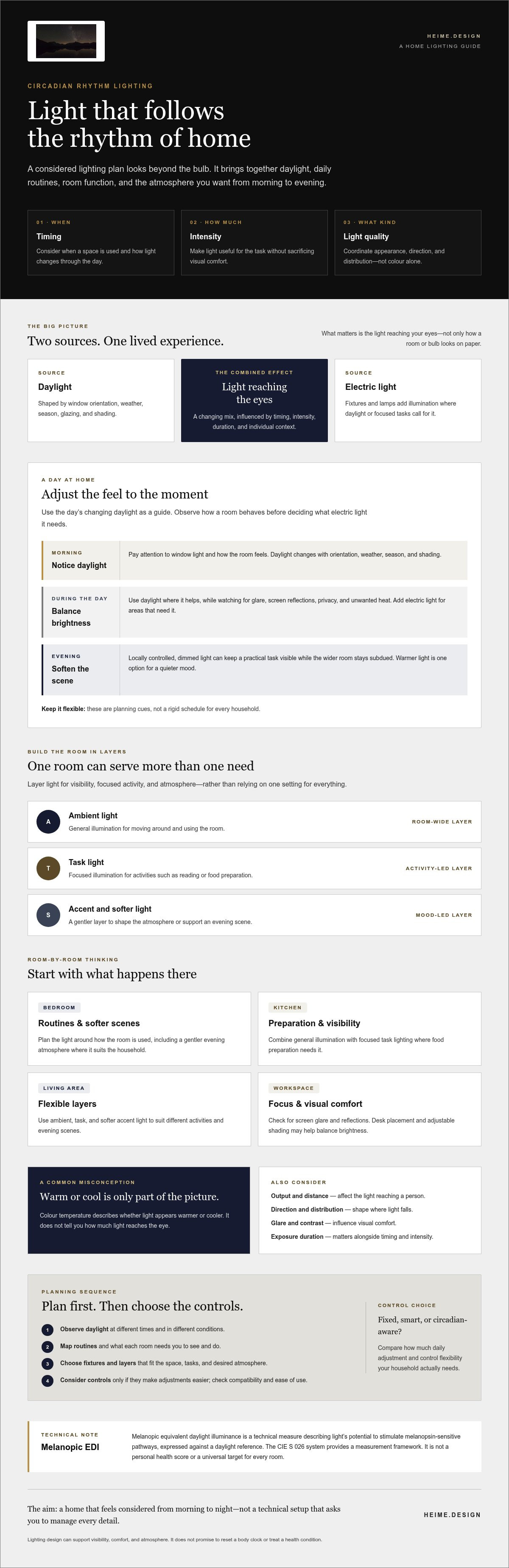
A useful plan starts with the household, not a fixture list. Follow a clear sequence: map daily routines, observe daylight, define each room’s tasks, layer suitable fixtures, then review how the lights will be controlled. This keeps circadian rhythm lighting design for homes practical and specific to how people use each space.
- Map routines. Note when rooms are used and by whom.
- Observe daylight. Check how light changes in each room through the day.
- Define tasks. List activities that need clear, focused light.
- Layer fixtures. Combine general, task, and accent lighting as needed.
- Review controls. Decide which lights should operate independently and how they’ll be adjusted.
Match each room’s lighting to its daily use
In a bedroom, consider comfortable light for reading, clear visibility when dressing, and low-glare navigation at night. In a kitchen, place task lighting to illuminate work surfaces and check that it won’t reflect uncomfortably from glossy counters. A workspace may need focused light that doesn’t create screen glare. In a living area, ambient, task, and accent layers can support different activities, with separate controls where they’re useful.
These are starting points, not templates. A room’s daylight, layout, finishes, and household routines all affect the right arrangement.
Choose fixtures and controls before installation
Coordinate fixture positions with furniture, circulation, and the activities planned for each area. Confirm that switches and controls are easy for household members to reach and use. Before committing, check fixture and lamp specifications, dimmer compatibility, and whether intended smart-home components work together. Product details and system requirements vary, so confirm them with the relevant suppliers or qualified professionals.
Use this checklist as you refine the plan:
- Can each light be controlled independently where needed?
- Could a fixture create glare at a desk, screen, mirror, or work surface?
- Are switches accessible along everyday routes?
- Can lamps be replaced and fixtures maintained without disrupting the room?
- Do project-specific targets and technical requirements need professional review?
For a larger renovation, lighting design can be coordinated with the architecture, materials, and technical documentation. A professional can help confirm project-specific requirements and clarify fixture, control, and installation decisions. For a considered plan, discuss residential lighting design with heime.design.
Integrating Circadian Lighting into a Cohesive Home Design
Lighting works best as part of the whole interior. Fixture placement affects how a room feels and functions. Wall colour, flooring, furniture, and other finishes influence how light is reflected or absorbed. Household routines matter too: controls should fit the way people actually move through the home.
Coordinating these choices can create a more flexible, coherent result, but it takes planning. Fixture locations, switching, controls, and installation details may need to be resolved alongside other design decisions. Smart-home integration can support a lighting strategy, but it isn’t a requirement. Manual switches and dimmers may suit some households better.
Coordinate lighting with materials, layout, and technology
A pale, reflective surface may make a room feel brighter than a darker, more absorbent finish under similar lighting. Glossy materials can create reflections, while fixture position affects where light falls and whether a source is visible from a seat or screen. Consider these interactions alongside furniture placement and the room’s purpose.
During a renovation or new build, technical documentation can help clarify fixture intent and control locations for the relevant project professionals. Confirm product specifications and control requirements before installation. Evaluate smart-home integration against household needs, system compatibility, and the level of control desired.
What to expect from a professional lighting design process
A considered process begins with routines, room layouts, daylight conditions, and design priorities. From there, a lighting designer can help coordinate fixture selections, light layers, and control intent with the broader interior. Technical documentation and project coordination can support clear communication as decisions move toward installation.
This can be especially useful when several rooms, custom details, or smart-home controls need to work together. The trade-off is additional specification and coordination, so the scope should match the project. Circadian rhythm lighting design for homes is not a promise of a particular health outcome. It is a way to plan the home’s light environment with attention to comfort, use, and daily experience.
heime.design offers lighting design and project coordination as part of its residential design capabilities. If you’re planning a renovation or new home and want lighting considered alongside the architecture and interiors, you can explore its residential design services.
Make Your Home’s Lighting Work as a Whole
Effective circadian rhythm lighting design for homes isn’t about choosing one special bulb or automating every fixture. It starts with how each room is used, the daylight it receives, and the kinds of light that support everyday tasks and comfort. Layered fixtures and thoughtful controls can create flexibility without adding complexity for its own sake.
Bring lighting into the wider design conversation early. Finishes, furniture, fixture positions, and household routines all shape the experience. Where a project involves renovation, technical coordination, or smart-home controls, professional input can help clarify decisions and bring the elements together.
heime.design offers lighting design, alongside neuroarchitecture, technical design documentation, and smart-home integration. These services can support a considered approach to lighting as part of a coherent residential design, without promising a particular health outcome. If you’re planning changes to your home, discuss a lighting plan for your home with heime.design.
Start with one room, one routine, and a clear sense of what you want the space to feel like. From there, build a lighting plan that feels natural to live with.
Frequently Asked Questions
What is circadian rhythm lighting design for homes?
Circadian rhythm lighting design for homes plans light quality, intensity, and timing around rooms and daily routines. It considers daylight alongside electric lighting, with practical goals of supporting visibility, comfort, and the intended use of each space. It doesn’t mean every bulb needs to change colour, and it shouldn’t be presented as a way to reset the body clock or treat a health condition.
Can circadian lighting improve sleep?
Circadian-aware lighting may help create a home light environment that better reflects daytime and evening routines, but it can’t guarantee improved sleep. Light timing, intensity, duration, and personal circumstances all matter. Consider comfortable, lower-glare lighting in the evening, while keeping enough light for safe movement and tasks. Lighting isn’t a substitute for medical advice, especially if sleep problems persist.
What colour temperature is best for circadian lighting?
There’s no single colour temperature that suits every room or person. Colour temperature describes whether light appears warmer or cooler, but it doesn’t show how much light reaches the eyes. A warmer tone can be one option for a calmer evening atmosphere; practical tasks may need clearer, brighter illumination. Choose settings alongside fixture placement, glare control, room use, and household preference.
Do I need smart bulbs for circadian lighting at home?
No. Smart bulbs aren’t essential. A thoughtful arrangement of fixed lights, separate switches, and compatible dimmers can provide useful flexibility without automation. Smart controls can add schedules, scenes, or remote adjustment, but those features only help if they fit household routines and are easy to operate. Before choosing devices, check their requirements and compatibility with existing fixtures, wiring, and controls.
How do I set up circadian lighting in a bedroom?
Start with the room’s everyday needs: reading, dressing, and moving safely at night. Consider a comfortable general light, a focused reading light, and a lower-glare option for navigation, each controlled separately where practical. Dimming or warmer-toned light can help create a quieter evening atmosphere, but neither guarantees better sleep. Also account for daylight, bedside access, and the habits of everyone sharing the room.
Is circadian lighting worth including in a home renovation?
It can be useful to plan lighting during a renovation, when fixture positions, switches, and controls can be coordinated with the layout. This may create a more flexible and coherent result. The trade-off is added specification and coordination, particularly if smart-home controls are involved. You don’t necessarily need to replace every light. Match the scope to your routines, design priorities, and project requirements.
What should I consider before choosing circadian lighting controls?
Begin with how each room is used and which adjustments would genuinely help. Consider whether controls are accessible and easy for household members, and whether you want manual switching, dimming, scenes, schedules, or sensors. Check wiring, fixture and dimmer compatibility, smart-home integration requirements, and ongoing maintenance before committing. For a larger project, ask the relevant design and installation professionals to confirm technical specifications.


