

What if a low tender is simply pricing a different project? Contractor tender documentation for luxury interiors should give every contractor the same clear basis for pricing. When scope, materials or work packages differ, bids can look comparable while relying on very different assumptions. Exclusions and allowances can make those gaps harder to spot.
Each proposal should reflect the design intent and the quality you want to achieve. The key is translating that intent into measurable scope, clear specifications and visible decisions. A coordinated tender package helps contractors price consistently and brings assumptions, exclusions and unresolved items into view before appointment.
This practical checklist explains what to include, from drawings and finish schedules to performance requirements, scope boundaries and pricing breakdowns. It also shows how technical design documentation, project management and construction coordination can support a clearer tender process. The result is a stronger basis for comparing proposals and carrying your interior priorities forward.
Key Takeaways
- Use contractor tender documentation for luxury interiors to translate design intent into a clear, measurable scope contractors can price consistently.
- Bring drawings, schedules and written specifications together, and distinguish confirmed selections from performance requirements and open decisions.
- Compare bids against the same work packages and return headings, then review scope coverage, assumptions, exclusions and alternatives.
- Before issuing the package, check drawing coordination, document references and unresolved items so gaps are visible from the outset.
- Coordinated technical documentation, project management and construction coordination can help keep design intent clear through tendering and delivery.
Why contractor tender documentation matters in luxury interiors
Contractor tender documentation for luxury interiors is the coordinated information contractors use to understand a defined scope and prepare their proposals. It brings drawings, schedules and written requirements into a shared reference point. Without that coordination, each contractor may price a different interpretation of the design, even when every proposal appears to cover the same rooms.
A design concept communicates the intended experience; a priceable contractor scope describes the work, materials and interfaces needed to deliver it.
This distinction matters when the result depends on bespoke work. A drawing may show a full-height timber wall, for example, but a contractor also needs its dimensions, finish, junctions with the floor and ceiling, and relationship to doors or lighting. The same applies to custom joinery, decorative finishes and specialist fittings. The more an element relies on careful coordination, the more ambiguity can affect its price, quality or scope.
What a tender package is meant to achieve
A tender package gives every invited contractor the same basis for understanding and pricing the work. It makes the project boundaries visible: what is included, what is specified, and which decisions remain open. This supports a fairer comparison because differences can be traced to scope, assumptions or alternatives rather than hidden interpretations.
Tender information is not a substitute for later construction coordination. It establishes the design and scope basis for pricing; coordination continues as the project moves toward delivery, resolving practical interfaces and responding to developed information. A clear package reduces avoidable uncertainty at tender stage while leaving the right work for the next stage. For an overview of how tenders fit into the wider process, see the Construction Bidding Process.
Where luxury interior tenders become difficult
Challenges often arise at the boundaries between trades and design elements. A bespoke vanity may involve cabinetry, stone, plumbing and integrated lighting. If the tender documents show the overall look but not the dimensions, finish expectations or connection points, contractors may make different assumptions about what they must supply and install. Those differences can surface as exclusions, proposed substitutions or clarification requests.
Quality language can also be interpreted in different ways. Words such as “premium,” “refined” or “high quality” express intent, but don’t define a selection or performance expectation on their own. Where available, pair them with a reference, material description, finish, sample status or other project-specific criteria. The goal isn’t to over-specify every detail. It’s to make important choices clear enough to price.
Some decisions may still be pending when the package is prepared. Record each one openly, including its status and the basis contractors should use in their proposals. Don’t let an unresolved finish or fitting disappear into a general allowance without explanation. Clear documentation shows what each bid includes and where clarification is needed before assumptions become part of the appointed scope.
What to include in contractor tender documentation for luxury interiors
A strong tender package gives contractors a clear route from design information to a considered proposal. For contractor tender documentation for luxury interiors, organize the material so each requirement can be found, understood and priced without guesswork. Begin with a scope summary that names the spaces, work packages, key deliverables and documents that form the pricing basis.
A meaningful contractor proposal needs a defined scope, coordinated drawings, clear specifications and visible assumptions.
Drawings, schedules, and specifications
Use drawings to show location and intent, schedules to organize selections, and written specifications to explain requirements a drawing cannot fully convey. Give each document a clear title, reference and revision so bidders can identify the information they’re using and flag conflicts precisely.
- Drawings: Include relevant plans, elevations and enlarged details for bespoke elements, such as a built-in wardrobe or a stone-clad wall.
- Schedules: Provide room, finish, lighting and fixture schedules where they clarify quantities, locations or selections.
- Specifications: Describe joinery materials, finish expectations, hardware, lighting intent and other project-specific requirements in direct terms.
Separate confirmed selections from performance requirements. A chosen stone can be named as a selection, while a fitting still being developed can be described by its intended function or performance. Mark each item’s status consistently. This helps contractors distinguish what to price as specified from what needs an allowance or further decision.
Scope boundaries, assumptions, and open decisions
Define what each work package includes and where responsibility passes between packages. For example, clarify how a joinery installation relates to electrical connections for integrated lighting. Identify the interface and show it in the documents where possible. Clear boundaries reduce the risk of an item being omitted or priced twice.
- Included work: State the rooms, elements, supply and installation tasks covered by the package.
- Interfaces: Describe connections between interior works and other project disciplines, including who provides information or completes adjoining work.
- Assumptions and exclusions: Gather them in a visible, consistently formatted section rather than scattering them through notes.
- Open decisions: Label unresolved items and set out the pricing basis bidders should use, such as a stated allowance or a clearly identified alternative.
Keep the package internally aligned. If a finish schedule names one surface while a drawing note describes another, identify the intended reference or resolve the conflict before issue. A simple document register can list each file, reference and revision, helping everyone work from the same tender set.
Coordinated technical design documentation connects design information to a scope contractors can price. heime.design brings interior architecture, project management and construction coordination together to support that process. Learn more about luxury interior design and project management as part of a joined-up approach to project delivery.
How to compare luxury interior contractor bids fairly
A fair comparison starts with a shared structure. Use the same work packages and tender return headings for every contractor, then assess each response against the same scope and specifications. This reveals whether a difference reflects price, coverage, an assumption or a proposed change.
The lowest bid isn’t automatically the closest scope match; it may include less, assume something different or leave more unresolved.
Build a like-for-like bid comparison
Create a matrix with one row for each work package and one column for each contractor. Add columns for the tender requirement, response status, notes and clarification needed. Keep each original proposal intact, and use the matrix to make differences visible rather than silently rewriting a contractor’s response.
- Included: The item is covered in the proposal as described.
- Excluded: The proposal clearly states that the item is outside its scope.
- Qualified: The item is included subject to a condition, assumption or alternative.
- Unanswered: The proposal doesn’t state how the item is treated.
Then check specification alignment. If one proposal offers a different finish, lighting fitting or joinery detail, record it as an alternative, not as an equivalent by default. Compare it with the stated design intent and requirements. If an alternative changes appearance, function or an interface with another work package, flag the difference for review before treating the bids as like-for-like.
Apply the same test across the full package. For a room with custom cabinetry, check whether each proposal covers the same cabinetry elements and related work. A headline total alone can’t show whether a missing item, different specification or qualification explains the difference.
Review allowances, exclusions, and clarifications
Allowances need context. Record what each covers, what selection or quantity it assumes, and whether proposals use the same basis. Two allowances with the same label may relate to different materials or levels of completion. Keep those distinctions visible instead of treating the amounts as directly comparable.
Use one clarification log for all proposals. Give each point a reference, the relevant work package, the question or discrepancy, the response and its status. This creates a record of what has been clarified and what remains open. It also helps keep amendments consistent across contractors during the tender process.
Separate a clarification from a change. A clarification explains how a proposal relates to the issued scope, such as confirming whether installation is included. A change alters the requested design or scope, such as replacing a specified finish with another. Assess scope changes deliberately and record their effect separately, so the comparison doesn’t blur the original tender basis with a revised proposal.
Before appointment, gather agreed clarifications and accepted alternatives into the final scope record and associated project documents. Keep unresolved items explicit. Coordinated contractor tender documentation for luxury interiors gives each response the same reference points, while project management and construction coordination help carry agreed decisions into delivery.
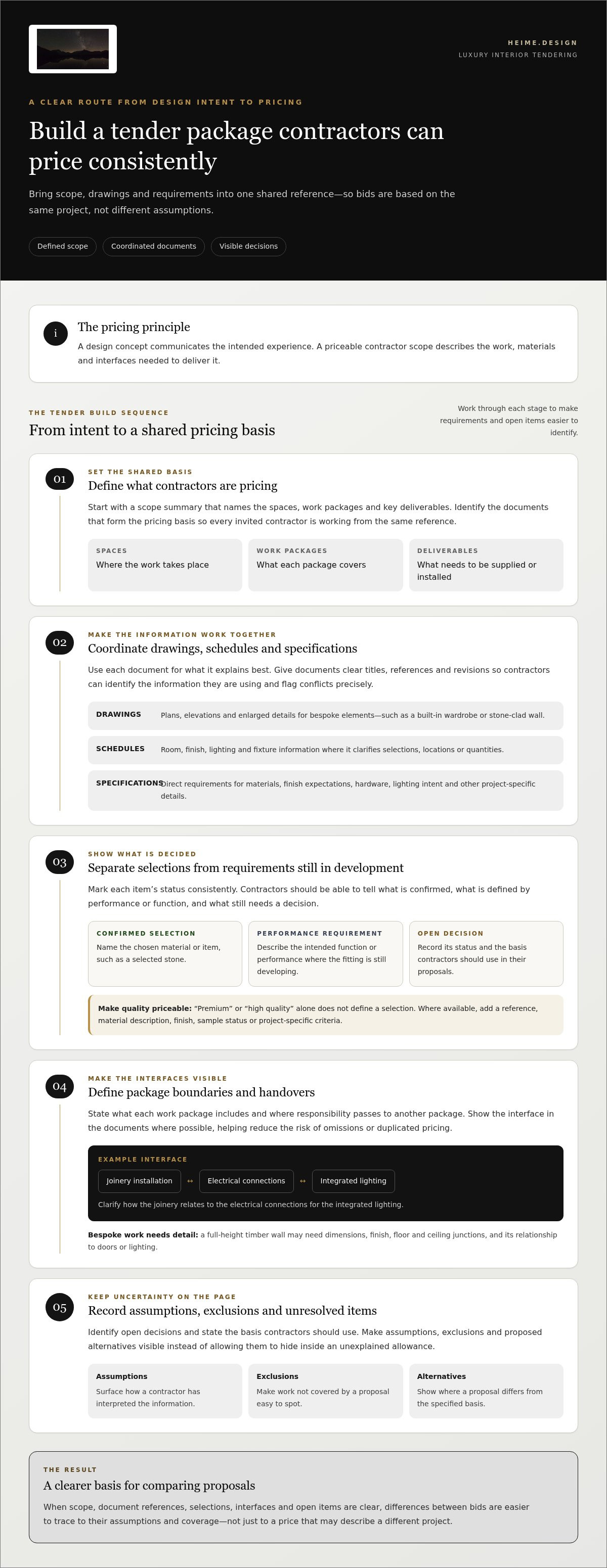
A pre-issue checklist for contractor tender documentation
Before issuing contractor tender documentation for luxury interiors, review the package as one connected set, not a collection of separate files. The aim is to catch mismatched information, unclear responsibility and open decisions before contractors build proposals around different assumptions. Use a consistent review sequence and record anything that needs resolution or transparent treatment in the tender.
Check package completeness and coordination
Start with the scope summary, then trace each included work package through the drawings, schedules and written requirements. Confirm that every stated item has a clear reference and that the documents describe the same design. Pay close attention to interfaces that could affect pricing or responsibility, such as lighting integrated into joinery or finishes meeting adjacent surfaces.
- Scope: Check that the summary names the work and spaces shown in the tender set.
- Drawings and schedules: Confirm referenced plans, details, room information and selections are present and aligned.
- Specifications: Check that written requirements support the drawings and identify the intended quality or performance.
- Document control: Match titles, reference numbers, revisions and cross-references across the package.
- Open decisions: Create a clear list of undecided items, their status and the pricing basis requested from bidders.
Don’t silently remove an unresolved choice from the package. Mark it as pending and explain how it should be treated in the return, such as a separately identified allowance or a clearly stated alternative. This makes uncertainty visible and easier to address during comparison.
Manage questions, revisions, and tender returns
Set one route for contractor questions and shared responses. Keep a log with the question, related document reference, response and date issued. If a response changes or clarifies tender information, distribute it consistently to all bidders so each proposal reflects the same basis.
Make every revision easy to identify. Update the document register, note what changed and withdraw superseded files from the active package. This helps prevent one contractor from pricing an earlier drawing while another works from the revised one.
- Use the same submission headings and return structure for every contractor.
- Request a clear breakdown by work package, with assumptions and exclusions stated.
- Check that alternatives and qualifications are identified rather than folded into a headline proposal.
- Log unanswered questions and unresolved items for review before appointment.
For complex projects, clear ownership of updates matters across design and delivery teams. heime.design’s project management and construction coordination connect technical information with project decisions. The international project management guide explores how coordination supports work across teams.
A coordinated tender set should stay clear from issue through contractor questions. Learn about interior documentation and project coordination at heime.design.
How heime.design supports luxury interior tender documentation
A considered tender package depends on more than attractive drawings. Design decisions need to become clear, coordinated information contractors can interpret and price. heime.design brings interior architecture and technical design documentation together, connecting the intended character of a space with the information needed to define its work.
This is especially valuable in high-value homes, where bespoke elements and personal priorities shape the brief. Documentation can be tailored to the project, making the relationship between room layouts, custom details, finishes and adjoining disciplines easier to follow. For projects with specific requirements around privacy, heritage or long-term use, UHNW residential interior design considers how a home’s wider purpose informs its design.
From design information to a coordinated tender package
heime.design’s technical design documentation translates design decisions into contractor-facing information. Drawings, specifications and schedules can be coordinated so key details are easier to locate and interpret. This helps surface interfaces, such as where built-in joinery meets lighting or adjacent finishes, and makes unanswered questions more visible before pricing begins.
The aim isn’t to remove every decision from the process. It’s to show what has been decided, what is defined by a performance requirement and what remains open. That distinction gives contractors a clearer basis for proposals and helps the project team identify where an assumption needs attention.
Coordination through contractor evaluation
Project management can bring structure to the tender exchange. Questions, responses and document updates can be organized into a shared record, helping the team follow what each clarification means for a proposal. After review, construction coordination supports continuity between accepted scope, design intent and project decisions as work progresses.
For international clients, heime.design’s team works in English, Spanish and Polish. Shared language across project communication can help keep design information and decisions legible to the people involved, while respecting the project’s individual requirements. The studio’s turnkey project coordination also connects documentation, evaluation and delivery within a joined-up process.
Clear contractor tender documentation for luxury interiors gives design intent a practical role beyond the drawing set. It supports consistent pricing, makes differences between proposals easier to understand and creates a useful record of decisions as the project moves forward.
If you’re preparing a tender or shaping the project scope, discuss your interior project with heime.design.
Carry your design priorities into the next stage
A tender package is also a point of alignment. Before appointment, decide which design priorities must remain fixed and where considered alternatives may be acceptable. This gives the project team a clear reference when proposals introduce changes and helps keep later decisions connected to the experience you want the interior to create.
Use contractor tender documentation for luxury interiors as the start of a well-informed working relationship, not simply a request for prices. A clear record of scope and priorities gives conversations after tender review a stronger foundation. It also helps keep the project moving with intention as decisions pass between design, management and construction stages.
heime.design can help shape that next step around your project and its priorities. Move forward with clarity by discussing your interior project with heime.design.
Frequently Asked Questions
What is contractor tender documentation for luxury interiors?
Contractor tender documentation for luxury interiors is the project information used to invite and assess proposals for a defined package of work. It can combine technical drawings, written requirements, schedules and instructions for returning a bid. For example, a tender for a custom dressing room might identify the rooms and cabinetry included, point to relevant details, and specify how contractors should state alternatives or unresolved items.
How detailed should interior design documents be before contractors prepare a tender?
They should describe the scope and key design requirements well enough for contractors to price on a consistent basis. The right level depends on the project and package. For bespoke joinery, this may mean dimensions, material and finish requirements, plus clear details at important junctions. If a selection is pending, identify its status and give bidders a consistent pricing instruction rather than leaving them to make separate assumptions.
Can contractors price a luxury interior project from concept drawings alone?
Concept drawings can help communicate the intended look, but they rarely define every item a contractor needs to price detailed work. They may not show construction dimensions, finish requirements or the extent of each work package. Contractors might still provide an early budget view, but it should be read alongside its assumptions and exclusions, not treated as a fully comparable tender. More developed technical information gives the proposal a clearer basis.
How many contractors should receive the same interior tender package?
There’s no single number that suits every project. The useful principle is to invite a manageable group capable of returning considered proposals within the tender process. Each should receive the same document set, revisions, instructions and shared clarifications. If a contractor joins later, issue the complete current package and all responses already circulated. Consistent information matters more than sending the tender to a large group.
Should provisional sums or allowances appear in an interior tender?
They can be used for items that remain undecided, but the tender should state what each allowance covers and what assumptions inform it. For example, an allowance for a decorative fitting should identify whether it covers supply only or includes related work, if that distinction applies to the package. Ask contractors to list allowances separately. This makes it easier to see whether proposals use the same basis.
What happens when a contractor identifies missing information during tendering?
The point should be raised as a written clarification linked to the relevant drawing, schedule or scope item. The project team can then issue a clear response to all bidders, especially if it affects their pricing basis. If the answer changes the documents, distribute a dated revision and identify the superseded information. Keep the question and response on record so the final agreed scope reflects the clarification.
Can tender documentation guarantee the final renovation cost?
No. Clear tender information can help contractors price a defined scope and make differences between proposals easier to assess, but it can’t guarantee the final cost. Changes to selections or scope, as well as conditions discovered during the work, may affect the amount. Before appointment, make sure the agreed price basis, exclusions, allowances and accepted changes are recorded in the project documents. Review any later change against that agreed basis.


