

What if a finish that looks perfect in a sample doesn’t perform as intended once it’s installed? Material specification services for luxury interiors connect the design vision to clear, coordinated decisions for documentation and construction. They define not only how a material should look, but where it belongs and what the project team needs to know about its use.
A useful specification does more than list finishes. It brings appearance, intended use, maintenance, and relevant technical requirements into view, so design intent is easier to communicate as a project develops. It also clarifies how material choices relate to drawings, lighting, joinery, and other design decisions.
This guide explains what material specifications cover, how they fit into technical design documentation, and what to consider when comparing levels of support. You’ll find practical ways to prepare a brief and assess a process that carries material decisions from concept into project coordination, with scope shaped around the property and its requirements.
Key Takeaways
- See how documented material choices connect the look of a space with its practical project requirements.
- Understand how material specification services for luxury interiors can be shaped around project scope rather than a universal package.
- Use clear criteria to compare scope, documentation, coordination, and decision ownership without narrowing the design vision.
- Prepare project goals, references, constraints, and existing documents to give material decisions a clear starting point.
- Explore how heime.design connects interior architecture and technical documentation with project coordination for international teams.
Why material specification services matter in luxury interiors
A material can look right on a mood board and still leave important questions unanswered on site. Material specification services for luxury interiors turn design choices into project-specific information: which finish is intended, where it will be used, and what matters for that application. The goal isn’t to make every decision technical. It’s to make the design clear enough for the project team to coordinate.
A coherent palette supports more than appearance. It connects the character of a room with its use, how people move through it, and how surfaces relate across adjoining spaces. A timber finish chosen for a private study, for example, may need different characteristics from one used in a busy shared area. The right decision depends on the intended use and the design, not just on how a sample looks in isolation.
Interior design brings together function and aesthetics across a space. For broader context on the history and standards of interior design, it helps to view material decisions as part of a larger design discipline rather than as a final layer of decoration.
What does material specification mean in an interior project?
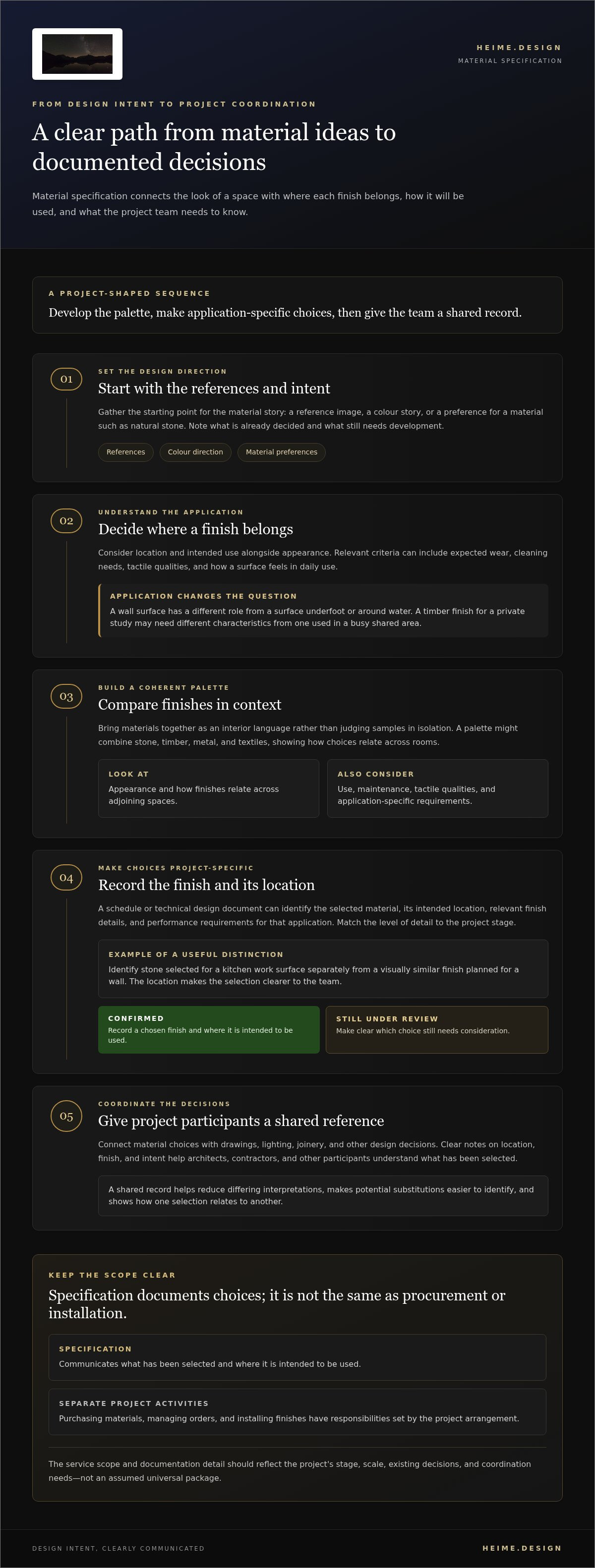
Early inspiration sets a direction: a reference image, a colour story, or a preference for natural stone. A project-specific decision identifies the selected finish and communicates it to the team in a useful form, such as a schedule or technical design document. Depending on the project, that record may identify the material, its intended location, relevant finish details, and application-specific performance requirements.
Requirements vary by material and use. A surface on a wall has a different role from one underfoot or around water. Clear documentation helps the design team and project participants understand what has been selected. It can also distinguish a confirmed choice from an option that still needs review, with the level of detail suited to the project stage.
When should a luxury project use specification support?
Specification support can be valuable during a renovation, a new build, or the fit-out of a commercial space. It also matters in specialist interiors, where materials need to be considered in relation to the setting and the wider design. Recording decisions as they develop helps them inform drawings and coordination, rather than leaving key selections until later.
Coordination is especially useful when a project spans several rooms, involves multiple decision-makers, or brings together architects, contractors, and international participants. Without a shared record, people may interpret a broad description differently, choose a substitute that changes the relationship between finishes, or overlook how one choice affects another. Clear notes on location, finish, and design intent give the team a common reference for resolving these questions.
Material specification services for luxury interiors therefore support both design clarity and project delivery. Their scope should reflect what has already been decided, what still needs development, and how the project team will use the documentation. For international work, coordinated communication can connect material decisions with wider international project management for luxury interior design, keeping decisions legible across participants and project stages.
What luxury interior material specification services can include
A specification process can start with the design direction, then develop into selected finishes and documented decisions that the project team can use. The scope may include reviewing references, shaping a palette, comparing material options, and recording choices in technical design documentation. Material specification services for luxury interiors are tailored to the project’s stage, scale, and coordination needs, so deliverables should be defined around the work rather than assumed to follow a standard package.
Specification is distinct from procurement and installation. Documentation communicates what has been selected and where it is intended to be used. Purchasing materials, managing orders, and installing finishes are separate project activities, with responsibilities set by the project arrangement. Construction coordination can help align decisions with project participants, but a specification by itself doesn’t assign every purchasing or site task.
From material palette to project documentation
A palette groups finishes into a considered interior language. It might bring together a stone surface, timber tone, metal finish, and textiles, showing how they relate across rooms rather than presenting each sample in isolation. A schedule can connect those choices to locations and relevant notes, such as the intended finish or where a selection appears in the design. The format and level of detail depend on what the project documentation needs to communicate.
For example, a project record might distinguish the stone selected for a kitchen work surface from a visually similar finish planned for a wall. That distinction gives architects, contractors, and other participants a clearer basis for coordinating their work. It also links the selection to a specific location, rather than leaving the team to interpret a broad mood-board reference.
Performance, maintenance, and coordination criteria
Appearance is one part of a material decision. Intended use matters too: consider expected wear, cleaning needs, tactile qualities, and how a surface will feel in daily use. Relevant criteria vary by material and application. Following established industry guidelines for interior design best practices and material selection can help frame these considerations alongside the wider design.
Selections also interact. A finish may read differently under the planned lighting, meet a joinery detail at an edge, or sit beside another surface with a contrasting texture. Recording these relationships helps the team coordinate design intent across disciplines. Environmental certifications or performance claims belong in the specification only when they’re relevant to the project and supported by verified information.
For a project that needs connected design and technical documentation, explore heime.design’s interior architecture and project coordination. HEIMÉ brings these services together, with scope shaped around the project’s requirements.
How to compare material specification services without limiting design
Clear criteria don’t dictate a look. They help you assess whether a service can translate your design direction into decisions the project team can use, while leaving room for finishes to express the intended character. A product list may name attractive options, but it won’t necessarily show how they relate to the design, where they belong, or how choices are coordinated.
Use the comparison points below to assess material specification services for luxury interiors. Focus on how the work connects to your project, not on whether it follows one aesthetic.
Scope
Does the work respond to the actual rooms, intended uses, and design stage, or does it only present a general selection of materials?
Documentation
Are decisions recorded in a form that connects finishes to locations and relevant design information?
Coordination
How does the process connect material decisions to technical design documentation and communication with project participants?
Decision ownership
Is it clear who develops selections, who reviews them, and who approves a change?
Revisions
Does the process account for updates when drawings, project information, or design decisions change?
What should a buyer compare in the service scope?
Start with the spaces and their intended use. A residential renovation, a new interior, and a commercial fit-out may call for different levels of selection and documentation. Compare how design decisions lead into technical documents and coordination, and whether the proposed scope reflects the areas that matter to your project.
Then clarify how revisions are handled as information develops. A useful process makes it possible to trace what changed and which decisions are affected. This doesn’t require a fixed package. It requires a scope shaped around the work and a shared understanding of who makes and approves decisions.
How can specifications protect creative intent?
Design rationale gives the team context, not just instructions. A note explaining that a finish was selected for its texture, visual warmth, or relationship to an adjacent surface helps participants understand what matters if an alternative needs consideration. A proposed substitute can then be assessed against shared aesthetic and performance criteria, rather than judged by appearance alone.
This approach supports flexibility. The specification records the qualities the design aims to preserve while leaving room to evaluate other options in context. If sensory experience informs material choices, neuroarchitecture offers a related perspective on how people experience designed spaces.
Compare the process, the clarity of its documentation, and how design decisions connect to project coordination. These criteria help protect creative intent without promising a particular cost, timeline, or construction outcome.
How to prepare for material specification services
A focused brief gives material decisions a useful starting point. Before selecting finishes, clarify what the project needs to achieve, which spaces matter most, and who will shape or approve decisions. This keeps material specification services for luxury interiors connected to the project’s real context, rather than a collection of disconnected preferences.
Information that helps establish the design brief
Gather existing plans, drawings, finish schedules, and notes that show the project’s current stage. Add references that express the intended atmosphere, along with practical priorities such as expected maintenance and the needs of the people using the space. Identify the stakeholders involved and the decisions each person needs to make. This helps the team see what is settled, what remains open, and where further coordination is needed.
Then work through the brief in sequence:
- Define project goals. Describe the intended character and function of each priority space.
- Gather references. Collect images, samples, or existing design information that communicates the direction.
- Map constraints. Note project-stage details, existing conditions, intended use, and known maintenance needs.
- Align decisions. Identify who reviews options, who approves selections, and how changes are shared.
- Document choices. Keep decisions and relevant context together so they can inform design and coordination.
A practical sequence for reviewing material decisions
Review the palette as a whole before judging each finish on its own. Consider how colours, textures, and surfaces relate across connected rooms. Then assess individual selections against their intended use, adjacent materials, and the design goals. A reference image can suggest a direction, but project drawings and room context help establish where a material belongs and how it relates to other choices.
For a commercial project, include how people will use and experience the space in the review. A hospitality interior, for example, may call for different priorities across arrival areas, circulation spaces, and quieter rooms. The design brief can make those distinctions visible without assuming that every area needs the same finish. This context is also relevant to commercial interior design for high-value spaces.
As decisions develop, keep a clear record of what has been agreed and what remains open. If project information changes, update the relevant decision and share it with the people it affects. This is especially useful when several stakeholders contribute or when design and construction coordination involve different participants.
With plans, references, priorities, and decision-makers in view, the specification process can be shaped around your project. Discuss your interior design project with heime.design to connect material decisions with technical documentation and project coordination.
How HEIMÉ connects material decisions with luxury interior delivery
A material choice sits within a larger design and delivery process. It relates to the architecture, how a room will be used, and the details that bring its finishes together. heime.design connects interior architecture, technical design documentation, and project coordination so material decisions can be considered in the context of the wider project.
A coordinated route from design intent to execution
As the design develops, technical documentation helps communicate decisions to architects and contractors. It gives project participants a shared reference for understanding how design choices relate to the spaces and details being developed. Coordination supports communication across project stages, while responsibilities for purchasing and installing materials remain distinct from design documentation.
This integrated approach matters in both residential and commercial interiors. In a home, a finish may need to work in relation to the character and use of several connected rooms. In a commercial setting, decisions may need to respond to different uses within the same space. In either case, considering materials alongside the interior design helps keep individual choices connected to the overall direction.
Material specification services for luxury interiors are most useful when their scope reflects the project’s context and documentation needs. They don’t replace the roles of architects or contractors. Instead, clear design information and coordination help those participants understand how material decisions fit into the work and where further alignment is needed.
For international projects, communication also crosses languages and working contexts. heime.design’s multilingual team works in English, Spanish, and Polish, supporting communication among international clients and project participants. This helps keep design discussions and coordination connected when people are working across languages.
Discuss your luxury interior project with HEIMÉ
A useful starting point is a focused brief. Share the project context, the spaces involved, how they’ll be used, and the design priorities that should guide material decisions. Existing drawings or project information can help establish the project stage. heime.design can then shape the scope around the design and coordination required, rather than treating it as a fixed package.
Whether you’re planning a residential interior or a commercial project, heime.design brings design, technical documentation, and project coordination into a connected process. The aim is to carry decisions forward with clarity while keeping the project’s individual design direction in view.
Discuss your interior project with HEIMÉ and share the context, priorities, and coordination needs that will shape the work.
Set your next design decision in motion
The next step isn’t choosing every finish at once. It’s deciding what the project should express, how each space will be used, and which priorities should guide the choices ahead. Material specification services for luxury interiors give that direction a clear starting point, shaped around the character of your property rather than a preset look.
Consider what you want people to feel in the space, which details matter most, and where you need support aligning design decisions with project requirements. These priorities can frame a brief that feels personal and purposeful. The scope can then take shape around the project, its stage, and the decisions still to be made.
Bring your ideas, plans, or early references together and take the next step with HEIMÉ. A focused conversation can establish a direction for your project-specific design and coordination brief.
Discuss your interior project with HEIMÉ. Your vision can become a considered plan for what comes next.
Frequently Asked Questions
What is included in material specification services for luxury interiors?
They typically include project-specific material choices and information that helps the design team understand where and how those choices fit. Depending on the brief, documentation may record finish descriptions, locations, and selection notes. The scope can also show how a decision relates to design drawings or other project information. It varies by project, so clarify what the team needs to decide and coordinate the next steps.
When should material specifications be prepared in an interior design project?
Begin once the design direction and intended use of the spaces are clear enough to guide choices, and before finishes need to be coordinated with later project decisions. Starting too early can mean documenting options that are still unsettled. Starting late can leave less time to align selections with drawings and the wider design. For a phased project, priorities can be documented as different spaces become ready for decisions.
Can material specifications change during a renovation?
Yes. Renovation work can reveal existing conditions that affect a planned selection, or the client may refine a design decision as the project develops. Record the updated choice, the reason for the change, and which rooms or documents it affects. Make the current decision easy to distinguish from the earlier one, then share the revision with relevant project participants so they’re working from consistent information.
How do designers assess whether a finish suits its intended use?
They consider the room’s function, how the surface will be used, and the care it is expected to need. A finish for a frequently handled surface may call for different scrutiny from one used mainly as a visual feature. Designers can review relevant product information and samples in context, including how colour and texture appear with the project’s lighting and adjacent materials. The applicable criteria depend on the finish and its use.
Do material specification services include sourcing and purchasing products?
Not necessarily. Specification identifies and documents design choices; sourcing, ordering, payment, delivery, and installation are distinct activities. Responsibilities depend on the project’s agreed scope and procurement arrangements. Before work proceeds, make clear who will obtain product information, place orders, track decisions, and communicate changes. This separation helps prevent a documented selection from being mistaken for a purchase or installation instruction.
How can I compare material options for sustainability?
Compare options using the same evidence and priorities. Relevant information may include material composition, origin, recycled content, expected care, and available product documentation. Treat environmental labels or certification claims as meaningful only when they’re verified and relevant to the specific material and project goal. A consistent comparison helps distinguish documented attributes from broad marketing language, without assuming that one material category is automatically the more responsible choice.
How much project information is needed to begin material specification?
You can begin with a clear project outline, even if every drawing or decision isn’t final. Plans or sketches, the project stage, intended room uses, visual references, and known practical priorities help establish context. Note what has already been approved and what remains open. As the design develops, additional drawings and schedules can refine the specification. The starting information should support useful discussion, not create pressure to have every answer ready.


