

Can a luxury renovation truly succeed when you're three thousand miles away? Most investors assume distance leads to compromise. In reality, international interior design project management is a precise technical discipline that bridges the gap between your vision and the local site. You likely know the frustration of navigating foreign architecture licensing or the silence of a contractor who doesn't speak your language. It's difficult to maintain high-end standards when you aren't there to verify every detail personally.
This guide provides an expert-led framework to master cross-border renovations with confidence. You'll discover how to secure asset value and ensure legal compliance in complex markets like Spain. We'll walk through the technical documentation and coordination steps required for a stress-free, turnkey result. By focusing on precision and clear communication, you can preserve your investment and create a legacy property without the traditional obstacles of international construction. It's time to move from uncertainty to a streamlined, organized workflow.
Key Takeaways
- Master the technical documentation required to bridge communication gaps in international interior design project management.
- Standardize your project’s technical drawings to ensure seamless execution by local contractors anywhere in the world.
- Navigate the complexities of Spanish building permits by understanding the specific roles of local architects and technical experts.
- Apply high-precision management frameworks to specialized assets, including legacy estates, luxury yachts, and private aircraft.
- Leverage neuroarchitecture and multilingual support to transform a distant renovation into a stress-free, value-driven asset.
What is International Interior Design Project Management?
International interior design project management is the technical discipline of overseeing high-end renovations across national borders. It isn't just a creative role. It's a logistical framework that ensures a project in a foreign market meets the same rigorous standards as a local build. While Interior design focuses on the aesthetic and functional environment; the international management side focuses on execution. It acts as the single point of truth. At heime.design, we align your vision with local regulations and contractor capabilities to prevent the friction that often stalls distant projects.
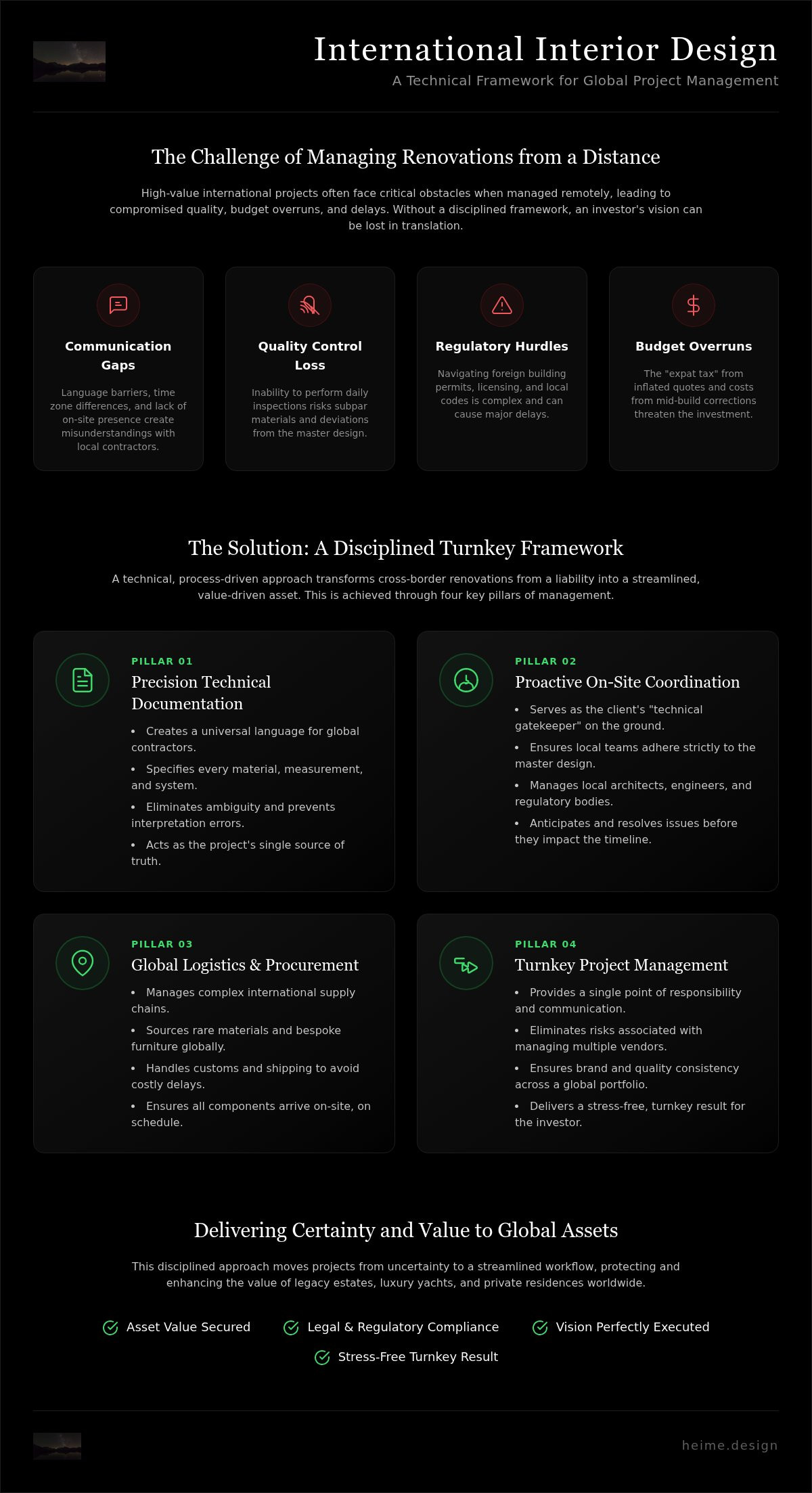
Distance removes the ability to perform daily site inspections. This makes the technical documentation phase the most critical part of the process. Every measurement, material specification, and electrical point must be documented with absolute clarity. High-quality technical drawings leave no room for local interpretation. When a contractor in another country receives these documents, the instructions are precise; regardless of any language barriers. This level of detail prevents expensive mid-build corrections and ensures the final result matches the initial vision perfectly.
The lead coordinator serves as your technical gatekeeper on the ground. They don't just relay messages. They verify that the local architect and lead engineer follow the master design without compromise. This protection of capital is vital for high-value investments. By catching errors on paper before they reach the construction site, you avoid the budget overruns common in unmanaged foreign projects. It's a proactive approach that prioritizes your timeline and your bottom line.
The Difference Between Local and Global Coordination
Managing a site from a different time zone requires proactive communication. It isn't enough to react to problems as they arise. A global coordinator anticipates them. They manage global supply chains for bespoke furniture, ensuring rare materials arrive on site without customs delays. Multilingual documentation ensures that local trades understand the specific high-end requirements of the project. This risk mitigation is essential for cross-border logistics where a single delay can ripple through the entire schedule.
Why High-Value Investors Choose Turnkey Solutions
Investors often face an "expat tax," where a lack of local knowledge leads to inflated quotes or subpar materials. A turnkey solution eliminates this risk. By using a single point of coordination for international interior design project management, you avoid the friction of managing multiple separate entities. This approach ensures brand and quality consistency across your global property portfolio. Whether it's a family estate or a commercial space, the finish remains identical because the management process is standardized and disciplined.
The Logistics of Cross-Border Interior Architecture
Cross-border projects fail when logistics are treated as an afterthought. Success depends on a unified technical approach that functions across jurisdictions. When managing international interior design project management, the most critical asset is the technical package. This documentation translates high-level concepts into actionable data for local trades. It removes the guesswork that often leads to delays or errors in foreign markets. Without a standardized system, your vision can easily get lost in translation between the design studio and the construction site.
Coordination with local engineers is vital for structural and HVAC compliance. Every market has its own regulatory quirks. A design that works in London might face unique hurdles in Spain or France. Expert project management ensures these technicalities are resolved during the design phase rather than during construction. This proactive approach keeps the build phase fluid and predictable. It's about building a bridge between international design standards and local building realities.
Technical Design Documentation for Global Builds
Standardized technical drawings create a universal language. These plans must account for every millimetre of the build, including detailed lighting design and smart home integration layouts. By ensuring compliance with EU building standards and local codes early, you prevent the need for costly retroactive changes. This precision is the hallmark of a professional interior architecture framework. It ensures that an electrician in Marbella understands the exact specifications of a lighting scheme designed in another country.
Cross-Border Procurement and Fit-Outs
Sourcing rare materials and bespoke furniture requires a robust global supply chain. It isn't enough to purchase a high-end piece; you must get it to the site safely and legally. This involves navigating complex customs regulations and arranging specialized logistics for high-value items. High-value interior elements require white-glove delivery and expert on-site installation to maintain their integrity. Managing these moving parts ensures the final fit-out matches the luxury standards of the initial render without unexpected damage or delays.
Site supervision remains the final line of defense. Regular inspections verify that local teams follow the technical documentation exactly. This oversight maintains quality control and keeps the project on schedule. It transforms a complex international build into a manageable, turnkey process. By maintaining a constant presence, even remotely, you ensure that the high-end quality standards are never compromised by local shortcuts.
Navigating Architecture Licensing and Permits in Spain
Spain's property market is attractive but legally rigorous. Success here depends on more than just aesthetic vision. It requires international interior design project management that understands the local bureaucracy. Every municipality has its own rules. Navigating these requires a precise, technical approach to avoid delays or fines. Without local knowledge, a luxury renovation can quickly become a legal burden.
You must distinguish between 'Obra Menor' and 'Obra Mayor' licenses. Obra Menor covers minor aesthetic updates like painting or new flooring. Obra Mayor is required for structural changes, layout modifications, or work on protected heritage buildings. Choosing the wrong license is a common mistake. It leads to immediate project shutdowns and heavy fines. At heime.design, we ensure the correct applications are filed from day one.
The 'Arquitecto Técnico', or aparejador, is a mandatory role for many Spanish renovations. They oversee technical execution and site safety. The team at heime.design coordinates directly with these local experts. This ensures your international design meets Spanish technical standards without losing its original character. We act as the technical bridge between your expectations and local construction laws.
Spanish Building Permit Coordination for Expats
Securing a permit starts at the local Ayuntamiento. The process is often slow and conducted entirely in Spanish. Technical documentation must be tailored to specific municipal requirements. We handle this coordination to prevent the common 'expat tax' of delayed approvals. Common pitfalls include:
- Submitting incomplete technical drawings.
- Failing to account for local heritage protections.
- Miscalculating municipal tax obligations (ICIO).
By preparing the documentation correctly, we shorten the approval timeline and keep the project moving.
Compliance and Interior Design Documentation
Luxury renovations in historic centers must meet strict heritage regulations. Compliance is not optional. Local authorities frequently inspect sites to verify permits. Proper documentation ensures your project remains active and legal. Effective international interior design project management acts as the bridge between your vision and the Spanish town hall. For a deeper look at this process, see our guide on Managing Luxury Renovations from Abroad. We provide the technical drawings and permit support needed to navigate the Spanish system with confidence. This protects your investment and ensures your property is fully compliant with local law.
Specialized Sectors: From Legacy Estates to Marine Refits
High-end design often extends beyond stationary real estate. Specialized environments like yachts and private jets require a level of technical rigor that standard residential firms cannot provide. In these sectors, international interior design project management moves from a convenience to a necessity. You're no longer just managing a layout; you're managing weight distributions, maritime safety codes, and aviation certifications. These projects demand a fusion of high-end aesthetics and extreme engineering precision.
Preserving value in legacy estates and generational family offices requires a different kind of foresight. These properties are more than homes. They are significant financial assets that must function for decades. Secure luxury interior design is often a priority for high-profile residences, requiring the integration of advanced surveillance and reinforced structures without compromising the architectural soul of the building. Success in these niche sectors depends on a manager who understands both the lifestyle of the UHNW client and the technical demands of the environment.
Luxury Marine and Aviation Interior Architecture
Maritime environments are notoriously harsh. Material selection for a luxury yacht refit must balance beauty with extreme durability. Salt air and constant motion require specialized adhesives and finishes that won't degrade. In contrast, VIP aircraft cabin design is dominated by weight and fire safety regulations. Every gram counts. Managing specialized contractors for these projects involves constant verification of certifications. We ensure that your bespoke furniture meets strict aviation standards while maintaining the comfort of a five-star suite. If you are planning a specialized refit, explore our yacht and private jet design services to ensure your asset meets global safety and luxury standards.
Legacy Property Design and Value Preservation
Transforming a heritage property for modern living is a delicate process. It requires future-proofing the asset through generational property design. We integrate modern smart home systems and neuroarchitecture principles into historic shells. This approach enhances the mental wellbeing of the inhabitants while preserving the property's historical value. For family offices and UHNW estates, the goal is often to create a space that remains relevant for the next fifty years. By focusing on high-quality technical documentation and timeless materials, we ensure the estate remains a high-value asset for the next generation. This meticulous coordination protects the property's legacy and your capital investment.
The Turnkey Solution: Seamless Coordination by heime.design
Successful cross-border projects require a partner who acts as a technical and cultural bridge. heime.design provides a single point of coordination for complex international builds. Our approach to international interior design project management removes the friction typically found in foreign renovations. We manage the entire lifecycle of your project. This includes the initial technical documentation, contractor vetting, and final site supervision. By centralizing communication, we ensure that your vision remains intact from the first sketch to the final fit-out.
Our multilingual team is a core asset for international project success. We operate fluently in English, Spanish, and Polish. This capability allows us to negotiate with local contractors and authorities without the risk of translation errors. We speak the technical language of architects and the practical language of tradespeople. This dual expertise prevents the delays and "expat taxes" that often inflate budgets. We ensure that every stakeholder understands the high-end quality standards required for your investment.
Positioning a property for long-term value requires a focus on both aesthetics and technical integrity. We don't just create beautiful interiors; we build assets. Our process ensures that your renovation is legally compliant and technically sound. This attention to detail preserves the property's value in the global market. Whether you're developing a family estate or a commercial space, our framework provides the precision needed for a stress-free, turnkey result.
Neuroarchitecture: Designing for Mental Comfort
Spaces impact the subconscious mind in profound ways. Neuroarchitecture is the science of how the built environment affects human emotion and wellbeing. At heime.design, we integrate these principles to design for mental comfort. It's about more than just wellness trends. We use data-driven insights into light, acoustics, and spatial proportions to reduce stress and enhance focus. For UHNW estates and legacy properties, neuro-focused design is the ultimate differentiator. It transforms a luxury residence into a sanctuary that actively supports the mental health of its inhabitants. We prioritize this psychological harmony in every project we manage.
Your Partner in International Design Excellence
A successful project starts with a clear, professional consultation. We define your goals and identify potential regulatory hurdles before the first stone is turned. The heime.design commitment is built on quiet confidence and minimalist precision. We avoid unnecessary complexity in favor of streamlined, efficient workflows. This ensures that your path from inquiry to action is frictionless. If you're ready to master the complexities of your next renovation, discover our international project management services. We provide the expert guidance needed to secure your property's future and ensure a seamless, high-end result.
Begin Your Global Transformation
Your international investment deserves a management framework that matches its ambition. We've explored how technical documentation and specialized Spanish permit coordination prevent the common risks of cross-border builds. Whether you're refitting a luxury yacht or restoring a heritage estate; precision is the only path to success. Standardizing your project's technical language ensures that high-end quality is maintained from a distance. It removes the uncertainty that often accompanies foreign renovations.
HEIMÉ provides this precision through Red Dot level design intentionality. Our multilingual team works fluently in English, Spanish, and Polish to bridge the gap between your vision and local execution. We handle the complexities of international interior design project management so you can focus on the result. It's about creating a legacy property that holds its value for generations. Your property should be a source of pride, not a logistical burden.
Start your journey with a team that values aesthetic harmony and structural integrity. Secure your international interior design project with HEIMÉ. We're ready to transform your global vision into a refined reality. Let's build something exceptional together.
Frequently Asked Questions
What exactly does an international interior design project manager do?
An international interior design project manager acts as the technical bridge between your vision and the local construction site. They handle the logistics, trade coordination, and quality control needed for cross-border builds. By centralizing international interior design project management, they ensure that distance doesn't lead to compromise. This role is about protecting your capital and timeline through precise technical documentation and constant site supervision.
How do you handle building permits in Spain for international clients?
We navigate the Spanish permit system by coordinating directly with local 'Arquitectos Técnicos' and municipal authorities. Our team prepares the specific technical drawings required for 'Obra Menor' and 'Obra Mayor' licenses. This proactive approach prevents the common delays and legal hurdles that international investors often face in the Spanish market. We ensure your renovation is fully compliant with local heritage and safety laws.
Can you manage a renovation if I am not in the country?
Turnkey remote management is our core specialty. We provide a comprehensive framework that allows you to oversee a renovation without being physically present. Through detailed reporting and strict site supervision, we verify that every phase of the build meets your expectations. This process removes the stress of distance and ensures that high-end quality standards are maintained regardless of your location.
What is the difference between a project manager and an interior designer?
Interior design focuses on the spatial vision and aesthetics, while project management focuses on the technical execution and logistics. HEIMÉ combines these disciplines to ensure a project is both beautiful and buildable. While the designer creates the concept, the manager ensures that the budget, timeline, and local regulations are respected. This dual approach provides a single, accountable point of contact for the entire renovation.
Why is neuroarchitecture important for luxury residential design?
Neuroarchitecture applies neuroscience to the design process to enhance the mental wellbeing of the inhabitants. It's about how light, acoustics, and spatial geometry impact the subconscious mind to reduce stress. In luxury residential design, this science-based approach creates a deeper level of comfort and exclusivity. It transforms a high-value property into a sanctuary that actively supports the long-term health of its owners.
Do you coordinate with local architects for licensing and compliance?
We handle all coordination with local architects to ensure your project meets licensing and compliance standards. This is particularly vital in markets like Spain, where technical documentation must align with specific regional codes. We act as the technical lead, ensuring that the local 'aparejador' or lead engineer executes the design exactly as intended. This collaboration protects you from project shutdowns and regulatory fines.
What specialized services do you offer for yacht and private jet interiors?
We provide technical design and procurement services that meet the strict weight and safety requirements of marine and aviation sectors. Our international interior design project management framework oversees specialized contractors who understand maritime codes and aircraft certifications. We balance high-end aesthetics with the extreme durability needed for these environments. This ensures your yacht or private jet interior is both luxurious and technically compliant.
How do you ensure the quality of local contractors in a foreign market?
Quality is maintained through hyper-detailed technical documentation that serves as a universal set of instructions. We vet local contractors based on their ability to execute high-precision drawings and follow international standards. Our multilingual team provides clear, direct communication to resolve issues before they reach the site. Regular supervision ensures that no shortcuts are taken and that the final result matches the initial design intent.


