

Why does a multi-million złoty villa sometimes feel like a sterile waiting room? The answer usually lies in the shadows. Professional lighting design for high end interiors is the silent architect of atmosphere. It defines the boundary between a cold showroom and a sanctuary. You know that true luxury isn't just about a designer lamp. It's about the emotional response a room triggers the moment you enter.
You've likely felt the frustration of clinical LEDs or the stress of managing technical specs with international teams. We're here to change that. This masterclass shows you how to transform your space through strategic layering, neuroarchitecture, and technical precision. You'll learn how to create a home that adapts to your mood, improves your sleep, and increases property value. Let's explore how light defines the modern luxury experience.
Key Takeaways
- Shift your perspective from decoration to architecture. Treat light as a structural element that defines the character of your space.
- Master the art of layering. Professional lighting design for high end interiors uses specific layers to provide both functional clarity and emotional depth.
- Prioritize biological wellbeing. Use neuroarchitecture and circadian lighting to align your home with your natural sleep and focus cycles.
- Focus on technical precision. Detailed documentation ensures seamless coordination between international designers and local contractors.
- View lighting as a long-term investment. Superior illumination preserves property value and enhances the experience of legacy estates.
What is High-End Lighting Design?
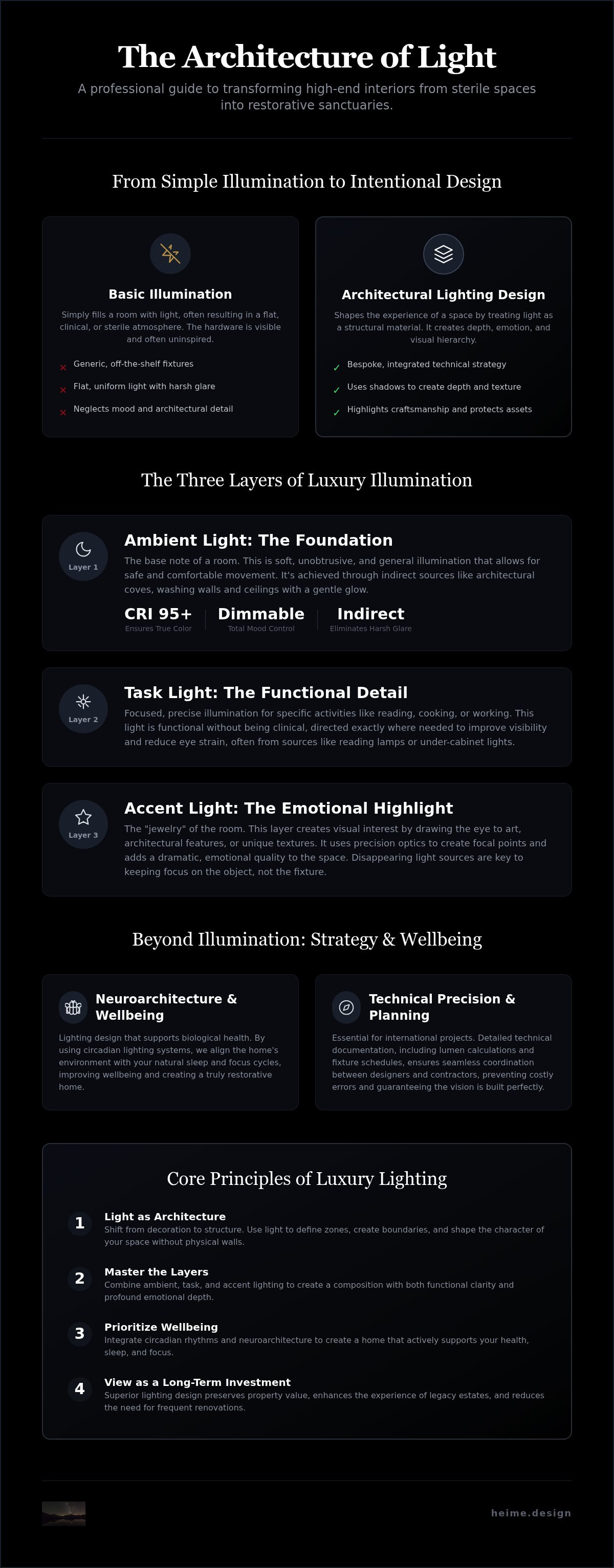
High-end lighting design isn't a decorative afterthought. It's a fundamental architectural tool. In luxury residences, the goal has shifted from simple visibility to the creation of a specific atmosphere. While basic illumination just fills a room with light, lighting design for high end interiors shapes how you experience space and time. It’s the difference between a house that looks expensive and a home that feels restorative.
We approach light through the lens of quiet luxury. This means the hardware often disappears, leaving only the effect behind. A bespoke technical strategy is essential here. It ensures that every beam is intentional, every shadow is planned, and every control system is intuitive. For international investors managing properties in Poland, this technical precision prevents costly errors during the construction phase. It ensures that the vision on paper translates perfectly to the physical build.
The Difference Between Illumination and Design
Generic fixtures often fail in high-value properties because they provide flat, clinical light. True design embraces the role of shadows. By controlling where light doesn't go, we create depth and visual hierarchy. This approach is vital for value preservation in legacy estates. Proper Architectural lighting design protects your investment by highlighting the craftsmanship of the building while ensuring the interior remains timeless. It’s a strategic asset, not just a utility.
- Emotional impact: Light dictates the mood of a room, moving from energetic to calm.
- Visual depth: Using contrast to make rooms feel larger and more textured.
- Asset protection: High-quality systems reduce the need for frequent renovations.
The Architecture of Light
Luxury design integrates light into the structural bones of a room. We don't just hang a lamp; we embed light into joinery, coves, and floor transitions. This defines zones in open-plan luxury interiors without the need for physical barriers. It allows a kitchen to feel like a workspace in the morning and a sophisticated lounge in the evening. It’s about creating boundaries through light rather than walls.
The relationship between material finishes and light reflection is critical. A polished marble floor in a Warsaw penthouse reacts differently to light than a matte oak wall. Lighting design for high end interiors accounts for these variables during the technical documentation phase. By planning the interaction between light and texture, we ensure the final result matches the initial vision with absolute precision. This level of detail is what separates a standard renovation from a high-end architectural transformation.
How to Master the Three Layers of Luxury Illumination
Mastering lighting design for high end interiors is about balance. One light source is never enough. We create a hierarchy of light. This composition defines the mood and utility of every room. It turns a flat space into a multidimensional experience. By understanding how to layer ambient, task, and accent lighting, you can control the narrative of your home.
Ambient Light: Setting the Base Note
Ambient light acts as the foundation. It should be soft and unobtrusive. We use indirect sources like architectural coves to bounce light off surfaces. This technique avoids the harsh glare common in standard builds. Dimming systems are a requirement in luxury spaces. They allow for total control over the environment. We rely on technical standards from the Illuminating Engineering Society (IES) to guide our lumen calculations. High Color Rendering Index (CRI) ratings are also critical. In high-end Polish residences, we prioritize CRI 95+ to ensure the natural beauty of materials like marble and walnut is fully realized. This ensures the colors in your home look rich and authentic.
Accent and Task: The Detail Work
Task and accent layers add the necessary contrast. Task lighting must be functional without being clinical. In a dressing room or a private library, the light must be directed exactly where it's needed. Accent lighting is more emotional. It draws the eye to legacy art or unique architectural details. We use precision optics to highlight paintings without risking damage to the pigments. Sculptural light fixtures often serve as the jewelry of a room. They provide a focal point while delivering a specific layer of light. These pieces should be selected for their form as much as their function.
The current trend for 2026 is the disappearing light source. We use miniature recessed spots and integrated linear tracks that blend into the ceiling. This creates a quiet ceiling that doesn't distract from the interior architecture. It allows the design to speak for itself without visual clutter.
Lighting and furniture must be planned together. A strategic high end furniture selection requires careful positioning to avoid unwanted shadows. We ensure your lighting design for high end interiors complements the textures and scales of your bespoke furniture. This coordination creates a cohesive, curated look that feels intentional. It makes every piece of furniture look like it was made for the space.
Planning a high-value property requires more than just good taste. Our team at heime.design provides the technical expertise to bring these complex layers to life through luxury interior design. We handle the documentation so you can enjoy the result.
Neuroarchitecture: Lighting for Mental Wellbeing
Light is a biological instruction. It enters the eye and signals the brain to release specific hormones. This is the foundation of neuroarchitecture. In the context of lighting design for high end interiors, we use these signals to enhance cognitive longevity. We design for the nervous system, not just the eyes. It's a shift from aesthetic luxury to biological wellness. Your home should actively support your brain's health.
High-end environments require this level of biological precision. Morning light should be rich in the blue spectrum. This suppresses melatonin and boosts cortisol to keep you alert and focused. As the day ends, the light must shift to warm, amber tones. This transition is vital for restorative sleep and long-term health. Academic leaders at Parsons' MFA in Lighting Design emphasize how spectral power distribution directly affects human performance. We integrate these findings into every technical documentation package to ensure the atmosphere is scientifically sound.
The Science of Circadian Lighting
We automate these transitions through smart home protocols. Lighting systems in luxury Polish villas now sync with local solar cycles automatically. At dawn, the house provides a gentle, energizing glow. By late evening, blue light is completely eliminated in bedroom sanctuaries. This supports the body's natural rhythm without requiring manual adjustment. It's a key feature of modern wellness estates. By 2026, these adaptive systems will be a standard expectation in high-value property renovations across Europe.
Creating Emotional Resonance
Light also dictates how we connect with others. Warm, low-level light fosters intimacy and social connection. It makes a grand dining room feel welcoming and grounded. Cooler, higher-intensity tones are better for focus. We use these in home offices and private aviation interiors where productivity is paramount. The goal is to match the light to the intended emotional state of the room.
The psychological comfort of negative space shouldn't be ignored. Over-lighting a room leads to sensory fatigue and anxiety. By leaving intentional areas in shadow, we provide the brain with a place to rest. This balance of light and dark is a hallmark of sophisticated lighting design for high end interiors. It creates a sense of calm and organization. It ensures your home remains a sanctuary, regardless of the world outside.
Technical Planning and Documentation for Luxury Projects
Technical documentation is the backbone of any luxury build. Without it, the most inspired vision remains a sketch. In lighting design for high end interiors, we provide the precise drawings that electrical engineers and smart home integrators require. This ensures every fixture performs exactly as intended. It eliminates guesswork on site. It protects your budget from the high costs of mid-construction corrections. We treat technical design documentation as a mandatory architectural layer.
The Importance of Detailed Lighting Plans
A comprehensive lighting plan includes more than just fixture locations. We create Reflected Ceiling Plans (RCPs), circuit diagrams, and switching schedules. These documents specify every driver, dimming protocol, and control group. This level of detail is vital for complex estates with dozens of lighting zones. We integrate these plans with advanced automation systems like KNX, Lutron, or Crestron. This ensures a seamless user experience across the entire property.
As of 2026, we also account for the latest smart home integration protocols to ensure future-proof connectivity. Precise documentation prevents costly site errors. It ensures the right cables are pulled and the correct drivers are installed before the walls are finished. This technical precision allows for the biological and emotional transitions discussed in previous sections. It is the silent engine of the home's atmosphere. Our technical drawings for documentation serve as the definitive guide for your site team.
Cross-Border Coordination
Managing a luxury project often involves multiple jurisdictions. You might be an investor in Switzerland building a villa in Spain or a penthouse in Warsaw. This requires expert international project management interior design. We coordinate with local contractors and international artisans to source bespoke components. Site supervision is a core part of our process. We ensure the design intent is maintained throughout the construction phase, regardless of the property's location.
Compliance is another critical factor. We navigate the revised EU Energy Performance of Buildings Directive (EPBD). This directive mandates specific automation and efficiency standards for 2026. Our documentation ensures your property meets all legal requirements while maintaining a high-end aesthetic. This oversight protects your property value and ensures long-term operational efficiency. We bridge the gap between architectural requirements and interior luxury through construction coordination.
Luxury is a result of meticulous planning. If you are ready to secure the technical integrity of your next project, explore our Technical Design Documentation services at HEIME. We handle the complexity so you can focus on the result.
Elevating Your Estate with HEIME’s Lighting Design
Luxury isn't a standard. It's a response to your specific lifestyle. We specialize in lighting design for high end interiors that prioritizes your biological needs and aesthetic values. Our approach treats light as a strategic asset. It preserves the value of your legacy estate while enhancing your daily wellbeing. We bridge the gap between complex engineering and refined interior architecture. We don't just specify fixtures. We curate experiences.
For UHNW clients, a home must function as a sanctuary and a high-performance environment. This requires more than off-the-shelf solutions. We integrate neuroarchitecture as a standard for high-end wellness. This ensures your property supports cognitive longevity and emotional balance. By treating light as a structural element, we transform legacy properties into modern masterpieces of health and design. It is an investment in the long-term value of your interior architecture.
The HEIME Curation Process
Our process is linear and efficient. We start with a discovery phase to understand your routine and biological goals. We analyze how you use each space throughout the day. We then move into technical execution. Here, we produce the end-to-end technical design documentation required for complex builds. This documentation serves as the definitive guide for international contractors, ensuring no detail is lost in translation. Finally, we handle the styling. This ensures your lighting design for high end interiors harmonizes perfectly with your bespoke furniture and art collections. It's a turnkey solution designed for international clarity and precision.
- Discovery: Defining your biological and aesthetic requirements.
- Technical Design: Creating precise documentation for seamless site execution.
- Site Supervision: Ensuring the design intent is realized by local teams.
- Final Styling: Calibrating the light to enhance every material and texture.
Your Next Step in Luxury Design
High-value properties require future-proof thinking. We integrate the latest 2026 smart home protocols and neuroarchitecture standards into every project. Whether you're renovating a historic villa in Poland or a modern estate in Spain, our multilingual team provides seamless coordination. We manage the contractors, the artisans, and the technical details. This allows you to focus on the result rather than the process.
Secure the future of your property. Invest in an atmosphere that adapts to you. Our team is ready to assist with international project coordination and bespoke interior architecture. Contact HEIME for a private consultation on your next renovation. We help you navigate the technical and aesthetic complexities of luxury lighting with quiet confidence and professional precision.
Secure the Future of Your Atmosphere
True luxury is found in the invisible details. You've seen how lighting design for high end interiors moves beyond simple fixtures to become a fundamental architectural layer. It's about aligning your home with your biological needs through neuroarchitecture and ensuring every technical detail is documented with absolute precision. This approach preserves your property's value while transforming it into a restorative sanctuary.
Managing complex builds across borders requires more than just an eye for design. It demands a multilingual team capable of navigating international regulations and coordinating with global contractors. At HEIME, we combine this international project management expertise with Red Dot level technical precision. We bridge the gap between architectural concept and physical reality; ensuring your vision is realized without compromise.
Your next project deserves this level of intentionality. Begin your bespoke lighting transformation with HEIME. We look forward to helping you define the light of your home.
Frequently Asked Questions
What is the best color temperature for a luxury living room?
The ideal color temperature is dynamic. We recommend a range between 2700K and 3500K. Warm light at 2700K creates an intimate atmosphere for evening relaxation. Neutral light at 3000K works best for daytime social use. High-end systems use tunable white technology to shift these temperatures automatically. This ensures the space always feels appropriate for the current activity and time of day.
How does lighting design affect the value of a high-end property?
Superior lighting design for high end interiors increases property value by highlighting architectural craftsmanship and ensuring timeless appeal. It transforms a standard residence into a curated estate. Investors see higher returns because professional lighting reduces the need for frequent renovations. It protects the integrity of high-value materials; making the property more attractive to future buyers who prioritize wellness and technical precision.
Can lighting design help with sleep disorders or jet lag?
Yes, lighting design is a powerful tool for managing sleep and jet lag. We use circadian rhythm protocols to mimic natural sunlight cycles. By increasing blue light exposure in the morning and eliminating it in the evening, your home signals your brain to regulate melatonin naturally. This is especially helpful for international clients frequently moving between time zones. It's a primary benefit of neuroarchitecture.
Do I need a separate lighting designer if I have an interior architect?
While an interior architect handles the broad vision, a specialized lighting designer provides deep technical precision. They focus on lumen calculations, beam angles, and control protocols. HEIME integrates both roles into a single workflow. This ensures your lighting design for high end interiors is perfectly synchronized with the structural bones of the room. It prevents the friction often found when coordinating separate consultants.
What are the biggest mistakes in high-end lighting design?
The most common mistakes include using a single overhead light source and ignoring Color Rendering Index (CRI). Flat lighting removes depth and makes even expensive furniture look dull. Visible hardware can also clutter a minimalist ceiling. We avoid these by layering light and selecting high-CRI LEDs (95+). This ensures textures are rich and the interior architecture remains the primary focus of the room.
How do smart home systems integrate with professional lighting plans?
Smart home systems integrate with lighting via specific communication protocols like KNX or DALI. We specify these in the technical documentation phase. This allows your lighting to respond to motion, time of day, or pre-set scenes. A professional plan ensures that the hardware and software are compatible. It results in a system that's intuitive to use and easy for local electrical teams to install.
What is neuroarchitecture and why is it used in lighting?
Neuroarchitecture is the study of how the built environment affects the human brain and nervous system. In lighting, it's used to design spaces that reduce stress and improve focus. We analyze how light intensity and color temperature trigger specific hormonal responses. This scientific approach ensures your home isn't just beautiful; it's a tool for better mental health and cognitive longevity.
How do I manage a lighting installation for a property abroad?
Managing a property abroad requires detailed technical drawings and site supervision. We provide end-to-end documentation that local contractors in Spain or Poland can follow with precision. Our multilingual team coordinates with local installers to ensure the design intent is preserved. This cross-border management prevents communication errors. It ensures your international renovation meets the same high standards as a local project.


