

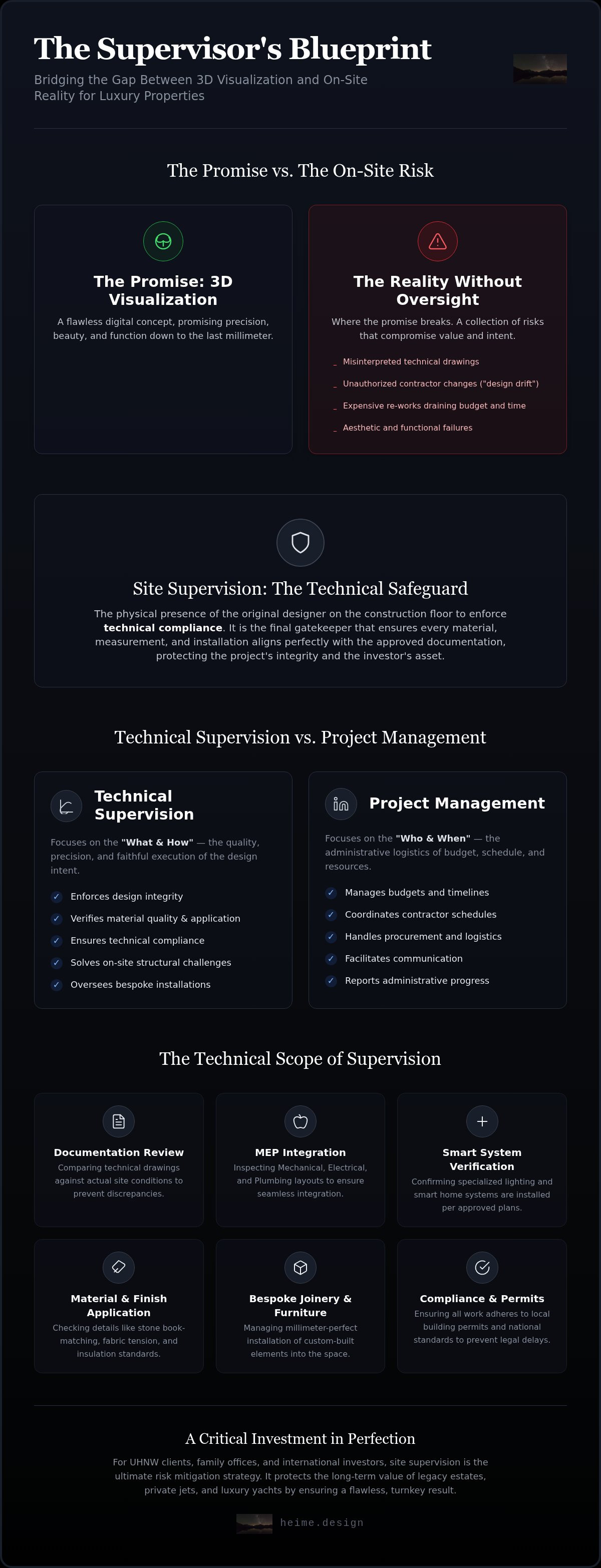
A flawless 3D visualization is a promise, but the construction site is where that promise often breaks. For international investors, the distance between a design concept and its physical reality is a significant risk. Without a constant, expert presence, technical drawings are easily misinterpreted. Contractor errors lead to expensive re-works that drain your time and budget. This is why professional site supervision interior design is the most critical layer of protection for any high-end property.
It's natural to feel uneasy when you aren't physically present to oversee a project in another country. You expect the final result to match the vision you approved. Down to the last millimeter. Your property is more than a home; it's a legacy asset that requires technical precision and strict compliance. This guide explores how professional oversight bridges the gap between creative intent and technical execution for luxury projects.
You'll discover how to eliminate the stress of international project management while preserving your property's long-term value. We'll examine the role of technical documentation, the importance of on-site coordination, and the path to a perfect turnkey result in 2026.
Key Takeaways
- Understand how site supervision interior design acts as the final gatekeeper for technical accuracy.
- Distinguish between administrative project management and technical oversight to protect your investment.
- Learn how multilingual coordination bridges the gap between international investors and local contractors.
- See how precise technical enforcement preserves the value of legacy estates and marine interiors.
- Identify the protocols used to verify that smart home systems align with your approved plans.
What is Site Supervision in Luxury Interior Design?
Site supervision interior design is the physical presence of the designer on the construction floor to enforce technical compliance. It’s the moment where abstract concepts become physical reality. This process ensures that every material, measurement, and installation aligns perfectly with the approved documentation. Without it, even the most detailed plans are subject to local interpretation. Site supervision is the technical safeguard of an interior architecture project.
In the Interior design profession, site inspections are a standard for quality control. It’s about more than just checking progress. Professional oversight prevents "design drift." This occurs when small, unauthorized changes by contractors slowly pull the project away from its original intent. In luxury renovations, these minor deviations can snowball into significant aesthetic and functional failures. Consistent site supervision interior design keeps the project on its intended path and ensures the final result matches the 3D visualizations exactly.
The Role of the Author Supervisor
The original designer understands the "why" behind every detail. They’re best suited to oversee the build because they see the project as a cohesive whole. When site conditions change, they interpret technical documentation for contractors in real-time. This ensures aesthetic integrity remains intact even if structural adjustments are necessary. It’s a bridge between the drawing board and the hammer. The author supervisor ensures that the soul of the design isn't lost during the messy reality of construction. At heime.design, we prioritize this continuity to maintain the precision of our bespoke concepts.
Protecting High-Value Property Investments
For UHNW clients and family offices, site supervision is a critical risk-mitigation strategy. It prevents costly errors and re-works that occur when technical drawings are misread. Precision is the foundation of long-term asset value. A legacy estate, a private jet, or a luxury yacht requires a level of detail that standard contractors might overlook. Professional oversight ensures that high-value materials are handled with the respect they deserve. It’s about securing a flawless turnkey result. By catching mistakes before they’re buried behind walls or under flooring, you preserve the property’s financial and functional worth. This level of technical enforcement is what defines the heime.design approach to project oversight.
The Technical Scope: From Documentation to Execution
Translation from paper to physical reality is rarely linear. Site supervision interior design bridges this gap by reviewing technical design documentation against actual site conditions. Construction sites are dynamic. Even the most precise drawings might encounter unexpected structural challenges. A supervisor identifies these discrepancies early. This prevents delays and ensures the original vision remains intact.
The technical duties of an interior designer extend far beyond aesthetic choices. It involves inspecting mechanical, electrical, and plumbing (MEP) layouts. We ensure they don't interfere with architectural features. We verify the installation of specialized lighting design and smart home systems. These components must be integrated seamlessly. We hide the complexity behind a minimalist finish. Managing the installation of bespoke joinery and high-end furniture requires a similar level of precision. Every millimeter matters when fitting custom elements into a luxury space.
Technical oversight also includes essential compliance. We ensure all work adheres to architecture licensing requirements and local building permits. We coordinate with local architects to ensure all technical drawings for documentation meet national standards. This prevents legal delays that can stall high-value projects. It protects your legal standing and property value. If you are planning a complex renovation, our bespoke interior design services ensure every material is applied with technical rigor.
Verifying Material and Finish Application
Luxury is found in the details. We check stone book-matching to ensure veins align perfectly across surfaces. Delicate fabric installations are monitored for tension and seam placement. We also verify that acoustic and thermal insulation meet the specified high-performance standards. It isn't just about how it looks. It's about how the space performs. High-end furniture selection must fit the spatial constraints exactly to maintain the intended flow.
Neuroarchitecture and Technical Precision
Precise execution supports the science of cognitive luxury. Neuroarchitecture focuses on how physical environments affect our well-being. This requires aligning lighting design with circadian rhythms through rigorous technical oversight. A slight flicker or the wrong color temperature can disrupt the intended physiological response. Flawless finishing and organized spaces reduce cognitive load. They create a sense of calm. When every element is executed with precision, the space feels intentional. This psychological harmony is the ultimate result of professional site supervision.
Site Supervision vs. Project Management: Key Differences
Project management and site supervision are distinct disciplines. One manages the process. The other manages the result. In high-value developments, separating these roles is a necessity. Project management handles the "who" and the "when." It’s the administrative engine. Conversely, site supervision interior design focuses on the "how" and the "how well." It’s the technical heart of the project. Both are required to bridge the gap between a design concept and a finished home.
In the context of international luxury, this distinction is even more pronounced. Investors often lack the time to oversee daily site activities. They need a project manager to protect the timeline and a supervisor to protect the quality. These roles work in tandem. The project manager identifies a delay in material delivery. The site supervisor adjusts the installation sequence to maintain momentum. This synergy prevents the project from stalling. We integrate these functions into our turnkey project management framework at heime.design. This ensures that administrative efficiency never compromises the technical execution.
Luxury projects are inherently high-risk. They involve global supply chains and specialized labor. A project manager ensures the bespoke marble arrives on schedule. A site supervisor ensures it’s installed with a zero-millimeter tolerance. Without both, the project either exceeds the budget or fails the aesthetic standard. This dual approach is the only way to guarantee a result that matches the 3D visualizations exactly. It provides a layer of security that standard construction management often lacks.
The Project Manager Role
The project manager acts as the primary contact for the operational side of the build. They manage contractors and procurement schedules to keep the project moving. For family offices, this role is vital for budget tracking and transparent financial reporting. They also coordinate the complex architecture licensing and permits required for international projects. Their goal is a frictionless workflow. They remove the administrative burden so the client can focus on the final vision rather than the logistics.
The Site Supervisor Role
The site supervisor works directly on the construction floor. They solve technical conflicts in real-time. If a structural beam interferes with a lighting layout, they find a solution that preserves the design. They approve the quality of craftsmanship for every luxury renovation. This requires direct, expert communication with specialist artisans and installers. They ensure that bespoke joinery or delicate stone work is handled with technical precision. They are the guardians of the physical result on-site.
International Coordination: Remote Supervision for Investors
Distance is the primary challenge for international property investors. Ensuring a high-end result from thousands of miles away requires more than just a camera. It demands technical expertise on the ground. Professional managing renovations from abroad relies on a presence that understands local regulations and global standards. Site supervision interior design provides this bridge. It allows clients to maintain total control without the need for constant physical travel.
Multilingual coordination is essential in European builds. Technical errors often stem from simple miscommunications between owners and tradespeople. Our team operates in English, Spanish, and Polish. This ensures that every specialist artisan and contractor receives precise instructions in their native language. We translate complex technical drawings into actionable tasks. This eliminates the "lost in translation" risks that often plague cross-border construction coordination in 2026.
Managing Spanish Building Permits and Compliance
Regional compliance in Spain is famously complex. It requires constant coordination with local architects and municipal authorities to avoid work stoppages. We ensure that all technical documentation meets specific regional licensing standards before and during the build. Site supervision plays a critical role in securing final occupancy permits. We verify that the physical construction matches the permitted plans exactly. This prevents legal delays and protects your asset's long-term liquidity.
Communication Protocols for Global Clients
Transparency is the foundation of remote trust. We provide structured reporting specifically designed for family offices and private investors. These aren't just status updates. They're technical audits. We use high-resolution visual documentation for remote approval of materials and finishes. This allows you to see the book-matching on a stone slab or the texture of a fabric in detail from your primary residence.
Bridging cultural and professional gaps is equally important. Local contractors often have different workflows than international clients expect. We manage these expectations through clear, documented protocols. This ensures a streamlined path from design to delivery. If you're ready to secure your international investment, our luxury interior design services provide the technical oversight you need.
Heime.design’s Expert Supervision for High-Value Assets
heime.design specializes in protecting the physical legacies of international clients. We provide expert oversight for UHNW residential interior design and legacy estates. These projects require more than standard construction monitoring. They demand a deep understanding of how generational value is preserved through technical excellence. Professional site supervision interior design at this level is about enforcing zero-tolerance standards. Every joint, finish, and structural integration must be perfect. We act as the technical guardians for family offices and private collectors. Our focus remains on the long-term preservation of the asset’s integrity.
Preserving generational value is a meticulous task. It involves documenting the "as-built" condition with extreme accuracy. This ensures that future renovations or repairs can be handled with the same level of care. We coordinate with specialist artisans who understand the nuances of rare materials. Whether it’s a centuries-old villa or a modern penthouse, the goal’s the same. We ensure that the physical execution honors the financial and emotional investment of the owner. Flawless execution’s the only way to safeguard a property’s market position for decades to come. This level of commitment is what defines the heime.design approach to site supervision interior design.
Marine and Aviation Interior Refits
Marine and aviation environments present unique technical constraints. Space’s limited. Weight’s critical. We oversee luxury yacht refits where every millimeter counts. This involves supervising the installation of specialized, lightweight luxury materials that meet strict safety codes. We ensure full compliance with international maritime and aviation standards. In VIP aircraft cabin designs, the precision of execution directly impacts both safety and aesthetic harmony. Our role’s to ensure that bespoke components fit perfectly within these high-performance environments. We manage the interface between complex engineering and high-end finishing.
Refitting a yacht or a private jet requires a different pace. The timelines are often compressed. The materials are frequently one-of-a-kind. We provide on-site presence to solve installation conflicts immediately. This prevents the design drift mentioned earlier in this article. We verify that every custom element’s secured properly for motion and vibration. It’s a technical challenge that rewards precision and foresight. heime.design provides the specialized knowledge required for these high-stakes environments.
Secure Luxury for Private Estates
High-value property requires sophisticated protection. We integrate advanced security systems within the luxury interior architecture. This’s done discreetly. The goal’s to provide safety without compromising the design intent. Confidentiality and discretion are central to our site visits. We understand the privacy needs of our clients. When transforming heritage properties, we focus on preserving historical value while introducing modern technical standards. This balance ensures the property remains a viable and secure asset for future generations. We verify that security hardware’s integrated into bespoke joinery and architectural features without visible seams or disruptions.
Securing Your Physical Legacy
Professional oversight is the only way to ensure that a high-end concept survives the construction process. It transforms technical drawings into a flawless physical reality while mitigating the risks of remote investment. By prioritizing site supervision interior design, you protect your property from the costly errors that arise during complex cross-border builds. This process ensures that every material, from book-matched stone to bespoke joinery, is installed exactly as intended. It's the difference between a project that merely finishes and one that truly excels.
Our approach combines specialized UHNW estate expertise with end-to-end turnkey solutions. We provide the technical bridge needed for international projects, offering multilingual project coordination that ensures every detail is executed with precision. Your property is a significant asset. It deserves the protection of expert technical enforcement to preserve its generational value and aesthetic integrity. We handle the complexity so you can enjoy the result.
Secure your investment with HEIMÉ’s professional site supervision.
We are ready to safeguard your vision and deliver a result that matches your approved visualizations with absolute accuracy.
Frequently Asked Questions
Why is site supervision essential for a luxury renovation?
Site supervision interior design is the only way to ensure that high-end materials and complex technical drawings are executed correctly. Luxury renovations involve intricate details like book-matched stone or integrated smart systems that contractors might misinterpret. A professional supervisor acts as the final gatekeeper for quality. They catch errors before they become permanent. This oversight preserves the property's financial value and ensures a flawless turnkey result.
How does site supervision differ from a general contractor’s role?
A general contractor manages the labor and construction process on-site. Their focus is on building the structure and managing trades. A site supervisor focuses on design fidelity and technical accuracy. They verify that the contractor's work matches the approved documentation exactly. While the contractor looks at the "how," the supervisor ensures the "what" meets the high standards of the original vision. This separation creates a necessary system of checks and balances.
Can site supervision be managed remotely for international projects?
Effective supervision requires a physical presence on the construction floor. It cannot be done through a screen. However, it allows the investor to remain remote. The supervisor acts as the client's eyes and ears on the ground. They provide high-resolution visual documentation and technical reports. This system bridges the gap for international investors. It ensures the project moves forward without requiring the owner's constant presence on-site.
What technical documentation is required for effective site oversight?
Effective oversight requires a comprehensive set of technical design documentation. This includes detailed floor plans, reflected ceiling plans, and electrical layouts. It also requires specific drawings for bespoke joinery, stone layouts, and lighting design. These documents serve as the benchmark for every site visit. Without this level of detail, a supervisor cannot verify if the execution matches the intended quality and functionality of the luxury space.
How much does professional site supervision cost in 2026?
The cost for site supervision interior design usually depends on the project's scale and technical complexity. It's often structured as a percentage of the total renovation budget or a fixed monthly fee for the duration of the build. Some professionals also offer per-visit rates for specific milestones. You should consult with your designer to understand the specific fee structure for your project. This investment typically pays for itself by preventing expensive re-works.
Does HEIMÉ coordinate with local architects for Spanish building permits?
HEIMÉ facilitates full coordination with local Spanish architects to secure necessary building permits. We ensure that our technical documentation aligns with regional licensing standards. This includes managing the communication between international design concepts and local regulatory requirements. Our team handles the technical drawings for documentation required for Spanish permits. This proactive approach prevents legal delays and ensures your project remains compliant with all national and local building codes.
What happens if the contractor deviates from the technical design?
If a deviation is discovered, the site supervisor issues an immediate correction order to the contractor. They analyze the discrepancy to determine if it's a simple error or a response to unforeseen site conditions. The supervisor then provides a technical solution that preserves the design's aesthetic and functional integrity. This real-time problem-solving prevents minor errors from snowballing into significant project failures. It ensures the final result remains true to your approved visualizations.
How often should a site supervisor visit the project?
The frequency of site visits depends on the project's current phase and complexity. During critical stages like MEP installation or bespoke joinery fitting, daily oversight may be necessary. For standard construction periods, weekly visits are often sufficient. We schedule visits around key milestones to verify work before it's covered by walls or flooring. This ensures that every layer of the construction meets our rigorous technical standards for luxury builds.


