

A luxury renovation shouldn't feel like a legal battle. For many global investors, the distance between vision and reality is measured in bureaucratic delays and lost translations. Managing cross-border interior design projects requires more than an aesthetic eye. It demands a technical bridge between international standards and local regulations. Success in 2026 depends on synchronizing global expectations with regional compliance.
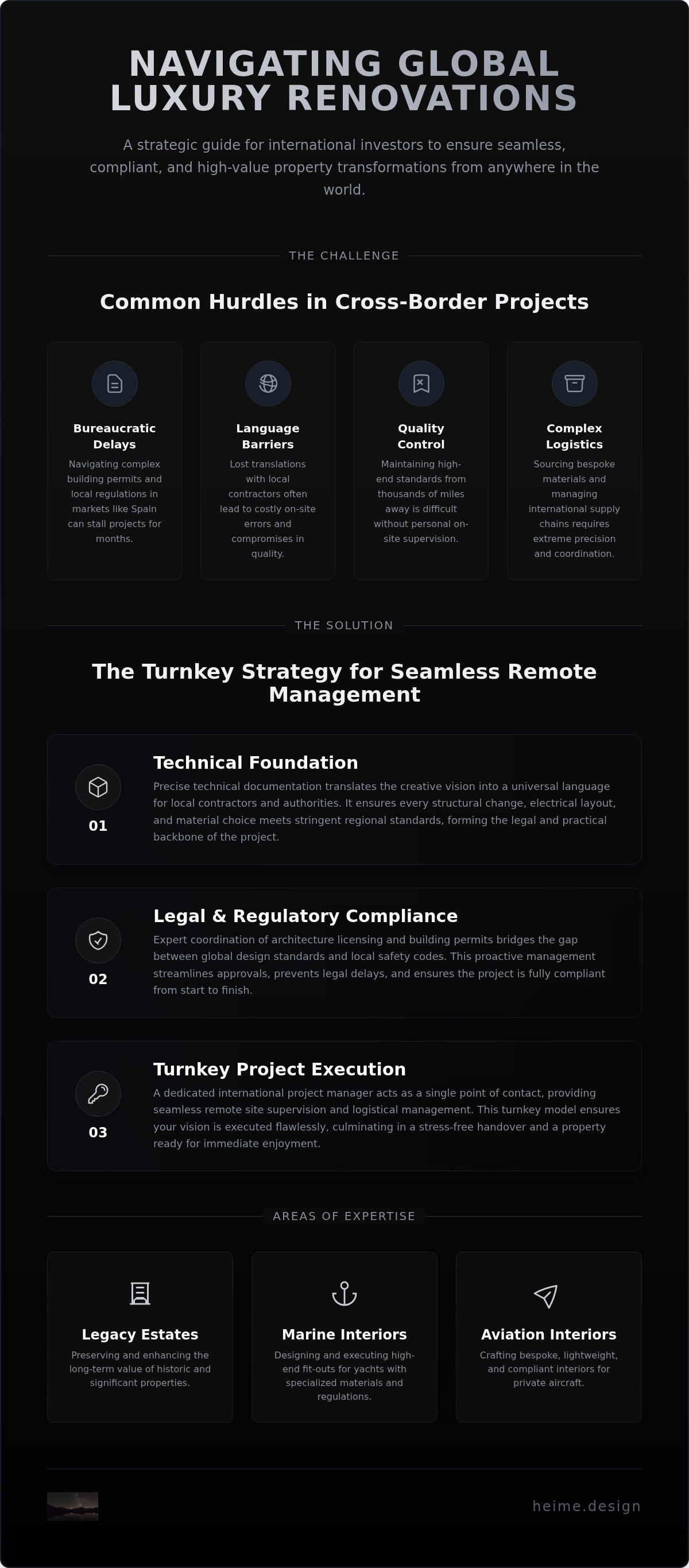
You likely understand the frustration of maintaining high-end quality from thousands of miles away. Navigating complex building permits in markets like Spain or managing contractors across language barriers can turn a legacy project into a source of stress. It's difficult to ensure every detail meets your standards when you aren't on-site to supervise the work personally.
This guide provides a clear strategy to ensure your international property transition is seamless and compliant. You'll learn how to navigate architectural licensing and preserve the long-term value of your estate. We will explore the essential steps for remote project management, technical documentation, and final turnkey delivery.
Key Takeaways
- Learn why precise technical documentation and local architecture licensing are essential for legal compliance in European renovations.
- Discover how a modern turnkey model enables you to manage high-end property fit-outs entirely from a distance.
- Master the logistics of cross-border interior design projects by aligning international standards with specific local building regulations.
- Understand the specialized requirements for preserving the value of legacy estates and complex marine or aviation interiors.
- Identify the criteria for choosing a boutique design partner that prioritizes personalized coordination over corporate complexity.
Understanding Cross-Border Interior Design Projects in 2026
Managing high-end interiors across different legal and cultural jurisdictions is the core of cross-border design. In 2026, global mobility is a standard for international investors. This shift drives a growing demand for studios that operate beyond traditional boundaries. Success in cross-border interior design projects requires a deep understanding of the interior design profession. It's not just about aesthetics. It involves architecture licensing, local building permits, and complex international logistics. An international project manager acts as your central point of contact. They bridge the gap between your vision and the local reality on the ground.
The primary challenges involve regulatory compliance and remote site supervision. Every country has specific rules for structural changes and material standards. Without local expertise, these regulations can stall a project for months. Logistical chains also become more complex when sourcing bespoke furniture or rare materials from multiple regions. A specialized studio manages these moving parts to ensure a seamless fit-out. It's about creating a streamlined path from the initial concept to the final handover.
The Complexity of International Design Coordination
Synchronizing international aesthetic standards with local craftsmanship is a delicate balance. High-end projects often rely on bespoke materials that must cross borders. Managing these supply chains requires extreme precision. You need to know that custom joinery or imported stone will arrive on-site exactly when the local team is ready. Bridging the gap between UHNW lifestyle expectations and local market realities is a constant task. Local contractors might have different technical approaches or working rhythms. Clear documentation ensures everyone follows the same high-quality roadmap. It keeps the project moving without compromising on the final finish.
Why Investors Choose Cross-Border Specialists
Investors choose specialists to mitigate risk. Professional site supervision and technical documentation protect your financial commitment. Communication is the most common point of failure in international work. A multilingual team prevents errors that lead to costly on-site corrections. When you're dealing with markets like Spain or Poland, local knowledge is a necessity. Specialists ensure your lifestyle identity remains consistent across every global property you own. Whether you're renovating a villa or a corporate space, the quality stays the same. This approach focuses on value preservation for your legacy estate and ensures a turnkey transition into your new home.
Technical Documentation and Architecture Licensing in Europe
Technical drawings are the foundation of any successful international renovation. They translate a creative vision into a technical language that local contractors and authorities understand. In Europe, this process is strictly regulated and requires extreme precision. High-end cross-border interior design projects often face significant delays when technical details are overlooked during the planning phase. Accurate documentation ensures that every structural change, electrical layout, or material choice meets regional standards. It serves as the definitive legal record for the property's transformation and long-term value.
Compliance coordination is essential in the modern European market. It bridges the gap between global design trends and local safety codes. Recent sustainable cross-border design initiatives show how the industry is evolving to prioritize environmental impact alongside technical rigor. Coordinating with local architects ensures that your project doesn't just look beautiful but is also fully legal. This collaboration is vital for securing building permits and avoiding administrative fines that can occur during the construction phase.
Building Permit Coordination for International Projects
Navigating the Spanish market in 2026 requires specialized knowledge of local timelines and documentation types. Spanish building permits often involve multiple layers of approval from municipal departments and regional heritage boards. Using professional Architecture Licensing Services in Spain streamlines this complex process. These services provide the technical drawings for documentation and manage the permit coordination directly with Spanish architects. This proactive approach prevents the legal delays that often derail construction schedules for international buyers.
Compliance and Technical Precision
Technical design documentation must align with strict local safety, acoustic, and environmental codes. In 2026, we see a stronger intersection between neuroarchitecture and regulatory compliance. Successfully executing cross-border interior design projects means design choices that impact mental well-being still fit within the technical framework of local building laws. Ensuring this alignment requires a meticulous professional who values both aesthetic harmony and structural integrity. If you're planning a high-value renovation, our team provides the Technical Design Documentation needed to secure your project's future and ensure a seamless turnkey transition.
Remote Management and Turnkey Project Execution
Executing cross-border interior design projects in 2026 relies on a sophisticated turnkey model. This framework allows global investors to delegate the entire process, from initial conceptualization to the final fit-out. It eliminates the need for constant travel. Instead, success is built on a secure communication rhythm. Clear reporting and scheduled digital walkthroughs ensure the client remains in control without the burden of daily oversight. Precision is the priority. Every step is documented to maintain a high-quality output and streamlined workflow.
Site supervision is the most critical element in maintaining luxury standards. It serves as the physical link between an international vision and local execution. For high-value properties and legacy estates, this oversight is a form of value preservation. It ensures that structural integrity and aesthetic harmony are maintained over decades. A meticulous project manager anticipates local challenges before they impact the schedule. This proactive stance keeps the project on track and protects your investment from common pitfalls in foreign markets.
The Turnkey Workflow for Global Investors
A structured approach is necessary for remote success. The 2026 turnkey model follows three distinct phases:
- Phase 1: Technical documentation and international permit coordination. This stage secures the legal foundation for the renovation.
- Phase 2: Contractor selection and cross-border construction coordination. We identify and manage local craftsmen who meet international quality benchmarks.
- Phase 3: Final fit-out and luxury property transformation. This final stage delivers a move-in ready home, complete with bespoke furniture and integrated technology.
Site Supervision from a Distance
Managing luxury renovations from abroad no longer requires a compromise on detail. Digital tools and cloud-based technical drawings allow for real-time progress monitoring. Every on-site decision is cross-referenced against the original design intent. This level of transparency ensures that "good enough" is never the standard. It allows for a seamless transition into a foreign property, regardless of the investor's location. For more insights on this approach, explore our strategy for International Project Management for Luxury Interior Design. We prioritize direct communication to make the path from inquiry to action as frictionless as possible.
Specialized Interiors: Marine, Aviation, and Legacy Estates
Mobile assets like yachts and private jets represent the ultimate challenge for cross-border interior design projects. Unlike stationary villas, these environments move across international jurisdictions while requiring a singular, high-end standard of luxury. They are high-performance machines that must also function as a sanctuary. Designing these spaces requires a technical bridge between engineering and interior architecture. Success relies on precise coordination between international suppliers and specialized local shipyards or hangars. It's about maintaining a consistent lifestyle experience regardless of the vessel's location.
Technical precision is non-negotiable in these environments. Every material choice impacts weight, safety, and durability. Designing for UHNW individuals in these sectors means prioritizing privacy and security without compromising on aesthetic harmony. We focus on creating functional luxury that survives the unique stresses of travel. This ensures that your mobile assets remain high-value investments that reflect your personal brand across the globe.
Luxury Marine and Aviation Interior Architecture
Bespoke refit services for yachts require a delicate balance. We must align high-end aesthetics with complex maritime technicality. A yacht is a corrosive environment. Every piece of high-end furniture and every finish must be selected for its ability to withstand salt air and movement. We coordinate with engineers to ensure that interior changes don't affect the vessel's performance. Our approach ensures a seamless transition from concept to the final fit-out.
VIP aircraft cabin design follows a similar logic of extreme constraint. We create high-end offices in the sky where space is the most precious resource. Every component must meet strict aviation safety codes. We use technical design documentation to ensure that bespoke elements are both beautiful and compliant. This level of detail allows for a turnkey delivery that meets the highest global standards for aviation interiors.
Legacy Estate Design and Value Preservation
Generational property design is about future-proofing your family’s physical legacy. We transform heritage properties into secure, modern family offices that serve as the foundation for a global lifestyle. This process involves integrating smart home technology and advanced security into historic architecture. We use neuroarchitecture to create wellness-focused environments that support the health of every family member. This ensures the residence remains relevant and valuable for decades. To learn more about our approach, see our guide on UHNW Residential Interior Design: Architecting Physical Legacies. If you're ready to secure your generational assets, explore our Bespoke Interior Design & Project Management services.
Choosing the Right Partner for Cross-Border Design
Selecting a partner for cross-border interior design projects is a strategic decision that goes beyond aesthetic preference. In 2026, the complexity of international regulations requires a studio that functions as a technical bridge. You need a team that understands how to translate a global vision into a local reality. This involves managing not just the design, but also the legal and logistical hurdles of a foreign market. A meticulous professional acts as your representative on the ground, ensuring that every detail aligns with your standards and local laws.
A boutique approach often outperforms large corporate firms in this specialized field. Personalized coordination is the key to success when managing high-value assets from a distance. In a boutique setting, the communication rhythm is faster and more direct. You aren't just another project in a massive pipeline. Instead, you receive the focused attention of a curated expert who values aesthetic harmony and technical precision. This proximity prevents the communication gaps that often lead to costly errors in international construction.
Essential Studio Capabilities
A capable international studio must offer more than just creative concepts. Look for a partner with a proven track record in international project management and construction coordination. They should provide in-house technical documentation services specifically for European jurisdictions. This is the only way to ensure that your project meets local building codes from the first day of planning. Additionally, a focus on neuroarchitecture and wellness-driven design is now a standard for luxury interiors. These elements ensure that your property supports your health and provides a sense of calm, regardless of its location.
The HEIMÉ Advantage
HEIMÉ provides a streamlined path for global property investors. We offer personalized turnkey coordination that removes the friction from international renovations. Our team specializes in cross-border interior design projects with a specific focus on Spanish building permit coordination and technical documentation. We bridge the gap between your international expectations and the local realities in markets like Spain and Poland. Our multilingual team ensures that every instruction is clear and every standard is met. We are committed to quiet luxury and technical excellence, preserving the long-term value of your legacy estate.
Preparing Your International Brief
The next step in your journey is preparing a comprehensive brief for your international luxury renovation. Focus on your lifestyle requirements, security needs, and any generational legacy goals. A clear brief allows us to create a precise roadmap for your project. It ensures that the transition into your new property is seamless and stress-free. If you are ready to begin, our team is here to provide the Bespoke Interior Design & Project Management services required to bring your vision to life.
Secure Your Global Legacy in 2026
Successful cross-border interior design projects rely on the intersection of technical precision and aesthetic harmony. By prioritizing architecture licensing and specialized permit support, you protect the long-term value of your international assets. Remote management is no longer a compromise on quality. It's a streamlined path to a turnkey home. Whether you're fit-out a villa in Spain or a private jet, the focus remains on technical excellence and seamless coordination.
We bridge the gap between global standards and local European regulations. Our team provides multilingual technical coordination and specialized Spanish permit support to ensure your renovation is fully compliant. We redefine luxury through neuroarchitecture, creating spaces that support your well-being and generational legacy. Connect with HEIMÉ for your international design project. Let's begin the transition into your new property today. Your vision deserves a professional bridge to reality.
Frequently Asked Questions
What are cross-border interior design projects?
Cross-border interior design projects involve the coordination of high-end renovations or new builds across different legal and cultural jurisdictions. These projects require a technical bridge between your international vision and local market regulations. Success depends on synchronizing global aesthetic standards with regional building codes. It's a specialized process that manages everything from architectural licensing to final fit-out, ensuring a seamless transition into a foreign property without the need for constant physical presence.
How do you manage a luxury renovation from another country?
Managing a luxury renovation from abroad requires a structured communication rhythm and a dedicated international project manager. You use digital tools and cloud-based technical drawings to monitor site progress in real-time. This model eliminates the need for frequent travel while maintaining high standards. Your project manager acts as a single point of contact, coordinating with local contractors and ensuring that every detail aligns with the original design intent and quality benchmarks.
What technical documentation is needed for a renovation in Spain?
Renovations in Spain require specific technical drawings for documentation to secure municipal building permits. This includes detailed interior architecture plans, electrical layouts, and structural compliance reports. You must align these documents with local safety, acoustic, and environmental codes. Professional documentation services manage this complexity, coordinating with regional authorities to prevent legal delays. This technical foundation ensures your project is fully compliant and avoids administrative fines during the construction phase.
Can an international designer coordinate with local Spanish architects?
Yes, an international designer frequently coordinates with Spanish architects to secure necessary licensing and permits. This collaboration ensures that bespoke interior concepts meet local architectural standards and building regulations. The designer provides the creative vision and technical documentation, while the local architect handles the official submission to municipal boards. This partnership is essential for international buyers who need to navigate complex legal landscapes while maintaining a specific high-end aesthetic.
What is the role of site supervision in cross-border construction?
Site supervision acts as the physical link between your international design vision and the local execution on the ground. A supervisor monitors daily progress, manages contractor schedules, and performs quality control checks. This oversight is vital for maintaining luxury standards and preventing costly errors. For investors, it provides peace of mind that the project stays on track and the final finish matches the technical documentation, regardless of their location.
How does neuroarchitecture apply to luxury residential design?
Neuroarchitecture applies scientific principles to luxury design to improve mental well-being and cognitive function. It focuses on how spatial layouts, lighting, and materials impact your brain and nervous system. In residential projects, we use this approach to create sanctuary-like environments that reduce stress and enhance rest. This specialized design method ensures that your home is not just visually stunning but also scientifically optimized for your health and long-term comfort.
What are the benefits of turnkey project management for global investors?
Turnkey project management offers a frictionless path from initial inquiry to final action. For global investors, the primary benefit is a seamless transition into a foreign property with zero daily stress. The studio handles contractor selection, permit coordination, and final fit-out. This end-to-end service mitigates financial risk and ensures that the project is delivered on time, within budget, and to a professional international standard without requiring your constant oversight.
How do you ensure value preservation in a legacy property renovation?
Value preservation in legacy estates requires a balance between heritage protection and modern technical integration. We use generational property design to future-proof the residence for decades. This involves upgrading structural systems and integrating smart technology while respecting the original architecture. Meticulous technical documentation and high-quality material selection ensure the estate remains a high-value asset. This approach protects your family's physical legacy and secures the property's financial worth for future generations.


