

A cross-border renovation needs one coordinated process for design, permits, contractors, decisions and spending. Multilingual renovation project management in Europe keeps these moving parts connected across languages, rather than treating communication as a separate task. The REMADE project will shape renovation interventions across four demonstration sites.
Language differences are easy to focus on first, but the larger challenge is keeping decisions, budgets and on-site work aligned from the initial design through delivery. Project management connects the renovation value chain, while clear multilingual coordination helps reduce friction.
Examples from France, Estonia, Lithuania and Finland show how to structure budgets, manage cash flow and identify project risks. The practical goal is to understand what needs coordination, which decisions affect the next stage and how to keep an international renovation moving as one project.
Key Takeaways
- Map who owns each decision, from design and permits to site work, so language differences don’t leave gaps between project stages.
- Compare renovation support across the countries covered and identify which local approvals and stakeholders shape the project.
- Build a budget around work stages, payment timing and risk points to see where cash flow needs careful coordination.
- Bring design and project coordination together when several teams, languages or jurisdictions need to work toward one clear plan.
Examples of renovation support in France, Estonia, Lithuania and Finland
Across Poland and other European markets, the coordination method can remain consistent even as requirements vary by country. Before setting a shared schedule, compare the local approvals, documents and decision-makers for each property.
Permits and Building Regulations
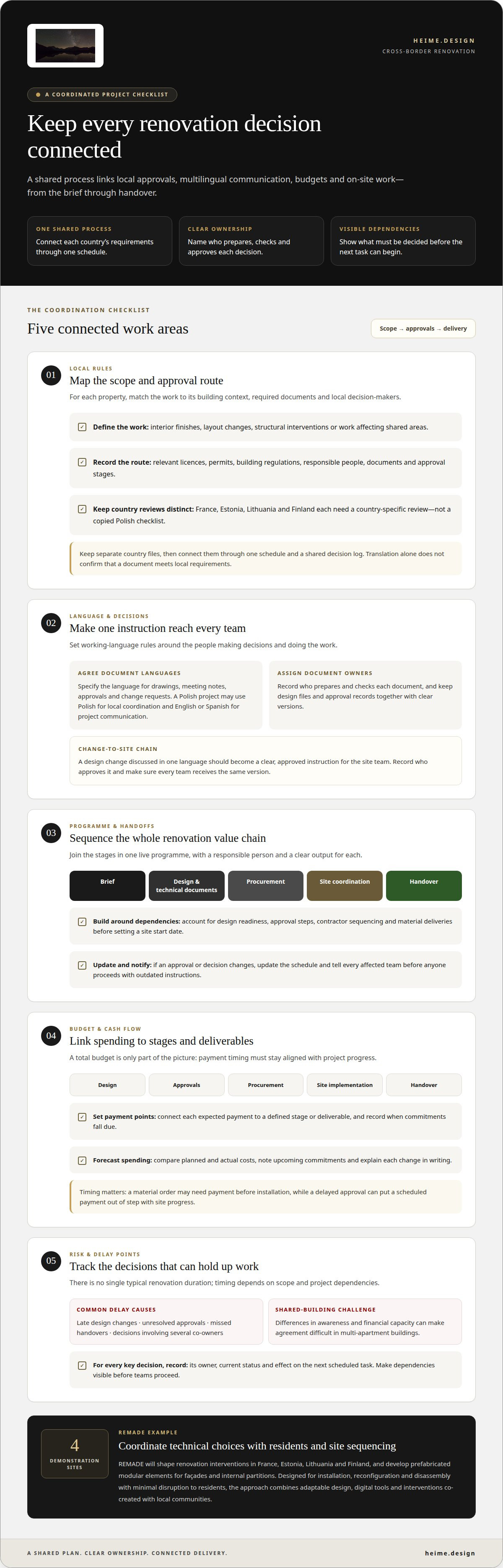
For a Polish renovation, first define the scope: interior finishes, layout changes, structural interventions or work affecting shared areas. Then map the licences, permits and building regulations relevant to that work and property. Record the responsible decision-makers, required documents and approval stages in one project plan so design, purchasing and site work follow the same sequence.
If proposed work affects a shared area, for example, add the relevant property decisions to the plan before scheduling that work. Keep design documents and approval records together, with clear versions for everyone coordinating the project.
Cross-Country Rules and Permit Requirements
France, Estonia, Lithuania and Finland each need a country-specific review, not a copied Polish checklist. For each property, compare the work scope, building context, approval route, required documents and local decision-makers. Keep the findings in separate country files, then connect them through one schedule and shared decision log.
This approach makes cooperation across languages easier. Translating a document does not establish that its content meets local requirements. Assign each approval step to a responsible person, record its status and note which design decision it depends on. Teams can then see cross-border dependencies clearly.
REMADE offers an example of coordinated renovation support. The project will shape interventions across four demonstration sites in France, Estonia, Lithuania and Finland, and develop prefabricated modular elements for façades and internal partitions. The elements are designed for installation, reconfiguration and disassembly with minimal disruption to residents.
REMADE also plans a neighbourhood-centred Renovation-as-a-Service model, combining adaptable, disassemblable design with digital tools and interventions co-created with local communities. For project teams, the lesson is to coordinate technical choices with resident needs, site sequencing and clear communication. Work in each country can meet local requirements while following a shared process for decisions, documents and progress updates.
Project management across the renovation value chain
Renovations move through connected decisions, from defining the brief to coordinating site work. A shared programme and clear framework help international teams track responsibilities, documents and approvals.
Language Support for Project Managers
Choose working languages based on the people making decisions and completing the work. A Polish project with international stakeholders may need Polish for local coordination and English or Spanish for project communication. Agree which language to use for drawings, meeting notes, approvals and change requests.
Record who prepares and checks each document. For example, a design change discussed in English should reach the Polish-speaking site team as a clear, approved instruction. This helps prevent teams from acting on different versions.
Finding and Verifying a Multilingual Manager
When evaluating a manager in Poland, compare their renovation experience with your project scope, then review a sample programme, decision log and progress report. Check that these documents show named responsibilities, document control, approval tracking and a clear process for resolving translation differences.
Ask for a worked example showing how a design change moves from discussion to site instruction. A useful explanation identifies who records and approves the decision, and how every team receives the same version. The European Commission advocates one-stop shops that oversee the whole renovation process as support structures.
Project Timelines and Delay Causes
There is no single typical duration for Polish renovations. Timing depends on the work scope, design readiness, approval steps, contractor sequencing and material deliveries. Build the programme around these dependencies instead of setting a site start date before earlier decisions are complete.
Common causes of delay include late design changes, unresolved approvals, missed handovers and decisions involving several co-owners. In multi-apartment buildings, differences in awareness and financial capacity can make agreement difficult. Track each decision, its owner and its effect on the next scheduled task.
Connect the brief, technical documents, procurement, site coordination and handover in one live programme. Assign a responsible person and a clear output to each stage. If an approval or decision changes, update the schedule and notify every affected team. This makes the consequences visible before anyone proceeds with outdated instructions.
Budgeting, cash flow and risk
Build the renovation budget around work packages, payment points and dependencies. For a Polish property, separate design, approvals, procurement, site implementation and handover. Link each expected payment to a defined stage or deliverable. This shows when funds are needed and which decisions could affect the schedule.
Cash flow depends on when commitments fall due, not just on the total budget. A material order may require payment before installation, for example, while a delayed approval can put a scheduled payment out of step with site progress. Maintain a forecast comparing planned and actual spending, recording upcoming commitments and explaining each change in writing.
Cross-border projects also need clear rules for currency and responsibility. Keep each project budget in its working currency, then record the conversion basis used for reporting in Poland. Assign someone to update the forecast when a supplier quote, design choice or programme changes. This creates a traceable view without mixing estimates with approved commitments.
REMADE will test circular business and financing models alongside renovation interventions, making it a useful example of linking financing decisions with implementation choices. If a project considers reusable façade or partition elements, assess procurement, installation, later reconfiguration and disassembly together. These choices affect more than the initial purchase, so record the assumptions behind each stage.
Track risks in a concise register. For each item, record its trigger, likely schedule or budget effect, responsible person and next action. Include approval dependencies involving authorities, supplier lead times, design changes and co-owner decisions. Regional support for energy renovation can also shape funding plans: the European Regional Development Fund and Cohesion Fund support regions developing such instruments. Treat potential support as a separate planning input, not as available cash, until its conditions and timing are incorporated.
Review the forecast at each project milestone. Compare actual progress with planned deliverables, update the cash-flow view and escalate changes before they affect the next payment or work package.
How do renovation rules and permit requirements differ across European countries?
There is no single permit checklist for every European renovation. In Poland and each other project country, first define the work, property type and building context. Then map the local approval route before finalising design decisions or site dates.
Compare countries by process, not by translating one permit form. For a Polish apartment and a property in France, Estonia, Lithuania or Finland, create a separate record of the authority or decision-maker, submission documents, language requirements and review sequence. The exact route depends on the work and property. A shared project schedule can show where local steps differ.
- Work scope: Separate finishes, layout changes and work affecting shared or structural elements.
- Decision route: Identify which local authority, property body or other decision-maker handles each approval.
- Documents: List required drawings, descriptions, signatures and translation needs for each location.
- Dependencies: Link each approval to the design, procurement or site task that follows it.
If a Polish design changes after documents are prepared, for example, record which drawings need revision and which scheduled decisions depend on them. Use the same change-control method in another country, while keeping that country’s approval file separate. A translated document is not automatically suitable for every jurisdiction.
Keep one comparison table for the whole portfolio, with a separate column for each country. Note the responsible person, document version, submission status and next action. In Poland, this makes local requirements visible alongside international planning without mixing separate approval processes.
For a cross-border project, coordinate renovation design and permits as connected workstreams. A clear record of local requirements helps align design decisions with the next project stage.
In Poland, the approval route depends on the work and property. Identify the relevant authority, property body or other decision-maker, and confirm the required drawings, descriptions, signatures, language requirements and review sequence. Distinguish between finishes, layout changes and work affecting shared or structural elements.
Heime.design: Luxury Interior Design & Project Management for international Clients
heime.design brings interior design and project management together for international renovation projects. Turn to the studio when a property needs a considered design direction and coordinated delivery, rather than separate decisions across design and renovation.
The studio offers bespoke interior design, renovation and project management, alongside interior architecture. Bringing these together can connect the project brief, design development and practical coordination in a more coherent process. For an international property owner, this creates one design-led framework for aligning decisions and the teams involved.
If your renovation needs this joined-up approach, visit heime.design to explore the studio’s work.
Shape the Next Stage of Your Renovation
Turn the project’s open decisions into a brief that teams can act on. Define the property goals, the people involved, design priorities and the decisions that need to come first. This gives each conversation a clear purpose and keeps the project direction visible as work develops.
A multilingual renovation project management approach in Europe can connect design intent with coordinated delivery. heime.design combines Luxury Interior Design & Project Management for international Clients with bespoke interior design, renovation and project management. Its luxury interior design work can help establish a clear vision from the outset.
Bring your project brief, priorities and questions into the next conversation. Contact heime.design about your project to explore a considered way forward. A well-defined starting point can make the next decisions clearer and give your renovation a confident direction.
Frequently Asked Questions
What services do multilingual renovation project managers in Europe provide?
The studio coordinates communication and delivery across the renovation team, adapting the process to the project scope. Typical tasks include organising design information, aligning contractor schedules, recording decisions, tracking changes and coordinating handover documents. For example, a manager can maintain one approved drawing set while sharing relevant instructions in the working languages. Agree the division of design, technical and site duties in the project brief.
How much does renovation project management cost in Poland and other European countries?
There is no single project management fee across Poland and Europe. The cost depends on the work scope, coordination required, project duration, documentation needs and whether site supervision is included. Cross-border work can also involve different currencies and country-specific processes. Compare proposals by deliverables and responsibilities, not just the headline fee, and document project budgets and payment schedules clearly in Polish złoty for Poland-based reporting.
How are renovation project managers, contractors, and property owners’ responsibilities divided?
The owner sets priorities, approves key decisions and authorises agreed spending. The project manager coordinates the plan, tracks actions and shares decisions with the relevant team. Contractors carry out assigned work and report progress or site issues through the agreed process. Put these boundaries in writing, including who can approve changes, record instructions and accept completed work. This reduces uncertainty when decisions affect several parties.
What are the steps for managing a renovation project in Poland from planning to handover?
First define the property goals and work scope. Then organise design information, identify decision-makers and establish the approval sequence. Prepare the budget and schedule around dependencies, then coordinate procurement and site activities against approved documents. Record changes as they arise. Before handover, gather completion records, outstanding actions and relevant project documents, then agree who receives each item. A written close-out list gives the owner and team a shared final reference.
What risks arise when coordinating multilingual renovation teams across Europe?
Key risks include inconsistent translations, teams using different document versions and decisions losing context as they pass between languages. A change agreed during a meeting, for example, may not reach a contractor in a usable written form. Use one decision record, identify the approved document version and assign responsibility for communicating each change. Track country-specific approval dependencies too, and make unresolved decisions visible before affected work proceeds.


