

A renovation in Poland becomes more manageable from abroad when a local project manager represents you on site and the contractor’s work is documented against agreed plans and milestones. Effective remote renovation oversight for international owners combines dated photos and video updates, written records of decisions, and a clear approval process for changes. A 20-25% contingency is recommended for overseas renovation projects, giving the budget room to absorb unforeseen work.
It’s reasonable to want your investment to feel more passive. But distance doesn’t remove the need for decisions; it makes clear roles, reliable reporting, and cost controls even more important. Without them, small changes can lead to unexpected expenses, and progress can be difficult to assess remotely.
This guide explains how digital records make progress visible, how to limit budget overruns, and how a local project manager differs from a general contractor. It also covers written responsibilities and milestone-based approvals that help you stay informed without managing every site detail yourself.
Key Takeaways
- Keep progress records tied to the approved plans, work stage, decisions, and follow-up so updates remain useful, not just visual.
- Set a written process for pricing and approving changes before work begins, and track commitments against the project budget.
- Choose a local representative whose role is clear and whose interests stay aligned with yours when coordinating contractors and site decisions.
- Define payment milestones, evidence of completed work, and responsibilities in the contract to make remote oversight more structured.
Digital project management and visual documentation tools
Remote oversight works when each update connects visible site conditions to a specific task, drawing, and decision. A photo of an unfinished wall means little on its own. Label it with the room, date, work stage, and relevant plan revision. Then compare it with the approved drawing before marking the task complete.
Use one shared project space for plans, progress records, questions, and approvals. Keep a consistent folder structure, such as “Kitchen / Electrical / Open items.” Give each drawing a revision label and archive replaced versions. This reduces the risk of a contractor following an outdated layout or an owner approving a change without understanding its cost or schedule impact.
- Progress photos: Capture the same viewpoint at each stage, such as before wall finishes, after installation, and after final inspection.
- Decision log: Record the question, options, decision-maker, approval date, and any effect on scope or timing.
- Issue register: Track each defect or incomplete task from first observation through correction and close-out.
- Payment evidence: Link each claimed milestone to dated images, inspection notes, and the relevant contract item.
International owners can navigate language barriers with Polish contractors through a bilingual project coordinator and written communication in a shared language. Use a short glossary for technical terms, then confirm important decisions in writing, ideally with an annotated drawing or photo.
Digital tools make it easier to follow the work, but they don’t replace direct observation. For concealed work, such as wiring before plastering, arrange a live walkthrough or independent site inspection before the area is closed. Record what was checked, who attended, what remains unresolved, and how follow-up was completed. This gives each update a clear purpose and creates a traceable project history.
Remote renovation costs and preventing budget overruns
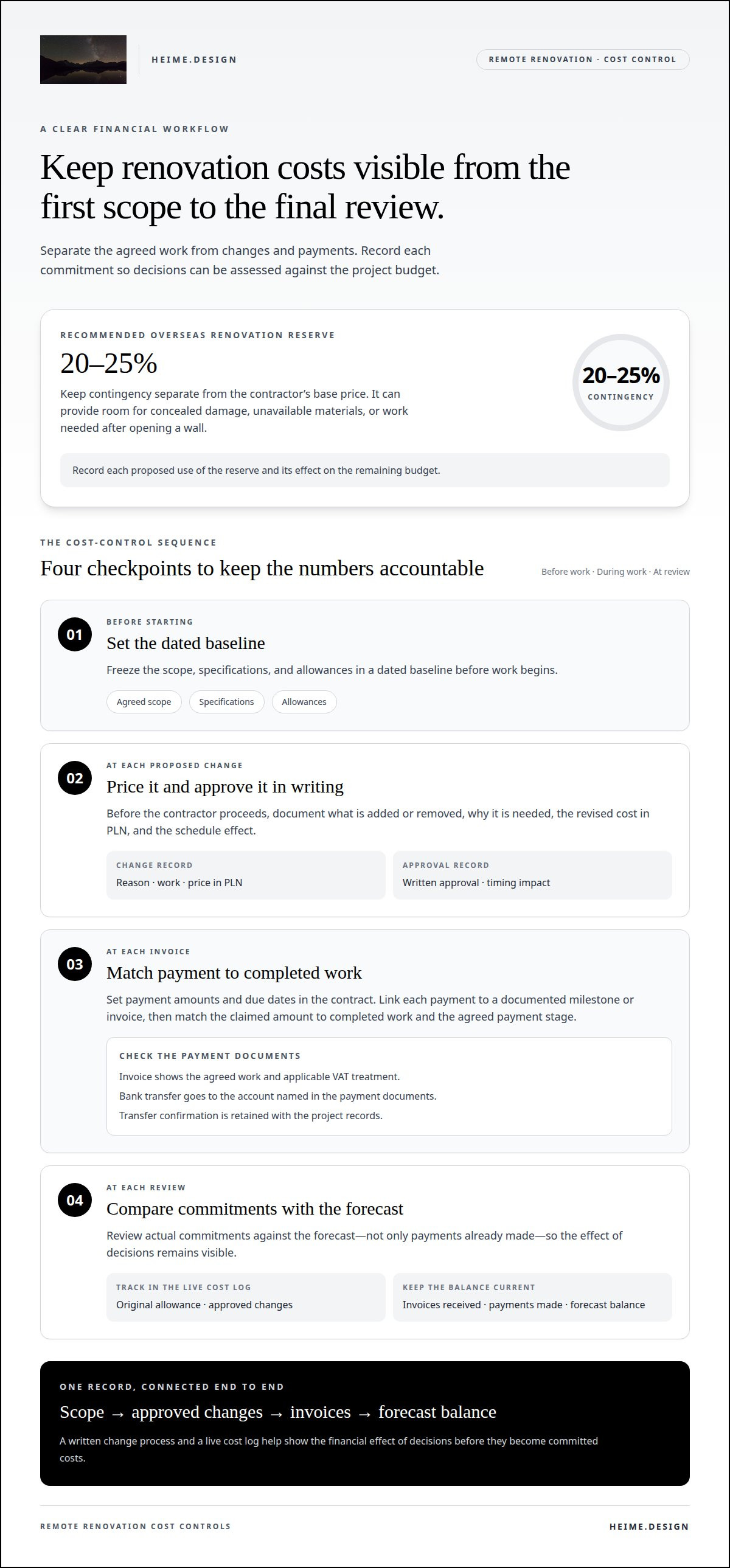
Start with a cost plan that separates agreed scope, provisional items, and owner-approved upgrades. For an overseas renovation, a 20-25% contingency budget is recommended. Keep it separate from the contractor’s base price. This reserve can cover concealed damage, unavailable materials, or work needed after opening a wall. Record each proposed use and its effect on the remaining budget.
Before work begins, establish a written change process. Each request should explain the reason, added or removed work, revised cost in PLN, and schedule impact. The owner should approve it in writing before the contractor proceeds. A live cost log should track the original allowance, approved changes, invoices received, payments made, and forecast balance.
For renovation payments in Poland, set amounts and due dates in the contract, and link each payment to a documented milestone or invoice. Ask for invoices that show the agreed work and applicable VAT treatment. Make bank transfers to the account named in the payment documents and retain the transfer confirmation.
Remote projects can face delays, cost overruns, and poor workmanship if hidden conditions, unclear approvals, or weak site checks go unnoticed. For example, a late decision on a replacement finish can delay ordering and disrupt the work sequence, while concealed installation defects may only become visible after finishing.
- Before starting: Freeze the scope, specifications, and allowances in a dated baseline.
- At each change: Log the price in PLN, supporting reason, approval, and schedule effect.
- At each invoice: Match the amount to completed work and the agreed payment stage.
- At each review: Compare actual commitments with the forecast, not just payments already made.
These controls help owners see the financial effect of decisions before they become committed costs. If design choices and construction coordination need to stay aligned, structured renovation planning can connect scope decisions with project oversight.
Selecting a local project manager or general contractor
For overseas projects, distinguish the person representing your interests from the company carrying out the work. Their written responsibilities should cover site decisions, quality checks, reporting, and approval limits.
Project Manager and Contractor Services
A project manager coordinates the renovation for the owner, while a general contractor organizes and delivers construction work. A site supervisor focuses on observing progress and workmanship against the agreed scope. Clear role boundaries matter: if an architectural package includes site visits, define those separately to avoid paying twice for the same visit.
Arrange an independent snagging inspection at key milestones and before handover. The inspector records incomplete or defective work, and the contractor’s corrections are documented before final acceptance.
In Poland, define who can instruct trades, approve variations, and confirm completed work. A manager receiving referral fees from contractors may face a conflict of interest, since their recommendations may not be solely owner-focused. Set out any referral arrangements and reporting duties in writing.
Protective Renovation Contract Terms
A protective renovation contract records the scope, materials, responsibilities, payment triggers, change process, inspection access, and handover documents. This gives international owners a clear basis for reviewing progress and resolving disagreements. It also distinguishes the contractor’s delivery duties from the manager’s coordination role.
Use milestone payments tied to evidence, not calendar dates alone. One suggested schedule is a 10% deposit, 25% upon permit approval and material delivery, then 20% at 25% completion after photo verification. It continues with 20% at 50% completion after a video walkthrough, 15% at 75% after third-party inspection, and a final 10% upon completion and client approval.
For each milestone, name the evidence required and the person authorized to approve payment. Include a defect list and correction process before handover. Keep the final inspection independent of the contractor’s own completion report.
Compare candidates by the work they will personally oversee, their reporting format, and how they handle language or professional misunderstandings. CORRECT Construct identifies these misunderstandings as a frequent source of property development and renovation problems. A written communication route, named decision-maker, and documented escalation process make projects easier to manage from abroad.
What should a renovation contract in Poland include to protect an international owner?
A clear contract turns a renovation plan into responsibilities, evidence, and decision rules. Attach the approved drawings, specifications, and finish schedule, identifying each document by title and revision. For example, name the kitchen plan and its current revision so the contractor and owner work from the same layout.
Define the contractor’s scope room by room. Describe materials by type or specification, and list exclusions such as furniture supply or appliance installation. State who coordinates trades, reports progress, and may approve changes. If the owner’s project manager can make site decisions, set limits on that authority in writing.
- Scope and documents: Attach drawings, specifications, material choices, and a list of excluded work.
- Changes: Require a written description of added or removed work, its price in PLN, and schedule effect before approval.
- Communication: Name the owner’s representative, the contractor’s contact, and the agreed route for notices and decisions.
- Close-out: Define the handover records, defect list, correction process, and completion approval.
State how invoices, payment evidence, and VAT treatment will be recorded. Tie each payment to a contract milestone and the evidence required to support it. A dated inspection report or accepted work record gives both parties a clearer basis for reviewing a claim.
Write site access and inspection arrangements into the contract. Independent third-party inspections at key milestones can support remote quality control. Also distinguish the architect’s duties from the project manager’s. Full-service architectural packages may include site visits, so unclear roles can lead to paying twice. Specify which visits belong to each role and what each report covers.
Use a handover checklist that names keys, manuals, warranties, as-built drawings, and unresolved defects. For a renovation with several trades, record who closes each item and how acceptance is documented. Plan your renovation project with coordinated design and project management for international ownership.
Heime.design: Luxury Interior Design & Project Management for international Clients
heime.design brings interior design and project management together for international renovation projects. It can be a natural next step when you need design decisions, technical coordination, and construction oversight to work as one process. Its bespoke interior design, renovation, and project management services can connect your intended result with the practical demands of delivery.
Consider this approach when planning a high-value renovation from abroad, seeking a coherent design direction, or wanting project responsibilities coordinated around your brief. Interior architecture can shape the space, while project management organizes the work around agreed plans and decisions. The right scope depends on your property, priorities, and project requirements.
Visit heime.design to discuss your renovation plans.
Shape the Next Stage of Your Renovation
A renovation managed from abroad works best when decisions follow a clear path from the owner’s priorities to the finished space. Set that direction before work gathers pace. This helps keep design choices, project responsibilities, and approvals aligned as the property takes shape.
For remote renovation oversight for international owners, the next step is to define the level of support your project needs. A focused design brief can clarify your priorities, where you need professional coordination, and which decisions you want to retain. This gives conversations with your project team a practical starting point.
heime.design works with international clients on design and renovation projects. If you’re ready to discuss your property and priorities, contact heime.design about your renovation.
With a clear direction in place, you can move forward with purpose and shape a space around how you want to live.
Frequently Asked Questions
How Can You Make an Overseas Investment More Passive?
Delegate routine site coordination while keeping major design, scope, and budget decisions with the owner. For example, a local representative can arrange access for trades and send a concise update when an issue needs your approval. Agree in advance which decisions they can make independently. This reduces day-to-day involvement without taking control away from you on choices that affect the property or investment.
Remote Overseas Property Management: What’s Important to Know After the Purchase?
Separate renovation oversight from ongoing property management once the work is complete. Renovation support focuses on delivering the agreed project; ongoing management concerns the property’s operation, maintenance, and readiness for its intended use. For property owners seeking examples of ongoing operational support, professional firms like morganpropertysolutions.com show how dedicated management handles routine maintenance and asset care once construction wraps up. Before handover, define who receives keys, manuals, and warranties, and who handles routine issues afterward. For a second home, a clear transition helps prevent unfinished project matters from becoming unclear operational tasks.
Who is this for?
Remote renovation oversight can suit international owners who cannot regularly visit a Polish property during construction. It can also help investors coordinate a refurbishment alongside other commitments. For buyers acquiring homes abroad through international agencies like Konradian, the arrangement is most useful when you need a local point of coordination but want to retain decisions about finishes, scope, and spending. A small, clearly defined project may require less coordination than a renovation involving several trades.
Why Choosing a Management Company Is Critical?
A dedicated management role gives the owner a clear route for site updates, decisions, and unresolved issues. Without that structure, a contractor may report progress while also assessing their own work, leaving the owner with limited independent oversight. Define who represents your interests, who delivers the construction, and who records outstanding items. For example, an independent inspection can assess completed work before a handover decision.
How does remote renovation oversight work for international property owners in Poland?
Remote renovation oversight for international owners connects site activity with decisions made from abroad. The local team shares evidence of progress, raises questions that affect scope, and records the owner’s responses. A useful routine might include a scheduled review of open decisions, upcoming work, and items needing attention. For example, an owner can approve a finish sample remotely before installation rather than deal with a mismatch after completion.
How much does remote renovation management cost in Poland in 2026?
The cost is based on the project scope and provided after a quote request. Key factors include property condition, design coordination, construction oversight, site inspections, and reporting needs. Keep management costs distinct from the contractor’s work, materials, and approved changes. Request a breakdown showing what each fee covers and how added tasks are handled, so you can compare the proposed scope with your renovation plan.


