

An elegant interior doesn’t automatically make a stronger rental investment. Turnkey interior design for luxury property investors makes financial sense only when the scope supports the rental strategy and the assumptions behind projected performance. A polished finish may attract attention, but rent, vacancy, operating costs and project spend determine whether that appeal translates into a return.
It’s reasonable to want a clear link between design decisions and rental results, especially when comparing a coordinated project with a more limited fit-out. This guide explains how to estimate potential returns without treating design claims as guarantees.
You’ll learn how to set a baseline using comparable rentals and operating assumptions, compare project scopes against the property’s intended use, and track measures such as achieved rent, time to let and ongoing costs after completion. Technical documentation and coordinated execution can make a project easier to assess, but its investment case still rests on measurable assumptions and results.
Key Takeaways
- Separate design quality from rental performance by judging each project against clear financial assumptions.
- Estimate ROI by defining a comparison period, setting a baseline, and comparing expected net gain with total project investment.
- Match full turnkey coordination, design documentation, or a limited refresh to the property’s rental strategy and your preferred level of involvement.
- Assess turnkey interior design for luxury property investors with conservative, expected, and optimistic scenarios, then track actual rental results against them.
- Use interior design, technical documentation, and coordinated project delivery to clarify scope and decisions without treating returns as guaranteed.
Why turnkey interior design ROI matters to luxury property investors
A well-designed property can feel considered and distinctive. That alone doesn’t show whether it performs well as a rental. Investors need both perspectives: design shapes the tenant or guest experience, while financial analysis tests whether the project supports the property’s investment objectives. For turnkey interior design for luxury property investors, the key question isn’t whether a finish looks premium, but whether the overall scope fits the rental plan.
Rental-property design ROI compares the financial outcomes associated with a design project against the full investment required to deliver it, over a defined period. It’s an estimate based on assumptions, not a promise of rent, occupancy or property appreciation. The broader Real Estate Investing overview also places property returns alongside valuation and risk considerations.
The result depends on the property’s intended use. A home planned for long-term tenants may need a different layout and level of furnishing from one intended for short stays. The target tenant, operating model and holding period all shape which outcomes matter. Assess each design decision against the chosen strategy, not a general idea of luxury.
What does ROI mean for a rental-property design project?
Project ROI focuses on the financial gain associated with a defined design project compared with its total investment. Rental yield usually compares rental income with a property’s value or cost, while cash-on-cash return compares annual cash flow with the investor’s cash invested. These measures answer different questions, and their results depend on the inputs and definitions used.
Don’t count design fees alone as the project investment. Include the relevant scope, such as documentation, renovation, furnishings and delivery costs, and account for project-related operating effects where applicable. State what’s included so you can compare options consistently.
Which investor assumptions shape the result?
Separate assumptions about the rental market from the project scope defined by the design team. That makes it easier to see whether a change in the estimate comes from rental expectations, the property plan or a design decision.
- Rental strategy: intended tenants, rental format and planned use of the property.
- Timeframe: expected holding period and the period used to assess project outcomes.
- Market evidence: comparable rental properties with a similar format and relevant location, supported by current, independent information.
- Design scope: the work, documentation and coordination required to prepare the property for its intended use.
For example, a furnishing choice may suit the target tenant, but its financial effect depends on assumptions about rent, vacancy and operating costs. Keep those assumptions visible rather than presenting them as design outcomes. A clear scope helps you compare turnkey interior design with a narrower fit-out on consistent terms, while recognizing that actual rental performance can differ from the estimate.
How to calculate interior design ROI for a rental property
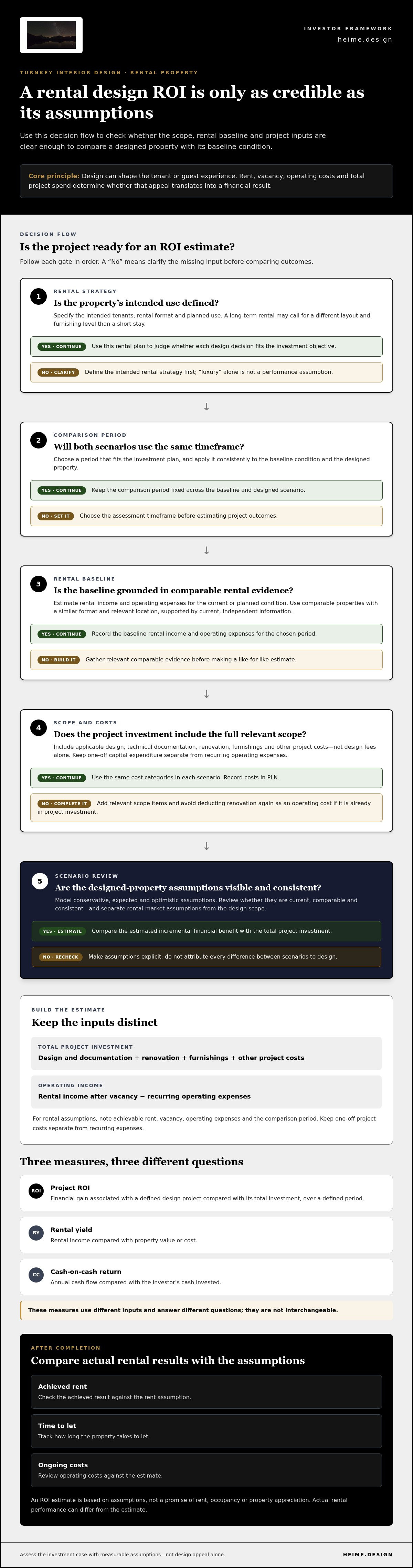
Use the same comparison period and assumptions for the property’s baseline condition and the designed scenario. This keeps the estimate useful. For turnkey interior design for luxury property investors, a simple framework can show what would need to change for the project to meet the investor’s objective.
- Set the comparison period. Choose a timeframe that fits the investment plan and apply it to both scenarios.
- Establish the baseline. Estimate rental income and operating expenses for the current or planned condition, using comparable evidence.
- Model scenarios. Record conservative, expected and optimistic assumptions for the designed property. Don’t attribute every difference to design.
- Review the inputs. Check that assumptions are current, comparable and consistent. Financing and policy conditions can also shape property returns; the National Bureau of Economic Research discusses these wider influences in Impact of Government on Real Estate Finance.
Estimated project ROI measures the incremental financial benefit of a design against its total project investment; rental yield measures rental income against property value, while cash-on-cash return measures cash flow against the investor’s cash invested. These measures use different inputs, so they aren’t interchangeable.
Which figures belong in the calculation?
Build a complete project investment figure, not a design-fee-only total. Include relevant design, technical documentation, renovation, furnishings and other scope items. Record costs in PLN and use the same treatment for each scenario. For rental assumptions, note achievable rent, vacancy, operating expenses and the comparison period.
- Project investment: [design and documentation] + [renovation] + [furnishings] + [other project costs]
- Operating income: [rental income after vacancy] − [recurring operating expenses]
Keep one-off capital expenditure separate from recurring expenses. If renovation is already included in total project investment, don’t deduct it again as an operating cost. This check helps prevent overstating the project’s financial effect.
How do you compare a baseline with a designed-property scenario?
Use evidence that matches the property’s rental format and relevant market. Then set out each scenario’s assumptions explicitly, including rent, vacancy and operating expenses. A difference in projected rent may reflect market conditions or the rental model, not design alone.
Calculate the operating-income difference for each period, then add those differences across the chosen timeframe. Use this formula:
Estimated ROI = ([cumulative incremental net operating income] − [total project investment]) ÷ [total project investment] × 100
Here, incremental net operating income is the designed scenario’s operating income minus the baseline’s, after recurring expenses but before deducting the project investment. Populate each bracket with your own figures. The result is an estimate, not a forecast or promise. A clearly documented scope, including turnkey project coordination, helps keep project inputs visible as the estimate develops.
How to compare turnkey design scope and investment trade-offs
Scope is an investment decision, not a measure of quality. The right fit depends on the property’s condition, rental plan, your available time and the assumptions behind the return estimate. Use this comparison to weigh the work involved against the intended use, without treating broader coordination as an automatic route to higher rent or occupancy.
| Scope | Investor involvement | Decision coordination | Documentation needs | Potential fit |
|---|---|---|---|---|
| Full turnkey coordination | Lower day-to-day involvement, with key decisions still requiring investor input | Design, project requirements, architects and contractors are coordinated | Technical documentation shaped around the agreed project scope | Complex renovation or fit-out, particularly when the investor wants coordinated delivery |
| Design-led documentation | Investor or appointed project team leads delivery decisions | Design direction is coordinated; execution requires separate management | Design and technical documents to guide the work | Projects with a capable delivery structure already in place |
| Limited refresh | Investor manages a focused intervention | Fewer design and delivery decisions, limited to the defined scope | Documentation focused on the refresh requirements | A property in suitable condition where targeted changes address the rental objective |
These are comparison categories, not guaranteed project outcomes. A full scope may clarify responsibilities across multiple decisions, but it doesn’t prove improved rental performance. A limited refresh may address a specific need, but could leave wider layout or technical issues unresolved. Assess tenant appeal separately from financial evidence. To test a claim, compare properties with a similar rental format and relevant features using current, independent market information. Track achieved rent, vacancy, time to let and operating expenses against the assumptions used in the estimate.
When might a more comprehensive scope fit the investment plan?
A coordinated scope may suit a project with connected design, technical and construction decisions, especially when you want less day-to-day involvement in delivery. Interior architecture, technical documentation and coordination across architects and contractors can make requirements and decisions more visible. You still define objectives and approve key choices. A wider scope supports a managed process, not a promise of rent, occupancy or resale value.
When might a narrower design scope be sufficient?
A focused refresh may fit when the property is in sound condition and the rental objective calls for limited changes. Compare the proposed work with the target tenant, rental format and operating requirements. A narrower scope can mean fewer decisions and less documentation, but may leave coordination or technical needs outside the project. Choose based on the property and stated assumptions, not on a presumption that more or less design always performs better.
How to test ROI assumptions and track rental-property performance
An ROI estimate is useful only if you can challenge its assumptions and revisit the results. For turnkey interior design for luxury property investors, a simple worksheet can connect the original plan to what the property actually delivers. Keep the record in one place, use PLN consistently, and label projections as scenarios rather than predictions or guarantees.
Set up the worksheet in this order:
- Record the baseline. Describe the property’s condition, rental format and current or planned performance before the design work. Note the period covered and the evidence behind each assumption.
- Define the scope. List the planned design, documentation, renovation, furnishings and other project items. Record later changes separately, with the reason and their effect on the project investment.
- Write down assumptions. Include expected rent, vacancy, operating expenses and the comparison period. Mark which inputs come from market evidence and which reflect the investor’s operating plan.
- Create three scenarios. Set out conservative, expected and optimistic versions of the assumptions. Don’t assign probabilities unless you have a sound basis for doing so.
- Log observed results. Once the property is operating, record actual income, vacancy, expenses and relevant maintenance alongside the original scenario.
This creates a clear trail from estimate to outcome. It can also help identify whether a difference came from the design scope, a change in project costs or a rental assumption that didn’t match actual conditions.
How can investors stress-test the estimate?
Change one assumption at a time. Test what happens if vacancy lasts longer, operating expenses are higher, project changes increase the investment, or achievable rent differs from the estimate. Then review a combined less favourable case. If the investment case depends on every assumption landing at its most favourable level, treat that as a risk to examine, not as a reliable forecast.
Keep the scenarios comparable. Adjust only the variable being tested, and record the source or reasoning for each change. This makes the effect easier to interpret and avoids presenting a scenario as a prediction.
What should investors measure after completion?
Track actual rental income, vacancy periods, operating expenses and relevant maintenance over time. Compare like with like: use the same time periods, rental format and expense categories as in the baseline. If the original comparison covered a particular operating period, use that same period when reviewing results rather than comparing a partial period with a full one.
Document material differences and their context. A change in rent may reflect market conditions or a change in rental strategy, while an expense increase may relate to operation or maintenance rather than design. Separate these factors before assessing the project’s contribution.
With heime.design’s turnkey interior design and project coordination, the project scope and decisions can be made clearer from the outset, giving investors a more structured basis for tracking assumptions and outcomes.
How heime.design connects turnkey interior design with investor objectives
For investors, design decisions are most useful when they serve a clear property objective. heime.design brings together interior design, interior architecture, technical design documentation and turnkey project coordination for residential and investment properties. Rental assumptions can help shape the brief, clarify priorities and define the work to be coordinated. They guide design decisions, but don’t guarantee rent, occupancy, appreciation or a particular return.
This is the role of turnkey interior design for luxury property investors: connecting the intended use of the asset with a defined design and delivery scope. For example, a brief for a furnished rental can identify the intended tenant, planned rental format and interior priorities. Those points can inform layouts, specifications and documentation. Coordination across architects, contractors and project requirements helps clarify decisions and responsibilities.
What does investor-aligned design coordination involve?
It starts with the investor’s objectives and the property’s current project stage. The design brief informs interior architecture; technical documentation sets out design requirements; and project coordination connects decisions across the people and work involved. This structure can help you understand what the agreed scope covers and who is responsible for decisions. It doesn’t replace an assessment of financial performance or guarantee delivery dates or outcomes.
heime.design focuses on design, documentation and coordination. Financial modelling, tax, legal and property-market advice are separate disciplines. Use appropriate independent expertise for those questions and keep the resulting assumptions distinct from design decisions.
For projects involving multiple countries, languages or teams, international project management for luxury interior design can help clarify the coordination context. Define the requirements and responsibilities for the specific property.
What information helps shape an initial project discussion?
A focused conversation can begin with the intended rental use and the project’s current stage. Share known constraints, desired scope and priorities that will guide design choices. You don’t need a finished ROI model; a clear outline of your objectives can help frame the design brief and identify which project decisions need coordination.
- Intended use: the rental format and the type of tenant the property is designed to serve.
- Project stage: whether the property is being planned, renovated or prepared for a defined fit-out.
- Known constraints: existing conditions, requirements or decisions that may affect the design scope.
- Investor priorities: your preferred level of involvement and the outcomes that matter most to the property plan.
If the asset is commercial, the commercial interior design investor guide offers a relevant perspective. For a residential investment, bring the rental strategy and property requirements into the discussion.
Turn your rental strategy into a clear design brief
Turn your ROI assumptions into decisions the project team can act on. Identify the outcomes that matter most, where uncertainty remains and what evidence you’ll use to review performance after completion. This gives design choices a clear purpose and makes it easier to revisit the plan if rental conditions or project requirements change.
For turnkey interior design for luxury property investors, a considered brief connects the property’s intended use with the scope of work without treating a forecast as a promise. It also creates a shared reference point for evaluating decisions as the project moves forward.
Bring your rental objectives, current project stage and priorities into a focused discussion with heime.design. Discuss your investment property and design objectives with heime.design to take the next step with a clearer direction for the property.
Frequently Asked Questions
Is turnkey interior design worth it for a luxury rental property?
It depends on the property, rental strategy, intended tenant and project scope. For turnkey interior design for luxury property investors, test whether the scope fits the asset and the operating plan. For example, a property with several connected renovation decisions may call for more coordination than one needing a focused update. Compare assumptions with relevant rental evidence, and treat the result as a scenario, not a promise of higher rent, occupancy or appreciation.
How do you calculate ROI on an interior design project for a rental property?
Compare the estimated net financial gain linked to the project with its total investment over a defined period. First, set a baseline using the property’s current or planned condition. Then model the designed scenario and record differences in income and expenses. Include relevant project inputs, and keep recurring costs such as maintenance separate from one-off work. Use comparable evidence for assumptions, avoid counting an expense twice, and label the result as an estimate.
What is the difference between rental yield and interior design ROI?
Rental yield relates rental income to property value or investment, according to the chosen method. Interior design ROI assesses the financial gain associated with a defined design project against that project’s investment. Cash-on-cash return instead uses the investor’s cash contribution as its basis. Before comparing figures, state whether income is gross or net and what the denominator includes. Without consistent definitions, two percentages can appear comparable while answering different questions.
Can turnkey interior design increase rental income?
It may support a property’s appeal to its intended tenant, but design alone can’t establish that rent will rise. Income also depends on market conditions, location, operating choices and tenant demand. Before changing a rent assumption, look for comparable properties with a similar rental format and relevant features. After letting, compare achieved rents and vacancy with the original assumptions. Interest in a listing or positive feedback isn’t the same as evidence of sustained rental performance.
How should investors compare full turnkey design with a limited refresh?
Compare each option with the property’s condition, target tenant, rental strategy, project complexity and your preferred level of involvement. Write down what each scope covers, who coordinates connected decisions and what documentation supports the work. A limited refresh may address a specific need, while a broader scope may suit a project with interdependent choices. Neither is automatically the better investment. The useful comparison is whether the scope matches the property plan and assumptions.
How long does it take to see a return on rental-property design?
There’s no universal payback timeframe. The estimate depends on project scope, the period the property isn’t earning rent during work, the holding period and actual income, vacancy and expenses once it operates. Choose a review period that fits the investment decision, then track results over comparable operating periods. A projected payback date should remain conditional on its assumptions. Don’t present it as a guaranteed timeline or promise of financial return.


