

What if the key to a successful renovation from abroad isn’t handing everything over, but knowing exactly how decisions are made? For overseas owners, distance can make it harder to coordinate designers, contractors, and suppliers, or to spot when site work no longer reflects the approved design. Turnkey interior solutions for overseas property buyers should bring clarity and control, not just fewer people to contact.
You still need a clear view of the work, the decisions ahead, and any issues that emerge. A well-defined scope connects design, technical documentation, and project coordination, while keeping you involved without requiring you to be on site. It should also show who prepares information, who recommends a response, and which decisions need your approval.
This 2026 guide explains what turnkey delivery can include, how to assess whether it fits your property, and what to look for in a project partner. You’ll also find a practical way to stay informed as the project progresses. heime.design brings interior design, technical documentation, site supervision, and project management together in a tailored scope. Its team works in English, Spanish, and Polish, supporting communication across borders.
Key Takeaways
- Turnkey interior solutions for overseas property buyers can bring separate project stages into a coordinated scope, with responsibilities tailored to the property.
- Map the journey from brief to handover so you know which decisions you’ll make and what information you’ll need at each stage.
- Compare turnkey coordination with separate design and contractor appointments by weighing accountability, communication, and design continuity against the trade-offs.
- Use a clear checklist to assess project scope, documentation, approvals, communication, and site coordination before committing.
- See how heime.design connects interior architecture, technical documentation, project management, and site supervision to support informed decisions from abroad.
Turnkey interior solutions for overseas property buyers: what they solve
When you own a property from abroad, small gaps in responsibility can quickly become difficult questions. The designer may set the direction, a contractor may interpret the drawings, and suppliers may need decisions before you can visit the site. Without clear roles and written approvals, it can be hard to see who is handling an issue, what has been decided, or what requires your input.
Turnkey interior solutions for overseas property buyers are coordinated services that connect agreed design, documentation, and project oversight so an owner can make informed decisions from a distance. The phrase takes its cue from the turnkey project model, where work is organized toward a ready-to-use result. In interiors, the precise stages and responsibilities depend on the project agreement.
What does turnkey interior delivery include?
A scope may begin with a brief, then move through an interior concept, technical design, coordination, and delivery oversight. Technical drawings and schedules translate design intent into information the project team can use. They can clarify layouts, finishes, lighting, and fittings, and help the people coordinating site work refer to the same approved decisions.
Design coordination and construction execution are different responsibilities. A studio may develop the design and coordinate the people involved, while a contractor carries out construction. Procurement, permits, installation, and direct construction management may also sit within the agreed scope, but shouldn’t be assumed. The agreement should state who prepares documents, coordinates trades, handles approval processes, and oversees delivery. Ask for each deliverable and responsibility to be described in practical terms, rather than relying on the word “turnkey.”
Why overseas owners value a coordinated approach
Living or working elsewhere can make it harder to align design decisions with technical input and site activity. A coordinated approach gives the project a structure: defined decision points, written approvals, and a consistent contact for questions and updates. A useful update should distinguish what is complete, what is in progress, what is blocked, and what decision is needed from you. That record helps you understand what has been decided and what information supports the next step.
Turnkey support isn’t meant to remove you from important choices. You remain involved in decisions that shape the property, from the design direction to key materials and finishes. The aim is to organize how those choices reach the project team and explain their practical implications, so distance doesn’t leave you guessing about what happens next.
How a turnkey interior project moves from brief to delivery
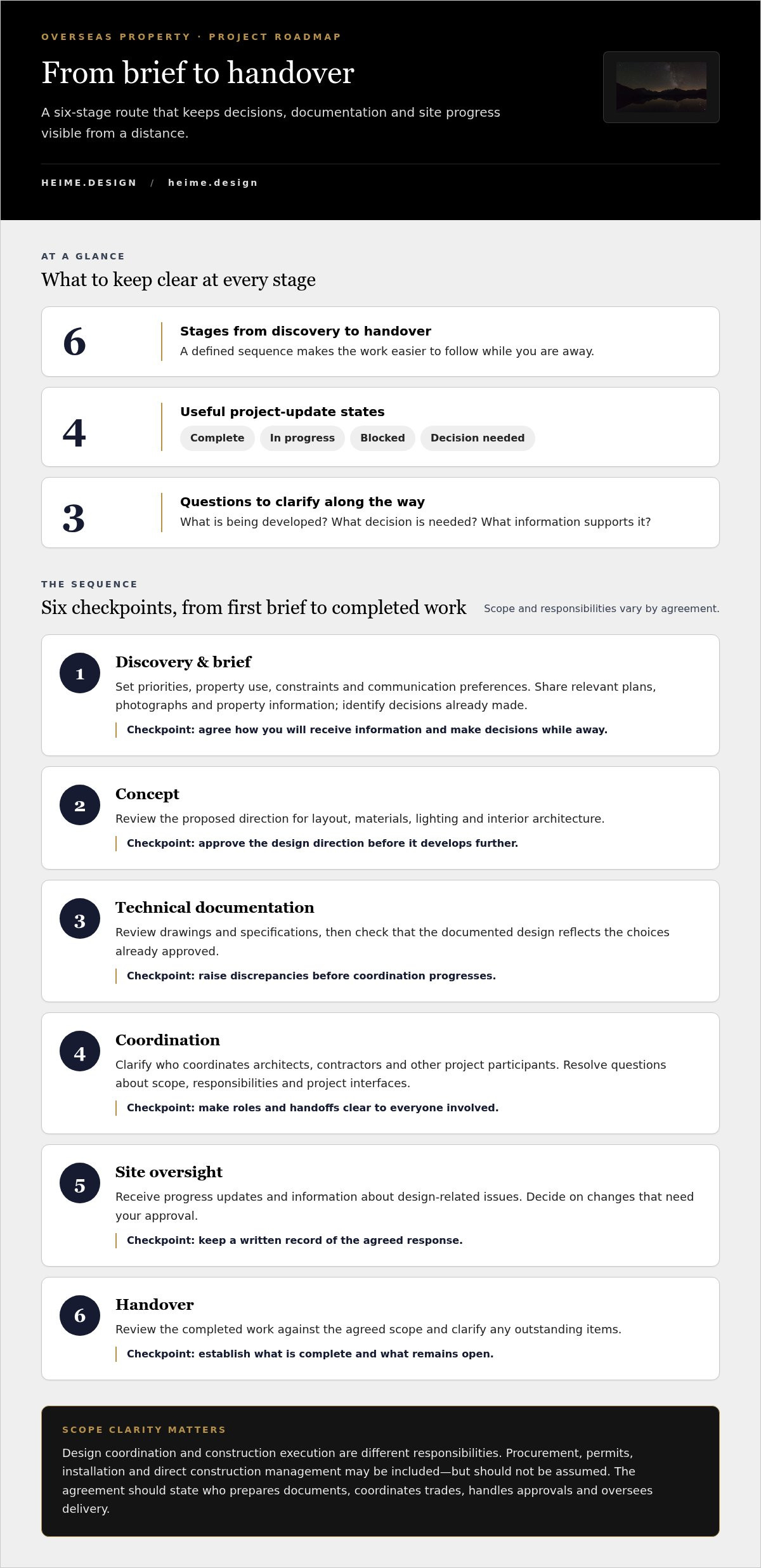
A clear sequence makes an overseas project easier to follow. At each stage, you should know what is being developed, what decisions are needed, and which information supports them. The precise scope varies, but the process often moves from discovery to design, documentation, coordination, site oversight, and handover. Agreeing on the approval points and the documents you’ll receive helps keep those stages visible.
- Discovery and brief: Set priorities, property use, constraints, and communication preferences. Share relevant plans, photographs, and property information, and identify decisions already made.
- Concept: Review the proposed direction for layout, materials, lighting, and interior architecture. Approve the design direction before it develops further.
- Technical documentation: Review drawings and specifications. Confirm that the documented design reflects the approved choices and raise any discrepancies before coordination progresses.
- Coordination: Clarify who coordinates architects, contractors, and other project participants. Resolve questions about scope, responsibilities, and project interfaces.
- Site oversight: Receive updates on progress and design-related issues. Decide on changes that need your approval and keep a written record of the agreed response.
- Handover: Review the completed work against the agreed scope and clarify any outstanding items.
From discovery to coordinated design documentation
The brief should cover how you plan to use the property, your priorities, existing conditions, and known constraints. It should also set out how you prefer to receive information and make decisions while away. For example, establish how design options and changes will be presented, and what supporting information you need to approve them. These details help the team ask for decisions in a useful order instead of sending requests without context.
As the concept develops, layouts, materials, lighting, and interior architecture form a coherent direction. Once approved, technical drawings and related documentation translate that intent into practical information for coordination. They can help align design choices with project discussions, but they don’t replace permits or approvals that may be required in the property’s jurisdiction. Design approval, local permit processes, and construction decisions are separate steps, with responsibilities defined for the specific project.
From coordination to site oversight and handover
Make roles explicit before work advances. The project agreement should identify who coordinates with architects and contractors, who handles jurisdiction-dependent permit processes, and who communicates design questions to you. Site supervision can help observe progress and report design-related issues. Agree on what it covers and how observations are reported, rather than assuming a universal inspection schedule.
At handover, review the work against the agreed scope and record any remaining decisions or items. A well-structured process supports your involvement without asking you to manage every conversation yourself. Explore turnkey interior design and project management as a connected approach to design, documentation, and coordination.
Turnkey versus separate design and contractor appointments: what changes?
For an overseas owner, the difference is how design and delivery responsibilities connect. With separate appointments, you engage the designer and contractor independently. With a turnkey arrangement, design and project coordination sit within one agreed scope, though construction execution may still be handled by a contractor.
Turnkey describes a coordinated scope, not an identical service package. The label alone doesn’t establish who is accountable for each task. Written responsibilities, exclusions, and the boundaries between the design team, contractor, and owner matter more.
| Area | Coordinated turnkey scope | Separate appointments |
|---|---|---|
| Accountability | Potential benefit: Design and coordination roles may be linked through one agreed scope. Trade-off: Responsibility still depends on what the agreement includes. | Potential benefit: Each appointment can define a distinct role. Trade-off: The owner may need to manage the interfaces between them. |
| Communication | Potential benefit: A consistent contact may help organize questions and approvals. Trade-off: The owner still needs visibility into decisions and issues. | Potential benefit: Direct contact with each professional. Trade-off: Information may need to be carried between parties. |
| Design continuity | Potential benefit: A shared brief can guide design and coordination. Trade-off: The team still needs clear approvals and change records. | Potential benefit: The owner can select separate specialists for each role. Trade-off: Design intent may need active coordination as work moves on site. |
Where an integrated scope can help an overseas buyer
Connecting design with project coordination can reduce the number of hand-offs between separate disciplines. For example, if a site question affects a specified finish, a coordinated process can connect the design decision with the people implementing it. A shared brief and documented approvals support continuity from concept to site. The benefit depends on the agreed scope, the project team, and how decisions are handled. When comparing proposals, look for a clear route from a site query to a recommendation, your approval where needed, and a recorded decision.
How buyers retain control over design and approvals
Coordination doesn’t mean giving up control. Define who prepares options, who recommends a response, and which changes require your approval. Record decisions in writing, including the approved design direction and any agreed changes. Keep major design, budget, and project decisions with the owner unless the agreement clearly assigns them elsewhere.
Before work begins, make the scope, responsibilities, exclusions, and change process clear. That framework helps turnkey interior solutions for overseas property buyers simplify coordination while keeping the owner informed and involved.
How to assess a turnkey interior solution before committing
A polished concept matters. So does the plan for carrying it through. For turnkey interior solutions for overseas property buyers, assess how the design, documentation, decisions, and site coordination fit together. A clear written scope helps you understand what is included, who is responsible, and how changes are handled. Compare proposals by matching each promised service to a specific deliverable, responsible person, and approval point.
Questions the scope and project plan should answer
Use the proposal and project plan to establish the working framework. They should make clear which design, technical documentation, coordination, and supervision tasks are included, and where responsibilities pass between the interior team, locally responsible architects, contractors, and the owner.
- Scope and deliverables: What design stages and documents are covered? Which procurement, construction, installation, or supervision tasks are included or excluded?
- Decisions and approvals: Who prepares options, who recommends a response, and which choices need your approval? How are approvals and changes recorded?
- Communication: Which channels are used, who is your main project contact, and how are decisions and emerging issues shared? Agree how you will receive updates and what requires a prompt decision.
- Local coordination: Where relevant, how does the project team coordinate with locally responsible architects or authorities on permit processes? The requirements depend on the project jurisdiction.
- Budget changes: How are changes to the agreed scope assessed, approved, and documented? A defined change process makes budget implications easier to track without assuming every detail can be fixed in advance.
Project-specific technical drawings, schedules, and written approvals can create a decision trail. From abroad, that record helps you follow how design choices translate into coordination and site discussions. It also makes it easier to see what is settled and what still needs your input. Keep the latest approved documents together so project participants can work from the same decisions.
Evidence that helps buyers make a considered choice
Review completed work that is relevant to your property and priorities. Look beyond finished photographs. Consider whether examples show a coherent path from the original design idea through technical detail to the completed space. Clear explanations of the working process and cross-border coordination can reveal how the team handles decisions, documentation, and project interfaces.
Awards, project counts, and strong imagery may offer context, but they don’t show on their own how responsibilities or approvals were managed. For a closer look at remote project coordination, read this guide to international project management for luxury interior design.
heime.design brings interior architecture, technical design documentation, project management, and site supervision into a scope tailored to the project. Explore heime.design’s interior design and project management services to consider how those elements can support your property transformation.
How heime.design supports overseas property buyers from first brief to project coordination
Once you understand what to look for in a project scope, the next step is finding an approach that suits your property and the level of support you need. heime.design works with international clients across Europe, connecting interior design and project management through a scope shaped around each project.
A connected design and coordination approach
The process can bring interior architecture, technical design documentation, project management, and site supervision into one coordinated brief. Design direction sets the intent. Technical documents help communicate that intent to the people involved in implementation. Project management and site supervision support coordination and help surface design-related questions as work progresses.
Responsibilities still depend on the agreed scope. Architects, contractors, and the project team may have distinct roles, and the arrangement can vary by property and location. heime.design works with the relevant project participants to connect design decisions with practical coordination, while keeping the owner involved in key choices. The aim is a clear path for decisions, not a hands-off process with no owner input.
Cross-border work also involves communication across languages and disciplines. heime.design’s team works in English, Spanish, and Polish, supporting conversations between overseas owners and project participants. For relevant projects in Spain, the studio coordinates with Spanish architects and authorities on licensing and permit processes. Requirements and responsibilities depend on the specific project and jurisdiction.
A clear next step for overseas buyers
To explore whether this approach fits, begin with the property context and what you want it to become. Share its intended use, your priorities, the stage the project has reached, and the level of coordination you’re looking for. These details give an initial conversation a practical focus: objectives, relevant project needs, and a suitable scope.
For buyers considering turnkey interior solutions for overseas property buyers, clarity starts before design work begins. A defined brief and tailored responsibilities help connect design, documentation, and coordination while preserving your role in important decisions.
If you’re planning a property transformation from abroad, discuss your project priorities and coordination needs with heime.design.
Bring your property plans into focus
A successful project from abroad depends on more than a cohesive design. It needs a clear scope, documented decisions, and defined responsibilities from the first brief through site coordination. Turnkey interior solutions for overseas property buyers can connect these elements while keeping you involved in the choices that matter.
HEIMÉ brings interior architecture, technical design documentation, project management, and site supervision together in a scope shaped around the property. The team works in English, Spanish, and Polish, supporting communication across borders. For relevant projects in Spain, HEIMÉ also coordinates with Spanish architects and authorities on permit processes, with responsibilities shaped by the project and its requirements.
Start with the essentials: how you plan to use the property, your priorities, and the stage you’ve reached. From there, you can explore an appropriate level of design and project coordination. Discuss your property and project goals with HEIMÉ. A clear first conversation can help turn distance into a well-structured way forward.
Frequently Asked Questions
What does a turnkey interior solution include for an overseas property buyer?
A turnkey interior solution can connect design, technical documentation, project coordination, and delivery oversight within an agreed scope. The exact work depends on the property and project agreement. Procurement, construction, permits, and installation may be included or handled separately. For overseas owners, the value is a clearer structure for responsibilities, decisions, and communication, while the owner remains involved in key approvals.
Can I manage an interior renovation remotely if I own property abroad?
Yes, a renovation can be coordinated while you’re abroad if roles, decision points, and communication are clearly established. Agree how you’ll review design options, approve changes, receive project information, and raise questions. Technical documentation and site supervision can support coordination and visibility, depending on the agreed scope. Remote management doesn’t remove the need for your input on important design, budget, and project decisions.
How does turnkey interior design differ from hiring an interior designer alone?
An interior designer alone may focus on the brief, concept, and design documentation. A turnkey scope can connect those services with project management, construction coordination, or site supervision. It doesn’t automatically mean one firm carries out every task. The agreement should explain who coordinates contractors, manages procurement, handles approvals, and oversees implementation. Compare the defined responsibilities, not just the service label.
How do overseas property buyers stay informed during an interior project?
Set an agreed communication approach before work begins. Clarify who your main contact is, which channels the team will use, how approvals are recorded, and how progress or design-related issues are shared. Keep a written record of decisions and changes alongside relevant drawings and project documents. This gives you a reference for what’s approved, what needs your input, and how the project team is responding.
Do overseas buyers need local architects for interior renovation permits?
Whether an architect or permit process is required depends on the project scope and the rules in the property’s jurisdiction. Interior design drawings don’t automatically replace local approvals. Identify which professionals and authorities are relevant to the proposed work, and define who coordinates with them. For relevant projects in Spain, HEIMÉ coordinates with Spanish architects and authorities on licensing and permit processes according to project requirements.
Is turnkey interior project management suitable for a property investment?
It can suit an investment property when coordinated design and delivery support match the project’s goals. Consider the intended use, target occupants, durability priorities, and the level of oversight you need from abroad. A defined scope can help connect design decisions with the project plan. It can’t guarantee rental demand, investment returns, or a specific completion outcome, so keep commercial assumptions separate from design and coordination decisions.
What should I prepare before discussing a turnkey interior project?
Prepare the property’s intended use, your priorities, its current project stage, and any known constraints. Existing plans, photographs, and available technical information can help explain the space. Note which decisions you’ve already made and what level of coordination you’re seeking. It’s also useful to outline your communication preferences and budget parameters, so the initial discussion can focus on objectives and a suitable project scope.


