

What if the biggest risk in an international design project isn’t the distance, but a decision that never reaches the right person? Cross-border architectural liaison services connect your design intent with local professionals, project requirements, and the decisions that move work forward.
For a project managed from another country, clarity about responsibilities matters as much as design quality. Who prepares each document? Who reviews it? Who makes the decision, and how will the rest of the team hear about it? Without agreed answers, separate conversations can leave people working from different assumptions.
This 2026 buyer’s guide explains what an architectural liaison does, what a useful scope should cover, and how to assess whether the support fits your project. It also shows how technical documentation, multilingual coordination, and project management can work together while keeping responsibilities clear. Approval requirements and regulated duties remain specific to the project’s jurisdiction. heime.design coordinates design documentation with Spanish architects and authorities, offering one example of how design-led liaison can connect an international client with a local team.
Key Takeaways
- Understand how cross-border architectural liaison services connect your design intent with the client, design team, and local project professionals.
- Map the scope from brief alignment to design coordination, communication, and technical documentation, while keeping approval responsibilities distinct.
- Compare working methods across scope, language coordination, documentation, local-team interfaces, and progress reporting.
- Define responsibilities and handoffs early to reduce duplicated work and gaps in remote project oversight.
- Prepare your project brief, available drawings, key decisions, and team contacts to make the first coordination discussion more focused.
What Do Cross-Border Architectural Liaison Services Do?
Cross-border architectural liaison services connect the client, design team, and local project professionals. The liaison helps carry design intent into project discussions, align information across teams, and clarify who needs to respond or act next. The goal is a shared, usable record of decisions and open questions, not another layer of messages to manage.
Depending on the agreed scope, liaison work can include coordinating communication across languages and time zones, organizing project information, and routing questions to the person who can answer them. Technical design documentation helps teams work from consistent information, but it does not secure approvals or replace documents required by local authorities.
Which project problems can an architectural liaison help solve?
Distance makes it harder to follow informal conversations and spot when a decision has lost context. Language differences can add another gap. A client may approve a feature based on its appearance, while the local team needs details such as dimensions, material choices, or how the feature relates to other project information.
For example, during a renovation, the design team may propose a revised room layout while local professionals assess existing conditions. A liaison can bring the client’s priorities and the team’s questions into the same discussion, record the points that need clarification, and assign each follow-up to a responsible person. This does not replace professional review. It makes handoffs visible and helps prevent a question from remaining unresolved because it reached the wrong person.
How does liaison differ from architecture and project management?
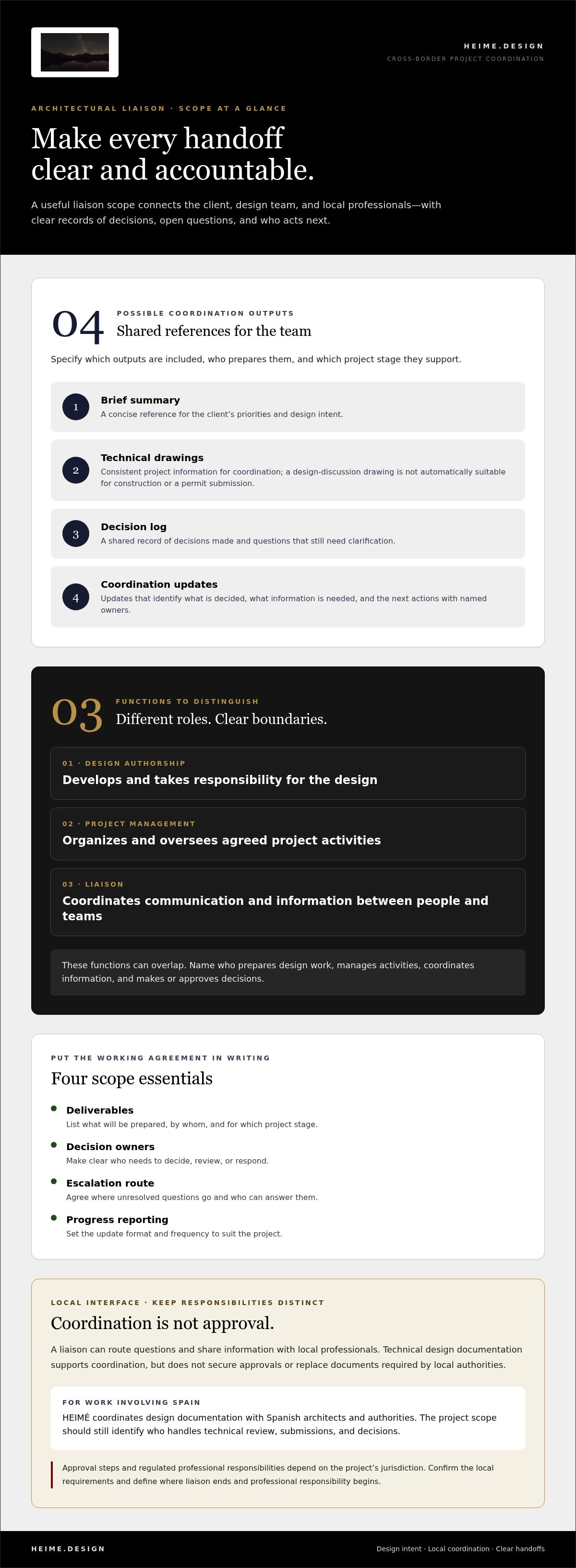
Design authorship concerns who develops and takes responsibility for the design. Project management organizes and oversees agreed project activities. Liaison focuses on communication and coordination between people and teams. These functions can overlap, so the scope should identify who prepares design work, manages project activities, coordinates information, and makes or approves decisions.
A liaison works alongside locally appointed professionals rather than automatically replacing them. In some jurisdictions, an Architect of Record has a formal role connected to project documents and local requirements. Titles and statutory responsibilities vary, so the term is not a universal definition of who can approve or sign documents.
For projects involving Spain, HEIMÉ coordinates design documentation with Spanish architects and authorities. The agreed scope should still make clear where liaison ends and where design, project management, or regulated professional responsibility begins. Defining those boundaries early helps the client understand who is responsible for each decision and handoff.
What should cross-border architectural liaison services include?
A useful scope explains how coordination will work from the initial brief through design development and ongoing project communication. Cross-border architectural liaison services can include aligning the client’s priorities with the design team, coordinating information with local professionals, recording open questions, and making decisions visible to the people responsible for acting on them.
Make the working arrangements specific. List the deliverables, decision owners, escalation route, and progress-reporting method. A useful update can separate decisions made, information still needed, and next actions with named owners. Agree on the format and frequency to suit the project instead of relying on a vague promise to “keep everyone informed.”
Which documents and coordination outputs should buyers expect?
Possible outputs include a concise brief summary, technical drawings, a decision log, and coordination updates. These give participants a shared reference and show what still needs attention. The scope should state which items will be prepared, by whom, and for which project stage. A drawing prepared for design discussion, for example, should not be assumed suitable for construction or a permit submission.
Technical design documentation supports coordination, but it does not replace approvals. The relevant professionals and authorities determine which documents are needed for a particular purpose. The AIA Global Practice Primer provides context on how legal, business, and project-delivery differences can shape international work. Use it as a reminder to define project-specific deliverables, not as a substitute for local review.
How do local architects and authorities fit into the process?
The liaison connects the client and design team with local professionals, helping route questions and share information needed for coordination. HEIMÉ coordinates design documentation with Spanish architects and authorities as part of its cross-border project work. The service scope should set out who handles technical review, submissions, and decisions, as well as where coordination begins and ends.
Approval steps and professional responsibilities depend on the jurisdiction. Review and describe them for the project’s location rather than assuming that one country’s process applies elsewhere. Clear interfaces help everyone understand what they provide and when another professional’s input is needed.
Before agreeing on a scope, gather the current brief, available drawings, project contacts, and key decisions already made. HEIMÉ’s international project coordination brings design documentation and communication together around the project’s agreed needs.
How can you compare cross-border architectural liaison providers?
Assess the working method, not just claims of international experience. Effective liaison connects design decisions to the people responsible for local delivery, then makes open questions, decisions, and next steps easy to track. Use the criteria below to judge whether the scope is practical and clear.
| Area | What a clear approach sets out | What to look for |
|---|---|---|
| Scope | Tasks included, exclusions, and interfaces with design and project management. | Named responsibilities rather than a broad promise to “coordinate everything.” |
| Communication | Working language, meeting or update rhythm, and how decisions are recorded. | A consistent process for sharing information across client and project teams. |
| Documentation | Which drawings, summaries, or coordination records are prepared and for what stage. | Clear distinctions between design coordination documents and material intended for approval or construction. |
| Local coordination | How the liaison works with locally appointed professionals and routes questions. | A defined connection between design intent and local project input. |
| Reporting | How progress, decisions, open items, and responsible people are reported. | Updates that show what needs attention and who owns the next action. |
Which scope and responsibility questions matter most?
For every key document and decision, establish who prepares it, who reviews it, who coordinates it, and who approves it. The scope should name decision-makers and explain how unresolved issues are escalated. Define site supervision separately, including its boundaries and relationship to other project roles. Coordination commitments are not the same as statutory professional duties, which depend on the jurisdiction.
How can you assess communication and cultural coordination?
Effective coordination is more than translating messages. It keeps the client’s priorities visible while explaining technical matters in language each participant can use. HEIMÉ’s multilingual team works in English, Spanish, and Polish, and coordinates design documentation with Spanish architects and authorities. The agreed scope connects this communication with the project’s specific responsibilities and handoffs.
Look for a process that produces records the team can act on. A decision log can state what was agreed, who owns the next action, and what remains open. A progress update can distinguish completed coordination from questions awaiting input. These practices give you a clearer basis for assessing a service than a general claim of global reach. In cross-border architectural liaison services, clear interfaces matter as much as familiarity with international projects.
Is a cross-border liaison an unnecessary extra layer?
It can be, if the role is poorly defined. When two people are expected to coordinate the same tasks, or nobody knows who owns a decision, another contact can add confusion. A clear scope prevents this by defining the liaison’s responsibilities, the limits of the role, and how it connects with project management and local professionals.
Remote oversight can leave the client relying on separate updates from designers, consultants, and local teams, each holding only part of the picture. A structured liaison role can create a coordinated communication path, preserve context, and make open decisions easier to track. These are potential coordination benefits, not guarantees of fewer delays or lower costs. The value depends on project complexity, language needs, and the number of participants.
When can a dedicated liaison make coordination clearer?
A liaison may help when a project brings together several disciplines, international decision-makers, or local processes that are unfamiliar to the client. The role connects discussions without taking over specialist duties. A decision record can state what was agreed, who owns the next action, and which questions remain open. That shared reference helps keep client priorities visible as work moves between participants.
For example, a design decision may need input from both the client and local professionals. The liaison can coordinate the information, identify what each person needs to respond, and clarify the next handoff. The relevant specialists still provide their own technical advice and carry the responsibilities defined for their roles.
When might another coordination role be unnecessary?
A straightforward project with an established, aligned team may need less liaison support. If communication is already clear and one person effectively coordinates information, a separate role could duplicate effort. Choose a scope proportionate to the work rather than assuming every project needs full-service coordination.
HEIMÉ tailors cross-border coordination to the project brief and team structure. The scope can show where liaison adds value, how it works alongside project management or site supervision, and which responsibilities remain with other participants. This makes the role easier to assess before work begins.
If you’re considering whether coordination support fits your project, explore HEIMÉ’s cross-border project coordination and see how it can align with your team and brief.
How do you start a cross-border architectural liaison engagement?
Start with the project facts, then shape the role around what the team needs. A clear brief helps establish whether cross-border architectural liaison services should focus on aligning priorities, coordinating design information, communicating with local professionals, or combining these tasks.
What should you prepare before the first project discussion?
Bring the information that explains the property, the goal, and the current state of the work. You don’t need a complete project pack to begin. A concise overview can identify missing information and help define what the initial scope should cover.
- Project basics: property objectives, project stage, and whether the work is a renovation, new construction, or interior fit-out.
- Existing information: available drawings, prior design decisions, and known site or project constraints.
- People and communication: decision-makers, languages used by the team, and local professional contacts.
- Open questions: current design, documentation, coordination, or approval-process questions that need direction.
What happens after scope and responsibilities are agreed?
The team aligns on the brief, communication channels, documentation, and interfaces between participants. The scope should state who owns decisions and deliverables, how updates are shared, and how unresolved questions reach the person responsible for addressing them. Local approval steps and professional responsibilities must be considered in relation to the project’s jurisdiction.
HEIMÉ brings interior design, technical documentation, and cross-border coordination together around the project brief. When the project calls for it, coordination connects the client and design team with local architects and other project participants. For a wider view of coordinated delivery, read the international project management guide. For Spain-specific licensing context, see the Spain architecture licensing guide.
With the project information in hand, discuss your priorities, team structure, and open questions, then define a liaison scope that fits the work. A clear starting point makes it easier to see who coordinates each handoff and how design intent stays connected to local delivery.
Bring Your International Project Into Clear Focus
A well-defined liaison role connects design intent with local project coordination. The right scope clarifies responsibilities, decision owners, documentation, and reporting, while leaving jurisdiction-specific professional duties with the appropriate local professionals. Cross-border architectural liaison services are most useful when the scope fits the project’s complexity, languages, and team structure.
HEIMÉ brings multilingual coordination in English, Spanish, and Polish together with technical design documentation and project coordination. Its work coordinating with Spanish architects and authorities shows how design-led support can connect an international client with local project participants.
Start with your project brief, available drawings, key contacts, and current questions. Then define coordination around the work ahead. Discuss your cross-border project with HEIMÉ to set a clear scope and connect your team.
Frequently Asked Questions
What are cross-border architectural liaison services?
Cross-border architectural liaison services coordinate communication and project information between an international client, the design team, and local project professionals. Depending on the agreed scope, this may include aligning the brief, coordinating technical documentation, tracking decisions, and supporting communication across languages. Liaison does not automatically replace architectural design, project management, or locally regulated professional responsibilities. Define the role for the project and jurisdiction so everyone understands its boundaries.
How is an architectural liaison different from a project manager?
An architectural liaison focuses on connecting design intent, client decisions, documentation, and local professionals across borders. A project manager may have a broader remit covering programme, resources, procurement, or delivery, depending on the contract. The roles can overlap, but they are not interchangeable by default. A clear scope should name each role, describe its responsibilities, and explain how participants coordinate. This helps prevent duplicated tasks and unclear ownership.
Do international renovation projects need a local architect?
Whether a local architect is needed depends on the project and its jurisdiction. Some work may require locally qualified professionals or particular approval processes; other tasks may have different requirements. A liaison can connect the client and design team with local architects and relevant authorities, but does not replace jurisdiction-specific professional advice. Before work proceeds, clarify who is responsible for design, review, submissions, and approvals within the project’s local framework.
Can architectural liaison services coordinate permit documentation?
They can support coordination around technical design documentation and communication with local architects or authorities when this falls within the agreed scope. Coordination is not a guarantee of approval, and it does not replace the professional responsible for permit submissions. Requirements vary by jurisdiction and project type. For Spanish projects, HEIMÉ coordinates with Spanish architects and authorities as part of its project support, helping connect design information with the local team.
What information should I prepare before hiring a cross-border liaison?
Start with the project’s country, type, objectives, current stage, and any available drawings or technical documents. Note who makes decisions, which languages the team uses, who the local project contacts are, and what questions remain open. This information helps shape a practical scope and clarify how the liaison will work with the design team and local professionals. You don’t need a finished brief; a clear outline of priorities is a useful start.
How do I know whether a liaison service is right for my project?
Consider whether distance, language differences, multiple participants, technical documentation, or unfamiliar local processes are making coordination harder. A defined liaison role can help maintain shared context and clarify who handles each decision. A small, straightforward project with an established, aligned team may need a lighter scope. Assess the responsibilities, communication process, and fit with your project rather than assuming every international project needs the same level of support.


