

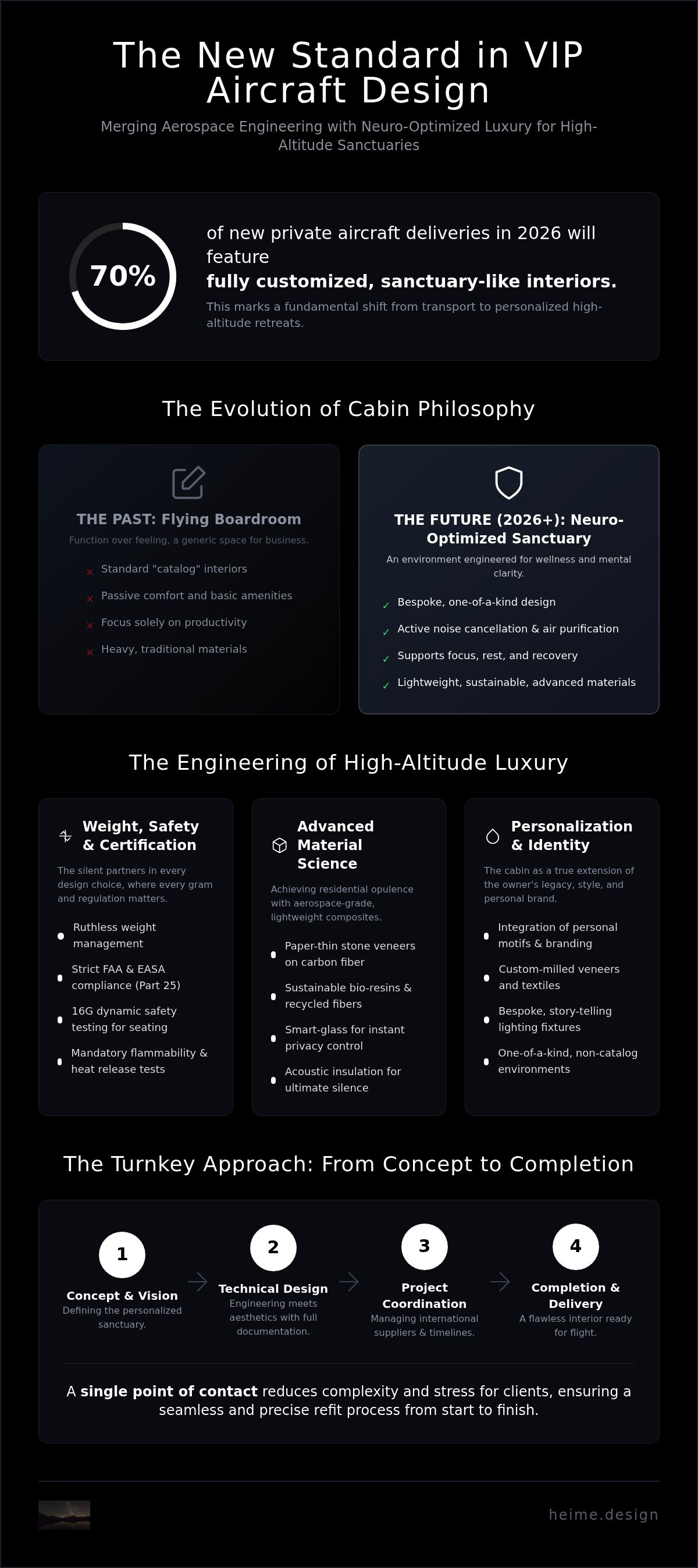
Over 70% of new private aircraft deliveries in 2026 will feature fully customized interiors, turning flight decks into personal sanctuaries. This shift highlights a new standard for VIP aircraft cabin design that goes beyond aesthetics. It's a technical challenge. You've likely felt the pressure of managing complex international project coordination while meeting strict FAA and EASA safety regulations. Balancing weight limits with high-end residential luxury is a delicate, necessary dance.
We'll show you how world-class VIP aircraft cabin design now merges aerospace engineering with neuro-optimized luxury. You'll discover how to achieve a bespoke environment that supports mental clarity and physical comfort during long-haul travel. This guide previews the future of turnkey management and neuroarchitecture. It provides a clear path to a cabin that functions as both a professional hub and a restful retreat. Every detail is intentional. We're moving toward a future where your space is as precise as the flight path itself.
Key Takeaways
- Learn why the shift toward neuro-optimized sanctuaries is redefining the standard for high-altitude wellness and mental clarity.
- Understand the technical balance required to meet FAA and EASA weight certifications without compromising on high-end residential aesthetics.
- Explore how modern VIP aircraft cabin design creates tailored environments for diverse needs, from mobile command centers to family-focused voyagers.
- Discover the benefits of a turnkey approach that manages international project coordination and technical documentation from concept to completion.
- See how minimalist precision and a single point of contact reduce stress for UHNW clients during complex aviation refits.
The Evolution of VIP Aircraft Cabin Design: 2026 Standards
VIP aircraft cabin design is no longer just about leather seats and polished wood. In 2026, it represents the precise intersection of aerospace certification and bespoke luxury. We've seen a clear shift. The "flying boardroom" is fading. In its place, owners demand neuro-optimized sanctuaries. These spaces prioritize mental clarity and physical recovery. It's about how the environment affects the brain during long-haul travel. Modern designers now focus on how light, sound, and air quality interact to reduce fatigue.
Modern standards require a sophisticated balance. Sustainability is a core requirement for 2026. We use materials like bio-resins and recycled carbon fiber that reduce weight and environmental impact without sacrificing opulence. Owners also need dual-purpose zones. A single area must transition seamlessly from a high-focus workspace to a deep-rest lounge. This requires intelligent lighting and adaptive furniture. Understanding aircraft cabin basics is the first step in appreciating these technical layers. It isn't just about the layout. It's about how every component meets safety standards while maintaining a residential feel.
From Transport to High-Altitude Sanctuary
UHNW clients now view their aircraft as extensions of their legacy estates. They expect the same level of comfort and privacy found in their primary residences. Acoustic engineering plays a massive role here. Silence is the ultimate luxury. We design to eliminate the hum of the engines and the vibration of the fuselage through advanced insulation and active noise cancellation. An Aviation Sanctuary is a space where environmental stressors are neutralized through design. It's a place to recharge, not just a way to get from A to B. We use soft, organic curves and natural textures to ground the passenger.
The Role of Personal Identity in Aviation
The era of the "catalog" interior is over. Today's projects focus on one-of-a-kind environments. We integrate personal motifs and graphic branding directly into the cabin surfaces. This isn't just about a logo on a headrest. It's about custom veneers, unique textiles, and bespoke lighting fixtures that tell a story. The cabin should reflect the owner's residential style perfectly. Every surface is an opportunity for expression. We manage the technical documentation needed to ensure these bespoke elements meet flammability and impact standards. When you step on board, you should feel at home, even at 40,000 feet. It's personal, precise, and entirely unique.
The Engineering of Luxury: Weight, Safety, and Certification
Engineering luxury is a game of grams. At 40,000 feet, every choice has a physical consequence. High-end VIP aircraft cabin design is not just about aesthetics. It's about meeting ruthless weight limits without losing the residential feel. We don't just select materials for their beauty. We select them for their airworthiness. Heavy materials like solid marble or thick hardwoods are replaced with advanced composites. This ensures the aircraft maintains its range and fuel efficiency while looking impeccable.
Safety is the silent partner in every design. FAA and EASA regulations, specifically 14 CFR Part 25 and CS-25, dictate every inch of the interior. Every textile, leather, and veneer must pass strict flammability and heat release tests. You can't simply install a residential silk on a bulkhead. It must be treated and certified to ensure it won't contribute to a cabin fire. Technical documentation is the most critical part of this phase. It bridges the gap between a creative vision and a flyable reality. If you're ready to start your journey, our team provides the technical design documentation needed to navigate these complexities.
Advanced Material Science in the Cabin
In 2026, we use carbon fiber cores to support paper-thin stone veneers. This creates the look of solid granite at a fraction of the weight. We also prioritize sustainable bio-materials that meet aerospace standards. Smart-glass technology is another essential. It allows for instant window dimming and privacy without the weight of mechanical shades. These trends in private jet interiors show a clear move toward lightweight, high-performance luxury that respects the environment.
Seating Engineering and Ergonomics
Seating goes far beyond the "lie-flat" promise. Every bespoke chair must undergo 16G dynamic safety testing to protect passengers during turbulence or impact. We focus on ergonomic design that provides pressure point relief for flights lasting over twelve hours. It's about physical longevity. Achieving this level of comfort while meeting safety codes is the hallmark of bespoke aircraft interior design. We balance soft-touch leathers with rigid internal structures. The result is a seat that feels like a lounge chair but performs like a safety device.
VIP Cabin Archetypes: Commercial Examples and Concepts
Successful VIP aircraft cabin design starts with a clear mission profile. You don't just build a cabin; you build a tool for your lifestyle. Narrow-body aircraft, like the Gulfstream G700, require precise zoning to prevent the space from feeling cramped. Wide-body platforms, such as the Airbus ACJ320neo, allow for the luxury of residential-scale rooms. We also see the rise of the 'Explorer' concept. These designs support long-range, multi-stop missions where the cabin acts as a self-sustaining base in remote areas. It's about resilience and refined comfort.
| Feature | Mobile Command Center | Wellness Retreat | Family Voyager |
|---|---|---|---|
| Connectivity | High-Speed Satcom | Low-EMF Zones | Multi-User Streaming |
| Sleeping | 2-4 (Daybeds) | 2 (Master Suite) | 6+ (Bunks/Suites) |
| Wellness Tech | Blue Light Filters | Circadian Lighting | Air Purification |
The Mobile Command Center: Business Efficiency
This archetype is for the executive who can't afford a second of downtime. We focus on high-speed connectivity and integrated conference tech that feels invisible until it's needed. Discreet storage for sensitive documents and secure communication hubs are standard. The layout prioritizes acoustics to ensure private conversations stay private. You'll find the 'Ultimate Office' concept detailed in our VIP aircraft cabin examples. It's a space designed for high-stakes decision-making at 40,000 feet.
The Wellness Retreat: Neuro-Optimized Luxury
Modern owners are moving away from traditional luxury tropes. They want environments that actively improve their health. We use circadian lighting to combat jet lag by mimicking natural sunlight patterns. Biophilic design is also key. We incorporate natural textures and patterns that lower cortisol levels. These private jet cabin design trends represent a shift toward neuro-optimized luxury. As noted in recent discussions on the future of private jet interiors, customization is now about creating meaningful, personalized spaces that support the passenger's biological needs.
The Family Voyager archetype serves a different purpose. It prioritizes flexible social spaces and durable materials that withstand high-traffic use by children and staff. Sleeping capacity is higher, often utilizing creative bunk solutions or convertible lounges. Whether you choose a narrow-body for speed or a wide-body for space, the archetype defines the floor plan. Every square inch must serve the mission.
Managing the Completion Process: A Turnkey Approach
Executing a VIP aircraft cabin design is a logistical marathon. The design is only as good as its execution. A turnkey approach ensures that the initial creative vision survives the rigorous technical requirements of the completion center. We manage this through a structured five-step process. This roadmap eliminates ambiguity and keeps the project on schedule.
- Step 1: Mission Profile and Preliminary Design Concept. We define how the aircraft will be used and establish the aesthetic direction.
- Step 2: Technical Engineering and Specification Documentation. This is the "blueprint" phase where every material and component is checked for airworthiness.
- Step 3: Material Sourcing and Vendor Coordination. We manage the procurement of certified luxury materials from global suppliers.
- Step 4: Site Supervision during the Completion or Refit. Our team stays on the ground at the completion center to oversee every detail of the installation.
- Step 5: Final Certification and Delivery. We ensure all EASA/FAA paperwork is in order for a seamless handover.
Managing these stages requires constant communication. We act as the single point of contact between the owner and the completion center. This reduces the burden on the client. If you are planning a new completion or a refit, our team provides Turnkey Interior Design services to ensure your vision reaches the runway without compromise.
International Project Management for Aviation
International coordination is essential for modern aviation projects. We often bridge the gap between UHNW expectations and technical aviation realities across different time zones. A project might involve a designer in Spain, an engineering team in Germany, and a completion center in the United States. Our international project management expertise ensures cross-border compliance and maintains a unified design language throughout the process. We speak the language of both the client and the engineer.
Refits and Renewals: Extending Aircraft Life
A cabin refit is a strategic investment. It allows owners to update legacy aircraft with 2026 technology and neuro-optimized interiors without the lead time of a new purchase. The economic and aesthetic benefits are significant. We treat these projects with the same logistical complexity as luxury yacht interior refits. Both require precise site supervision and a deep understanding of weight distribution. By renewing the interior, you extend the aircraft's operational life while significantly increasing its resale value. The hull remains the same, but the experience is entirely new.
Heime Design: Orchestrating High-Altitude Excellence
Heime Design operates at the intersection of minimalist precision and technical aviation expertise. We don't just design; we orchestrate. Our studio provides a single point of contact for international UHNW clients. This structure removes the friction typically found in VIP aircraft cabin design. It ensures that your vision is never lost between the engineer and the artisan. We prioritize clarity and intentionality in every project. Every decision is measured for its impact on both style and performance. We focus on high-quality output and streamlined processes.
Our extensive residential portfolio allows us to create more comfortable, "human" aircraft interiors. We understand how people live in their homes and translate that experience into the sky. It's about more than luxury; it's about life. We design for value preservation and generational legacy. A well-executed interior is a tangible asset. It maintains its relevance and worth over time. We ensure that every material choice and layout configuration serves the long-term value of your aircraft. Your cabin should be as enduring as your estate.
Cross-Pollination: From Legacy Estates to the Sky
Neuroarchitecture isn't just for villas. We apply these principles to the cabin to neutralize the stressors of flight. By using natural patterns and specific lighting, we ensure a seamless aesthetic transition from the home to the private jet. The cabin becomes a "living" environment. It's designed to evolve as your needs change. This consistency between your estate and your aircraft provides a profound sense of continuity. We use technical design documentation to ensure these residential-inspired elements meet every safety code. The result is a space that supports your mental clarity and physical comfort during long-haul travel.
Start Your Aviation Design Journey
Timing is everything. Early-stage consultation during the acquisition process prevents costly design revisions later. We coordinate directly with Spanish and international architects for holistic project management. This collaborative approach ensures that the architecture of the aircraft aligns with your global property portfolio. We manage the technical drawings for documentation and site supervision. This allows you to focus on your mission while we handle the technical complexity of the build. Whether you're planning a new completion or a refit, we provide the technical expertise to make it happen. Reach out to us for a private consultation on your next aviation or marine project.
Shaping Your High-Altitude Legacy
The standard for private aviation has shifted. It's no longer enough to offer luxury; the cabin must now actively support your well-being. Modern VIP aircraft cabin design represents the perfect alignment of neuroarchitecture and aerospace engineering. You've seen how technical documentation and weight certification form the backbone of a successful interior. These elements ensure your sanctuary is as safe as it is beautiful. A turnkey approach manages this complexity, allowing you to focus on your mission while we handle the global coordination.
We're here to bridge the gap between residential comfort and technical reality. Our team acts as your single point of contact, ensuring every detail reflects your personal identity and legacy. Whether you're planning a new completion or a strategic refit, the goal is clarity and precision. Discover our specialized aviation and marine design services at HEIMÉ. We're ready to help you orchestrate your next high-altitude sanctuary. Your journey toward a more intentional, restorative flight experience starts here.
Frequently Asked Questions
What is the typical timeline for a VIP aircraft cabin completion?
A full VIP aircraft cabin completion typically spans 12 to 24 months, depending on the airframe size and customization level. Initial design and engineering documentation take several months before the aircraft even enters the hangar. Refits are significantly faster, often finishing in 4 to 9 months. These timelines ensure every bespoke component meets rigorous safety standards and certification requirements before the first flight.
How do weight restrictions impact the choice of luxury materials like marble or wood?
Weight restrictions are the most significant constraint in VIP aircraft cabin design. We don't use solid slabs of stone or heavy timber. Instead, we apply paper-thin veneers of marble or wood over lightweight honeycomb or carbon fiber cores. This approach achieves the desired residential aesthetic without compromising the aircraft's range or fuel efficiency. Every gram is calculated to balance opulence with aerospace performance.
What is neuroarchitecture, and how is it applied to private jet interiors?
Neuroarchitecture is the study of how the built environment impacts the human brain and nervous system. In private aviation, we apply these principles to neutralize flight stressors like cabin pressure, vibration, and artificial light. We use specific textures, organic shapes, and circadian lighting to lower cortisol levels. This creates an environment that actively promotes mental clarity and physical recovery during long-distance travel.
Can an existing aircraft cabin be refitted to include 2026 wellness technology?
Yes, existing aircraft can be refitted with 2026 wellness technology during a scheduled maintenance interval. We can integrate advanced air purification systems, circadian lighting, and noise-reduction materials into legacy airframes. This process extends the aircraft's life and improves the passenger experience. It's a strategic way to bring older jets up to modern neuro-optimized standards without the lead time of a new purchase.
What are the primary differences between narrow-body and wide-body VIP designs?
The primary difference lies in zoning and floor plan flexibility. Narrow-body designs focus on maximizing every square inch through multi-purpose furniture and clever storage. Wide-body aircraft allow for true residential-scale rooms, including master suites with full showers and dedicated dining areas. While narrow-body jets prioritize speed and efficiency, wide-body completions offer the space for complex archetypes like family voyagers or mobile command centers.
How does Heime coordinate projects with international completion centers?
We act as the single point of contact between the owner and global completion centers. Our team manages the technical design documentation and site supervision across borders, whether the project is in Europe or the United States. We coordinate with engineers, vendors, and regulatory bodies to ensure the design remains consistent. This turnkey approach reduces client stress and ensures compliance with both FAA and EASA standards.
Are there specific safety certifications required for bespoke furniture in a jet?
Bespoke furniture must meet strict 16G dynamic safety testing and flammability standards. Every seat, table, and cabinet undergoes rigorous evaluation to ensure it won't fail during turbulence or impact. Materials like leathers and textiles must be certified fire-retardant. We manage the documentation required for these certifications, ensuring that your custom interior is both legally compliant and physically safe at 40,000 feet.
What are the most popular cabin layout trends for 2026?
The most popular trends for 2026 include fully enclosed privacy suites and multi-purpose "adaptive" zones. Owners are moving away from open-plan cabins in favor of dedicated spaces for deep rest and high-focus work. We're seeing a rise in biophilic elements and integrated wellness tech that feels invisible. These layouts prioritize the passenger's biological needs, creating a more personalized and restorative flight experience than traditional designs.


