

The most valuable luxury on a sailing yacht isn't the rare veneer. It's the invisible volume created by precision engineering. Many owners find that even expensive vessels feel cramped once the sails are up and the heeling begins. You've likely experienced the friction of a beautiful cabin that lacks intuitive flow or a saloon where technical requirements clutter the aesthetic. It's a common struggle to balance high-performance naval architecture with high-end comfort. Mastering sailing yacht interior spatial planning is the only way to resolve these tensions while maintaining maritime performance.
This guide demonstrates how precision spatial planning and neuroarchitecture transform limited volumes into expansive living spaces. You'll discover how to make your vessel feel larger than its length overall. We'll preview the 2026 trends in maritime ergonomics, including weight-neutral composites and evidence-based design that prioritizes your cognitive comfort. From acoustic thresholds to smart technology, learn how to design an interior that performs as well as the hull beneath it. The result is a seamless integration of luxury materials and technical precision tailored for the modern mariner.
Key Takeaways
- Learn to balance weight-neutral materials with luxury finishes to maintain vessel performance without sacrificing aesthetic quality.
- Discover how modern sailing yacht interior spatial planning uses the "moving horizon" concept to optimize safety and comfort during active sailing.
- Explore neuroarchitecture techniques that visually expand cramped cabins and enhance cognitive comfort while at sea.
- Evaluate the financial feasibility of structural layout changes versus cosmetic updates for your next major winter refit.
- Understand how precise technical design documentation ensures seamless coordination between naval architects and international fit-out teams.
The Fundamental Constraints of Sailing Yacht Interior Spatial Planning
Designing for the sea is fundamentally different from designing for land. On a yacht, every centimeter must justify its existence. Success in sailing yacht interior spatial planning requires a delicate balance between luxury volume, structural weight, and human ergonomics. While residential design focuses on static comfort, maritime interiors must evolve into floating legacy estates that maintain their poise in high seas. This evolution requires a shift from purely decorative thinking to a mindset that respects the physical realities of a vessel in motion.
Volume vs. Mass: The Maritime Designer's Dilemma
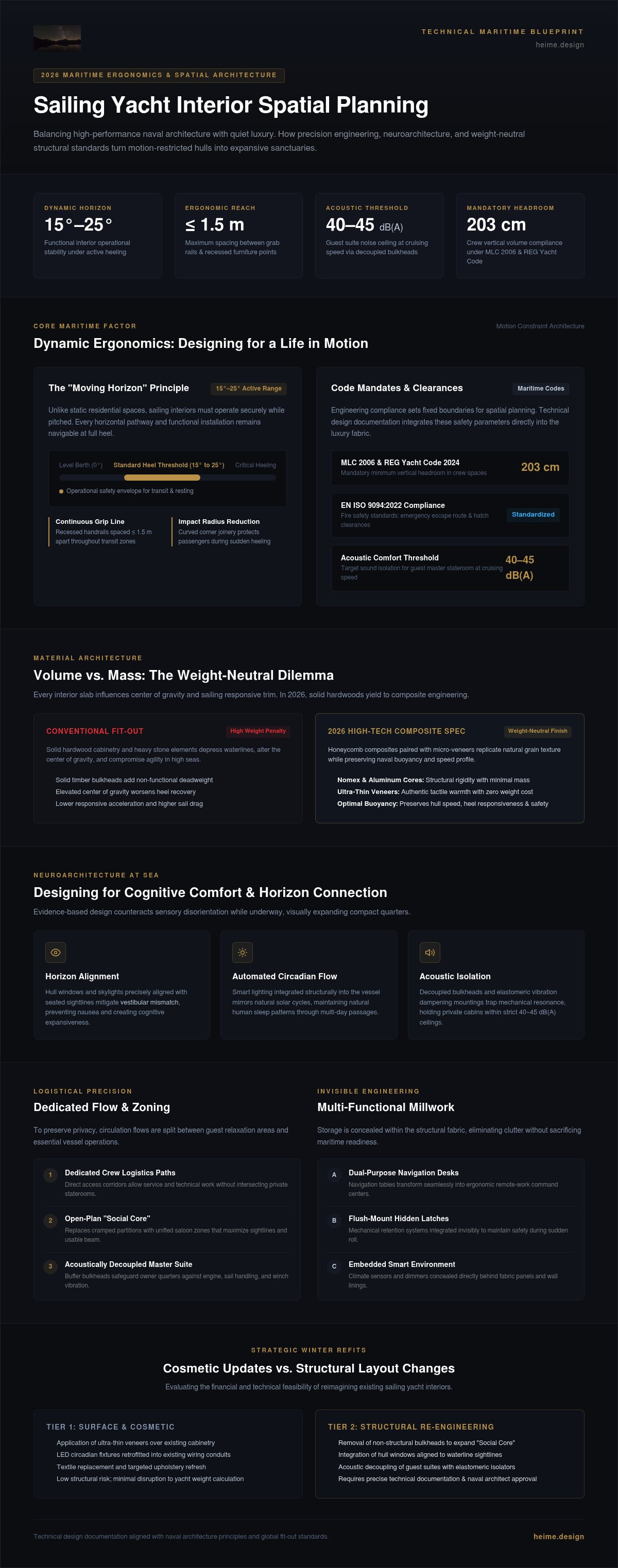
Every piece of furniture or stone slab added to a vessel impacts its center of gravity and overall buoyancy. Modern interior architecture must align strictly with naval architecture principles to ensure the yacht remains stable and responsive. In 2026, the industry has shifted away from solid hardwoods toward high-tech honeycomb composites. Materials like Nomex or aluminum cores, finished with ultra-thin veneers, allow for a high-end look without the weight penalty. Technical design documentation is vital here. It acts as the bridge between aesthetic vision and engineering compliance, ensuring that the vessel's performance isn't compromised by its decor.
Dynamic Ergonomics: Designing for a Life in Motion
Motion is the primary constraint of maritime design. The "Moving Horizon" factor dictates that every surface and passage must be functional at heeling angles between 15 and 25 degrees. Effective sailing yacht interior spatial planning prioritizes safety through strategic handrail placement and rounded furniture edges. Current standards require grab rails to be spaced no further than 1.5 meters apart; this ensures a secure grip is always within an arm's reach during transit. Use of recessed lighting and integrated furniture grips maintains a minimalist aesthetic while providing essential security.
Ergonomics also involve strict regulatory compliance. Under MLC 2006 and the REG Yacht Code 2024, mandatory headroom in crew spaces is set at 203 cm. For owners, this translates to a need for vertical volume that doesn't disrupt the sleek exterior profile. Fire safety standards, such as EN ISO 9094:2022, further dictate escape route dimensions and hatch clearances. These technical boundaries don't limit design. Instead, they provide a framework for creating a secure, organized sanctuary that feels stable even when the environment is tilting.
Technical Principles of Modern Yacht Interior Architecture
Modern sailing yacht interior spatial planning has moved beyond the rigid, compartmentalized layouts of the past. Today, the focus is on creating an open-plan "Social Core" that feels as expansive as a luxury penthouse. This transition requires a sophisticated approach to natural light and storage. Integrated hull windows and skylights are no longer just aesthetic choices. They are strategically aligned with the interior furniture to create sightlines that connect guests to the horizon. This connection reduces vestibular mismatch and enhances the overall sense of volume.
Storage in 2026 is defined by invisibility. Modern millwork utilizes hidden latches and multi-functional furniture solutions, such as navigation tables that transition into remote work hubs. Smart home technology is now embedded into the vessel's structural fabric rather than being added as an afterthought. From automated circadian lighting to integrated climate control, these systems are designed to be felt rather than seen. If you're planning a vessel that balances these complex systems, our team at heime.design can help align your vision with technical reality.
Zoning for Privacy and Performance
Effective zoning ensures that crew logistics never interrupt the owner's experience. This involves designing dedicated "crew paths" that allow for service and maintenance without crossing through private guest zones. Acoustic spatial planning is a major component of this strategy. To maintain cognitive comfort, modern designs target noise ceilings of 40 to 45 dB(A) in guest suites at cruising speed. Achieving these levels requires a deep understanding of marine ergonomics and habitability standards. By decoupling bulkheads and using elastomeric mounts, we can isolate vibration and ensure the master stateroom remains a silent sanctuary.
Material Selection and Technical Precision
The materials used in 2026 yacht interiors are borrowed from aerospace engineering. Carbon fiber, titanium, and aircraft-grade honeycomb composites provide the durability required for the marine environment while keeping the vessel light. Technical precision is non-negotiable during installation. Detailed technical drawings must account for every millimeter of the hull's curvature to ensure custom furniture fits perfectly. These plans also ensure compliance with fire safety certifications, such as the EN ISO 9094:2022 standards. Every material, from the veneer to the adhesive, is selected to meet strict safety regulations while maintaining a minimalist, high-end aesthetic.
Neuroarchitecture at Sea: Designing for Cognitive Comfort
Luxury is often equated with weight and texture. In the maritime world, true luxury is cognitive ease. High-performance sailing yacht interior spatial planning now incorporates neuroarchitecture interior design to solve the psychological challenges of long voyages. Confined volumes can trigger "cabin fever" or vestibular mismatch. To counter this, we use spatial strategies that increase perceived volume. This includes applying prospect-refuge theory; we position seating with clear sightlines to the open horizon while keeping sleeping quarters deeply cocooned for security.
Circadian lighting is another essential tool for mental clarity. In 2026, standard installations use tunable LEDs ranging from 2,200K to 6,500K CCT. These systems mimic natural light cycles to regulate melatonin production and daytime alertness. It grounds the guest in the maritime environment even when they are below deck. Sensory balance is achieved through acoustic decoupling and tactile variation. Soft, matte surfaces prevent light glare, while strategic acoustic lining keeps private cabins at a restful 40 to 45 dB(A) to prevent sleep fragmentation.
The Psychology of Small Spaces
Effective design reduces cognitive load through the intentional use of negative space. We prioritize unobstructed sightlines that stretch the full length of the cabin. Symmetrical layouts are particularly effective on sailing yachts. They provide visual anchors that help the brain process vessel motion, which can significantly reduce the onset of motion sickness. Every element follows American Bureau of Shipping ergonomics guidance to ensure the physical environment supports human behavior. We move beyond traditional color palettes, using tonal shifts that enhance mental wellbeing and create a sense of openness.
Wellness-Focused Marine Interiors
Modern luxury marine interior architecture integrates wellness into the vessel's structural fabric. This goes beyond adding a gym. It involves dedicated wellness suites and integrated air purification systems that maintain air quality in enclosed hulls. Climate zones are tailored to individual cabins to ensure thermal comfort. Spatial planning now accounts for dedicated quiet zones where owners can disconnect from the digital world. These environments are designed to support long-term mental health, ensuring the yacht is a sanctuary for recovery rather than just a mode of transport.
Strategic Yacht Refits: Reimagining Existing Layouts
A strategic refit is often the most efficient path to a high-performance interior. While new builds offer a blank canvas, they involve wait times of three to five years. Refitting an existing vessel allows for immediate layout modernization without the shipyard backlog. The process begins with a comprehensive spatial planning audit. We identify inefficiencies like oversized navigation stations or redundant bulkheads that restrict movement. In the current market, cosmetic refurbishments for 40-50 ft sailing yachts typically range from 130,000 zł to 350,000 zł. Strategic sailing yacht interior spatial planning during a refit does more than update aesthetics. It increases the vessel's market position by aligning it with contemporary habitability standards.
Financial feasibility is a core part of our audit. Marine surveyors generally recommend that refit expenditure shouldn't exceed 30% of the vessel's pre-refit market value. Beyond this threshold, the investment may not be recovered at resale unless the yacht has a rare naval pedigree. If you're looking to modernize a legacy vessel while maintaining its value, HEIMÉ provides the technical expertise to balance luxury with financial logic.
The Refit Planning Process
Execution requires absolute technical precision. Detailed design documentation is mandatory before the first bulkhead is removed. This ensures that new weight loads and furniture placements align with the original naval engineering. Managing these projects across international borders adds layers of complexity. Coordination between designers, specialized joiners, and shipyards must be seamless. We prioritize clear communication to ensure the fit-out meets 2026 safety and fire certifications without delays.
Case Study Concepts: Legacy Estate Vessels
Legacy yachts from the 1990s often feature compartmentalized, closed galleys. Modern owners prefer social cooking environments that integrate with the saloon. We reimagining these spaces by removing non-structural partitions to create an open-plan core. Cabin configurations also require updates for multi-generational use. This involves converting twin cabins into flexible VIP suites with modular furniture. Success in these transformations relies on international project management. It ensures that specialized materials, like lightweight composite joinery costing between 2,000 zł and 20,000 zł per square meter, are sourced and installed to the highest standards.
HEIMÉ’s Bespoke Approach to Marine Spatial Planning
At HEIMÉ, we believe in quiet confidence. Excellence doesn't shout. It's found in the precise alignment of a bulkhead or the intuitive flow of a saloon. Our approach to sailing yacht interior spatial planning is rooted in the intersection of neuroarchitecture and naval precision. We don't just design rooms. We curate high-performance environments that respond to the human nervous system. Every design choice serves a specific functional purpose. We prioritize clarity over complexity. This ensures your vessel remains a sanctuary of order, even in the most demanding maritime conditions. We ensure that sailing yacht interior spatial planning accounts for every technical constraint while maintaining a high-end feel.
Our studio functions as a boutique innovator. We're meticulous professionals who value aesthetic harmony and streamlined processes. By focusing on negative space and essentialism, we create interiors that feel expansive and intentional. We bridge the gap between the artistic vision of the owner and the rigid requirements of naval engineering. This methodology ensures that luxury never compromises the vessel's performance or safety. We handle the technical design documentation and project management so you don't have to navigate the complexities alone. We're here to guide you through the technical maze of maritime design with a personalized touch.
Turnkey Coordination for Global Yacht Projects
We act as the essential link between UHNW clients and specialized international contractors. Managing a maritime renovation involves high stakes and complex logistics. Our team provides end-to-end turnkey management. This journey begins with technical drawings and continues through to site supervision and the final fit-out. We offer multilingual support for cross-border maritime renovations, ensuring your vision is translated accurately to shipyards and joiners. Every word and design choice in our documentation serves a functional goal. This level of precision reduces errors and keeps the project on schedule. We ensure every material, from lightweight composites to fire-rated adhesives, meets 2026 safety certifications without compromise.
Designing Your Maritime Legacy
A yacht is more than a vessel. It's a legacy estate that should preserve its value for generations. We design spaces that respect the history of the vessel while integrating modern technology. Our focus is on value preservation for legacy estates and vessels. This requires a personalized touch and a deep understanding of secure luxury interior design for private residences at sea. We prioritize both physical security and cognitive comfort in every layout. Whether you're embarking on a major refit or a new build, our methodology ensures your vessel remains a high-value asset. We invite you to collaborate on your next legacy project and experience a design process that values aesthetic harmony as much as structural integrity. Start your yacht refit or new build journey with HEIMÉ and transform your maritime vision into a technical reality.
Navigating the Future of Maritime Design
Achieving a high-performance interior requires more than aesthetic intuition. It demands a rigorous alignment between naval engineering and human psychology. By integrating neuroarchitecture with precise technical documentation, you can transform restricted volumes into expansive sanctuaries. Effective sailing yacht interior spatial planning ensures that every centimeter of your vessel contributes to both safety and serenity. This approach moves beyond simple decoration to create a vessel that feels larger than its length overall.
Whether you're modernizing a legacy yacht through a strategic refit or embarking on a custom new build, the goal is a seamless integration of luxury and performance. We provide specialized expertise in UHNW marine projects, ensuring your international build is managed with technical excellence. Your maritime residence should be a place of recovery and cognitive ease. It's about creating a space that functions perfectly even in the most demanding conditions.
Design your maritime legacy with HEIMÉ’s bespoke yacht interior services.
Your vision deserves the precision of a studio that understands the unique demands of life at sea. We're ready to help you navigate the path from initial inquiry to a finished masterpiece. Let's create a space that performs as beautifully as it looks.
Frequently Asked Questions
What is the most important factor in sailing yacht interior spatial planning?
The most critical factor in sailing yacht interior spatial planning is the integration of naval architecture with human ergonomics. Unlike land-based structures, a vessel is a dynamic environment that operates at heeling angles of 15 to 25 degrees. Every layout choice must account for the center of gravity and weight distribution to maintain performance. A successful design ensures that safety and luxury are balanced, providing secure handholds and clear passage without cluttering the aesthetic.
How does yacht spatial planning differ from residential interior design?
Yacht spatial planning differs from residential design because it must address constant motion and severe space constraints. In a home, you design for static comfort. On a yacht, you design for "life in motion," where every surface must be functional while the vessel tilts. You must also prioritize weight-neutral materials like honeycomb composites instead of heavy solid woods. Technical requirements, such as watertight bulkheads and escape hatches, dictate the floor plan more than purely decorative preferences.
Can I change the layout of an existing yacht during a refit?
You can change the layout of an existing yacht during a refit, provided the modifications don't compromise structural integrity. Removing non-load-bearing partitions can create the open-plan social cores popular in 2026. However, major changes require a spatial planning audit to assess weight shifts. Refit costs for 40-50 ft yachts often start around 130,000 zł. It's often more efficient than a new build, allowing for modern habitability without the multi-year wait times of a shipyard.
What role does neuroarchitecture play in marine interior design?
Neuroarchitecture focuses on the cognitive impact of the marine environment on guests and owners. It uses spatial tricks like prospect-refuge theory to mitigate "cabin fever" and motion sickness. By aligning sightlines with the horizon and using circadian lighting, we can reduce the brain's stress in confined spaces. This evidence-based approach ensures that the interior isn't just beautiful but actively supports mental wellbeing and restful sleep through acoustic decoupling and sensory balance.
How do I choose the right materials for a luxury yacht interior?
Choosing materials for a luxury yacht requires a focus on durability, fire safety, and weight reduction. You should prioritize aircraft-grade composites and ultra-thin veneers that meet EN ISO 9094:2022 standards. Solid marble or heavy hardwoods are often replaced with lightweight alternatives to protect the vessel's performance. Every material must resist high humidity and salt air. It's essential to select finishes that offer tactile luxury while remaining functional in a high-traffic, high-motion environment.
Is it possible to integrate smart home technology into a sailing yacht?
It's entirely possible to integrate smart technology, but it must be embedded into the vessel's structural fabric. Modern systems focus on automated circadian lighting and invisible climate control that responds to the yacht's location. In 2026, these integrations are managed through technical design documentation to ensure they don't interfere with the yacht's navigation systems. From voice-controlled lighting to remote monitoring, smart tech enhances the luxury experience by simplifying complex onboard systems.
What technical documentation is needed for a yacht interior renovation?
A yacht renovation requires a comprehensive package of technical design documentation. This includes General Arrangement (GA) plans, detailed joinery drawings, and weight distribution studies. You also need documentation that proves compliance with maritime safety codes like the REG Yacht Code 2024. These drawings ensure that every custom piece fits the hull's unique curvature. Having precise documentation is the only way to coordinate international contractors and shipyards effectively during a complex refit project.
How does spatial planning affect the resale value of a luxury yacht?
Precision sailing yacht interior spatial planning significantly increases a yacht's resale value by ensuring the vessel meets modern habitability standards. A layout that feels cramped or outdated can reduce market interest. By modernizing a legacy yacht with open-plan concepts and wellness zones, you preserve its position in the luxury market. Refit expenditure should generally stay within 30% of the vessel's value. A well-planned interior proves that the vessel has been maintained to the highest technical and aesthetic standards.


