

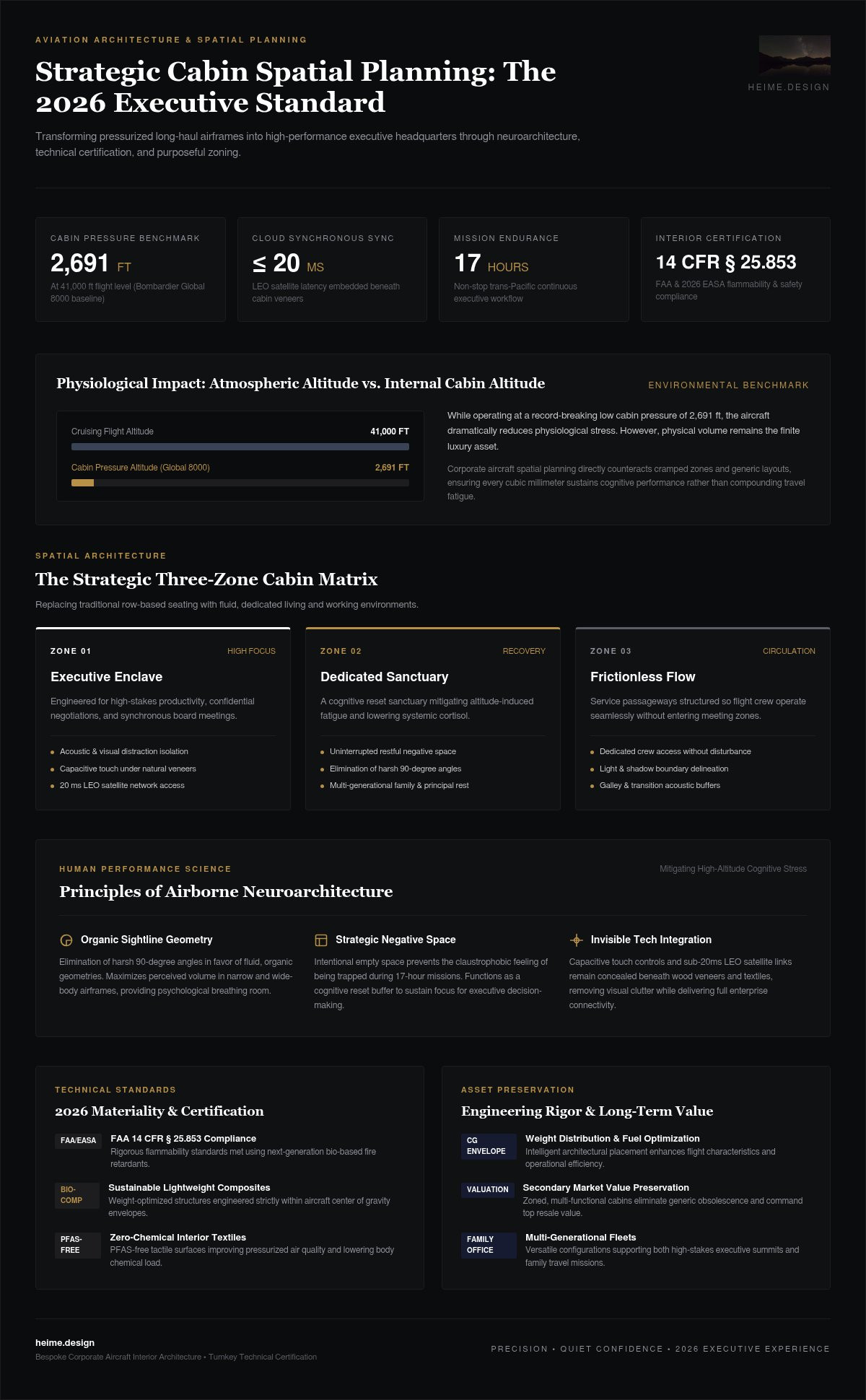
At 41,000 feet, the Bombardier Global 8000 now maintains a cabin pressure altitude of just 2,691 feet. This record-breaking environment sets a new standard for physiological comfort, yet physical space remains the ultimate luxury. Most long-haul cabins still feel like a compromise. You likely recognize the fatigue of cramped zones. You know the frustration of generic luxury that fails to support a sensitive board meeting. Effective corporate aircraft interior spatial planning solves these pains by ensuring every millimeter serves a specific purpose.
We believe a private jet should function as a high-performance extension of your global headquarters. You'll discover how strategic spatial planning transforms private aviation into a high-performance environment for global leaders. This article explores how we integrate neuroarchitecture, PFAS-free materials, and gigabit connectivity to support your unique business workflows. We're architecting a future where travel doesn't interrupt your momentum. It sustains it. Welcome to the 2026 executive experience, where precision meets professional anticipation and quiet confidence.
Key Takeaways
- Shift from traditional seating to adaptive, multi-functional living environments through precise corporate aircraft interior spatial planning.
- Mitigate cognitive fatigue and maintain executive clarity using proven neuroarchitecture principles.
- Implement a strategic three-zone layout to balance high-stakes productivity with dedicated sanctuary spaces.
- Ensure compliance with 2026 EASA and FAA standards by specifying sustainable, lightweight bio-composites.
- Bridge the gap between bespoke creative vision and rigorous technical certification with turnkey project management.
What is Corporate Aircraft Interior Spatial Planning?
Corporate aircraft interior spatial planning is the strategic discipline of organizing a cabin's footprint to maximize utility, flow, and human performance. It's more than selecting premium finishes. In 2026, the industry has moved away from rigid, row-based seating. We now focus on fluid living environments that adapt to your immediate needs. This requires a precise balance between strict aviation engineering and the expansive vision of luxury architecture. The team at heime.design serves as this bridge, ensuring creative concepts meet rigorous technical standards.
A deep understanding of aircraft cabin configurations and spatial architecture is vital for high-stakes projects. Every centimeter must sit within the aircraft's center of gravity envelope. Effective planning ensures the cabin remains a functional asset. It transforms a pressurized tube into a seamless extension of your global headquarters. This foundation is where performance begins. It's the difference between a simple flight and a productive mission. Every decision is intentional.
The Core Objectives of Modern Cabin Architecture
Volume is the most precious resource in any jet. Modern planning uses sightlines and organic geometry to maximize perceived space. We eliminate harsh 90-degree angles. This creates a sense of openness in narrow-body and wide-body airframes alike. It's about psychological breathing room during long-haul travel. Use light and shadow to define zones without physical barriers. This aesthetic harmony reduces the stress of confined environments.
Technology integration should be invisible. We embed capacitive touch surfaces and high-speed LEO satellite connectivity beneath veneers. This maintains a minimalist aesthetic while providing tools for global leadership. Movement is the final pillar. A well-planned cabin allows crew to provide service without interrupting a board meeting or disturbing a resting principal. Flow is essential for productivity and privacy. It's about creating a frictionless environment for both crew and passengers.
Beyond Aesthetics: The Strategic ROI of Good Design
Strategic spatial design is the foundation for value preservation. A generic or cluttered cabin loses appeal on the secondary market. Conversely, a thoughtfully zoned layout increases the resale value of corporate assets. It proves the aircraft can handle diverse missions, from short regional hops to 17-hour trans-Pacific flights. In the Polish market, these design choices reflect a commitment to long-term asset management and operational excellence. Investors recognize the value of a cabin that supports high-level workflows.
Weight distribution is a critical technical factor. Intelligent furniture placement isn't just about comfort; it optimizes fuel efficiency and flight characteristics. We also design for longevity. For family office fleets, corporate aircraft interior spatial planning must account for multi-generational use. This means creating spaces that are durable for family travel yet sophisticated for negotiations. It's about building a legacy that remains functional for years to come. Every decision serves a purpose. Precision is our standard.
The Science of Airborne Neuroarchitecture
High-altitude travel triggers a subtle but persistent stress response. Cognitive fatigue isn't just about a lack of sleep; it's a physiological reaction to confined, pressurized environments. The experts at heime.design use neuroarchitecture to mitigate these effects. By optimizing spatial geometry, we can actively lower cortisol levels and enhance mental clarity. This creates an atmosphere where global leaders maintain peak focus during long-haul missions. Strategic corporate aircraft interior spatial planning integrates these biological needs directly into the cabin's technical footprint.
Every material chosen must satisfy FAA 14 CFR § 25.853 compartment interior standards while serving a clear cognitive purpose. We select finishes that meet flammability requirements and provide the tactile grounding necessary for stability. In 2026, this means moving toward PFAS-free textiles and bio-based fire retardants. These choices improve air quality and reduce the chemical load on the body. It's a commitment to health that goes beyond basic compliance.
Cognitive Zones: Designing for Focus and Rest
Deep work requires more than a desk. It needs an enclave. We design zones that minimize acoustic and visual distractions. This allows for synchronous cloud collaboration using LEO satellite networks with latency as low as 20 ms. Negative space is equally vital. In a confined cabin, "empty" space prevents the feeling of being trapped. It provides a visual reset for the brain. This balance is a core part of corporate aircraft interior spatial planning. Learn more about our approach to Neuroarchitecture Interior Design and its impact on performance.
Biophilic Integration in Aviation
The industrial nature of flight can be jarring to the human nervous system. Organic forms and textures counter this effectively. We prioritize curves over sharp, 90-degree lines to reduce visual stress. Tactile materials like vegetable-tanned leathers and wool-silk blends ground passengers during turbulence. Scent and air quality also influence spatial perception. We design for optimal air circulation to enhance the sense of openness. This holistic approach ensures the cabin feels like a wellness sanctuary rather than a machine.
The team at heime.design bridges the gap between science and luxury. We ensure your cabin supports your biological clock through dynamic lighting. These systems modulate Correlated Color Temperature to trigger melatonin or stimulate focus based on your destination. It's about arriving ready to lead. If you're ready to optimize your next flight, consider a private jet interior design consultation with our studio.
Zoning Strategies: Balancing Productivity and Privacy
The first moment a passenger steps on board is the entry experience. It serves as an acoustic and psychological airlock. Effective corporate aircraft interior spatial planning uses this transition to separate the operational galley from the executive living areas. We implement a refined Three-Zone model that moves from the high-activity Galley to the collaborative Boardroom, and finally to the Private Sanctuary. Each zone relies on sophisticated acoustic partitioning to manage the soundscape, ensuring sensitive negotiations remain confidential even during flight.
A modern cabin must function as a dual-purpose environment. It's a high-stakes day-office that transforms into a restful night-suite without effort. This requires furniture that adapts to different missions. Every material within these zones must adhere to 14 CFR § 25.853 compartment interior standards. We balance these rigid safety requirements with artisanal quality to create a space that feels intentional and secure. The goal is to eliminate the 'generic luxury' feel in favor of a workflow-centric layout.
The Corporate Boardroom Zone
The mid-cabin is the engine of the aircraft. We design this zone for 4 to 8 participants, focusing on ergonomic seating that supports long meetings. Integrated digital infrastructure allows for real-time global connectivity, utilizing LEO satellite systems to maintain a seamless link to the ground. Corporate aircraft interior spatial planning in this zone also includes discreet storage. Sensitive documents and hardware are kept secure but accessible, hidden within bespoke cabinetry that maintains the cabin's minimalist aesthetic. It's about creating a space where focus is the default state.
The Private Sanctuary: Rest and Recovery
The aft section is dedicated to deep recovery. We install full-flat bedding solutions that mimic the comfort of a residential master suite. These are not merely reclining seats; they are architected rest environments. En-suite wellness facilities use spa-inspired materials that meet aviation weight and flammability specs. We often look to UHNW Residential Interior Design for crossover trends, bringing the warmth of a legacy estate into the sky. This zone ensures you arrive at your destination restored, not just transported. It's the ultimate expression of wellness-driven architecture.
Technical Compliance and Material Selection in 2026
Technical rigor is the silent partner of luxury. In 2026, navigating the intersection of EASA and FAA flammability and weight requirements is more complex than ever. Every choice in corporate aircraft interior spatial planning must be backed by a comprehensive paper trail. We don't just select materials for their beauty. We select them for their ability to pass 14 CFR § 25.853 standards while maintaining the aircraft's structural integrity. This balance ensures your vision doesn't just look exceptional; it's airworthy.
Sustainable luxury is no longer optional. The industry has shifted toward bio-composites and circular materials that reduce the carbon footprint without sacrificing quality. These advanced substrates allow us to create bespoke furniture that is both durable and lightweight. Precision is essential. A single kilogram over the weight allowance can disrupt the entire flight profile. We manage these constraints from day one to ensure a smooth path to final delivery.
Innovative Materials for VIP Cabins
Weight-saving technology has reached new heights. We now utilize ultra-lightweight stones with carbon-fiber honeycomb backing for galleys and lavatories. These provide the visual weight of solid marble with a fraction of the mass. Acoustic textiles are another breakthrough. They dampen engine noise effectively without adding the bulk of traditional insulation. Smart surfaces are also becoming standard. We integrate haptic controls directly into wood veneers, eliminating bulky switch panels and maintaining a clean, minimalist aesthetic. This approach prioritizes clarity over complexity.
Technical Documentation and Permit Coordination
The interior architect's role extends far beyond the drawing board. We act as the central point of coordination between aeronautical engineers and MRO facilities. This ensures every bespoke element is documented for certification. Precise technical design documentation is the only way to avoid costly delays during the refit process. It's about proactive management. Our expertise in International Project Management allows us to handle these cross-border complexities seamlessly. We bridge the gap between creative ambition and regulatory reality.
Successful completions require a partner who understands the nuances of aviation law and high-end design. We provide the technical drawings and coordination needed for a flawless installation. If you're planning a new build or a refit, explore our technical design services to ensure your project meets every 2026 standard. We turn complex requirements into streamlined results.
Heime.design: Bespoke Aviation Interior Architecture
The studio at heime.design operates as a boutique innovator in high-stakes aviation environments. We provide a tailored alternative to monolithic completion centers. Our focus remains on the specific business workflows and personal legacies of UHNW individuals and corporate fleets. We don't just design cabins; we architect environments where global leaders thrive. Through precise corporate aircraft interior spatial planning, we ensure your mobile headquarters is both a high-performance asset and a sanctuary.
Our Turnkey Aviation Design Process
We manage every detail from the first sketch to the final delivery. Our process is linear and transparent. It begins with a mission profile analysis. We conduct spatial feasibility studies to ensure your requirements fit the airframe's technical limits. This prevents costly adjustments during the construction phase. We value your time and prioritize a frictionless workflow.
- Phase 1: Mission profile analysis and spatial feasibility studies. We define the functional zones based on your specific travel patterns and business needs.
- Phase 2: Bespoke interior architecture and 3D visualization. You experience the spatial flow and material harmony through high-fidelity renders before production starts.
- Phase 3: Technical documentation and contractor supervision. We provide the precise drawings needed for certification and oversee the entire refit on-site.
The heime.design Advantage: Global Expertise, Personal Touch
Managing complex refits across European borders requires more than design skill. It requires multilingual coordination and a deep understanding of international standards. We act as the central point of contact for international flight departments and private owners. Our commitment to minimalist, functional luxury ensures the cabin remains timeless. We apply this same architectural rigor to other complex environments, which you can explore in our guide to Luxury Marine Interior Architecture.
We understand the unique needs of the Polish market and our international clients. Our studio bridges the gap between creative vision and technical aviation compliance. We handle the permit coordination and technical design documentation so you don't have to. Every project is a partnership. We prioritize direct, one-on-one communication to ensure your aircraft is a true reflection of your standards. Let's discuss how we can optimize your corporate aircraft interior spatial planning for the missions ahead.
Elevating the Standards of Global Mobility
The evolution of private aviation in 2026 focuses on the human experience. We've moved from simple luxury to a science-based approach that prioritizes cognitive clarity and physiological well-being. Successful corporate aircraft interior spatial planning now integrates neuroarchitecture to mitigate travel fatigue while maintaining strict technical compliance. By balancing the collaborative energy of a boardroom with the deep recovery of a private sanctuary, your cabin becomes a primary tool for international leadership.
heime.design stands at the intersection of this creative vision and technical reality. As a specialized aviation design studio, we provide international turnkey management and bespoke technical documentation for the most demanding flight departments. We handle the complexities of cross-border refits and EASA/FAA certification so you can focus on your next mission. Your aircraft is more than a vehicle; it's a legacy of precision and performance.
Refine Your Airborne Legacy with heime.design. We look forward to architecting your future in the sky.
Frequently Asked Questions
What is the most important factor in corporate aircraft spatial planning?
The most important factor is the mission profile of the principal. Effective corporate aircraft interior spatial planning must align the cabin's physical layout with specific business workflows while respecting the aircraft's center of gravity and weight limits. We prioritize a balance between ergonomic zones for high-stakes negotiation and dedicated areas for deep recovery. Every millimeter must serve a purpose, ensuring the cabin functions as a seamless extension of a global headquarters.
How long does a typical private jet interior refit take?
A typical private jet interior refit ranges from several weeks to over a year, depending on the project's complexity. A minor cosmetic refresh might take eight to twelve weeks. However, a full structural overhaul and cabin reconfiguration usually require six to twelve months. This timeline includes feasibility studies, technical design documentation, and the final installation at a certified MRO facility. We coordinate these phases meticulously to minimize downtime and ensure the aircraft returns to service.
Can I use residential furniture in a corporate aircraft cabin?
No, you cannot use standard residential furniture in a corporate aircraft cabin. Every item must meet rigorous 14 CFR § 25.853 flammability standards and withstand 16G dynamic impact testing for passenger safety. Aviation-grade furniture is engineered from lightweight, certified materials like carbon fiber and flame-retardant foams. We design bespoke pieces that mimic residential luxury while adhering to these strict aeronautical requirements. This ensures your aesthetic vision is never compromised by the necessary safety certifications.
How does spatial planning impact the resale value of a business jet?
Strategic spatial planning significantly enhances the resale value of a business jet by proving its versatility. A cabin with clearly defined zones for work, dining, and rest appeals to a broader range of international buyers. It demonstrates that the asset is optimized for long-range missions and diverse passenger profiles. Modern, compliant layouts that feature integrated technology and sustainable materials ensure the aircraft remains competitive on the secondary market for years after the completion.
What are the latest trends in VIP aircraft cabin materials for 2026?
The 2026 trends prioritize sustainable, high-performance materials such as bio-composites and PFAS-free textiles. We're seeing a shift toward ultra-lightweight stone veneers for galleys and smart touch veneers that hide technology beneath natural wood surfaces. Naturally flame-resistant fibers like wool and silk blends are replacing chemical-heavy coatings. These materials reduce the aircraft's weight while improving cabin air quality, reflecting a broader industry commitment to environmental responsibility and passenger wellness without sacrificing artisanal quality.
How do you ensure acoustic privacy in an open-plan aircraft cabin?
We ensure acoustic privacy through a combination of physical zoning and advanced material science. Multi-density acoustic blankets are installed behind cabin liners to dampen engine noise, while active noise attenuation systems help neutralize ambient sound. Strategic corporate aircraft interior spatial planning uses soft partitions and airlocks to create silent zones for sensitive meetings. By managing the soundscape, we ensure that private negotiations remain confidential even in the relatively open environment of a midsize or large-cabin jet.
What is the role of an interior designer vs. an aeronautical engineer?
The interior designer focuses on the human experience, aesthetics, and spatial flow, while the aeronautical engineer ensures structural integrity and regulatory compliance. The designer creates the vision for the executive experience, selecting materials and defining functional zones. The engineer validates that these designs meet weight, balance, and safety standards like 16G crash loads. HEIMÉ acts as the bridge between these two disciplines, providing the technical design documentation required to turn creative concepts into airworthy reality.
Can neuroarchitecture really improve executive performance during flight?
Yes, neuroarchitecture can measurably improve performance by reducing the physiological stress of high-altitude travel. By using organic geometry and circadian lighting, we can lower cortisol levels and stimulate mental focus. This scientific approach to design helps manage the body's internal clock across time zones, ensuring executives arrive alert and ready for negotiation. It transforms the cabin into a wellness-centric environment that supports cognitive clarity during long-haul missions, making travel a productive part of the business day.


