

The most vulnerable phase of a private jet transformation doesn't happen on the hangar floor. It happens at the drafting table. Flawless executive jet interior refit coordination requires architectural design vision aligned with rigorous aviation engineering. Without an integrated approach, even the finest bespoke concepts risk stalling under complex airworthiness regulations.
Every flight department dreads unexpected downtime extensions during scheduled maintenance. Fragmented communication between design studios, MRO facilities, and certification engineers routinely forces unacceptable compromises between aesthetic intent and strict compliance. You shouldn't have to choose between bespoke artisanal finishes and airworthiness certification. This guide outlines how to orchestrate the entire refurbishment journey with precision, ensuring schedule integrity, rigorous material compliance, and flawless craftsmanship from day one.
We'll examine the complete refit roadmap, showing you how to synchronize cabin design with technical maintenance cycles to deliver an elevated, flight-ready interior without delays.
Key Takeaways
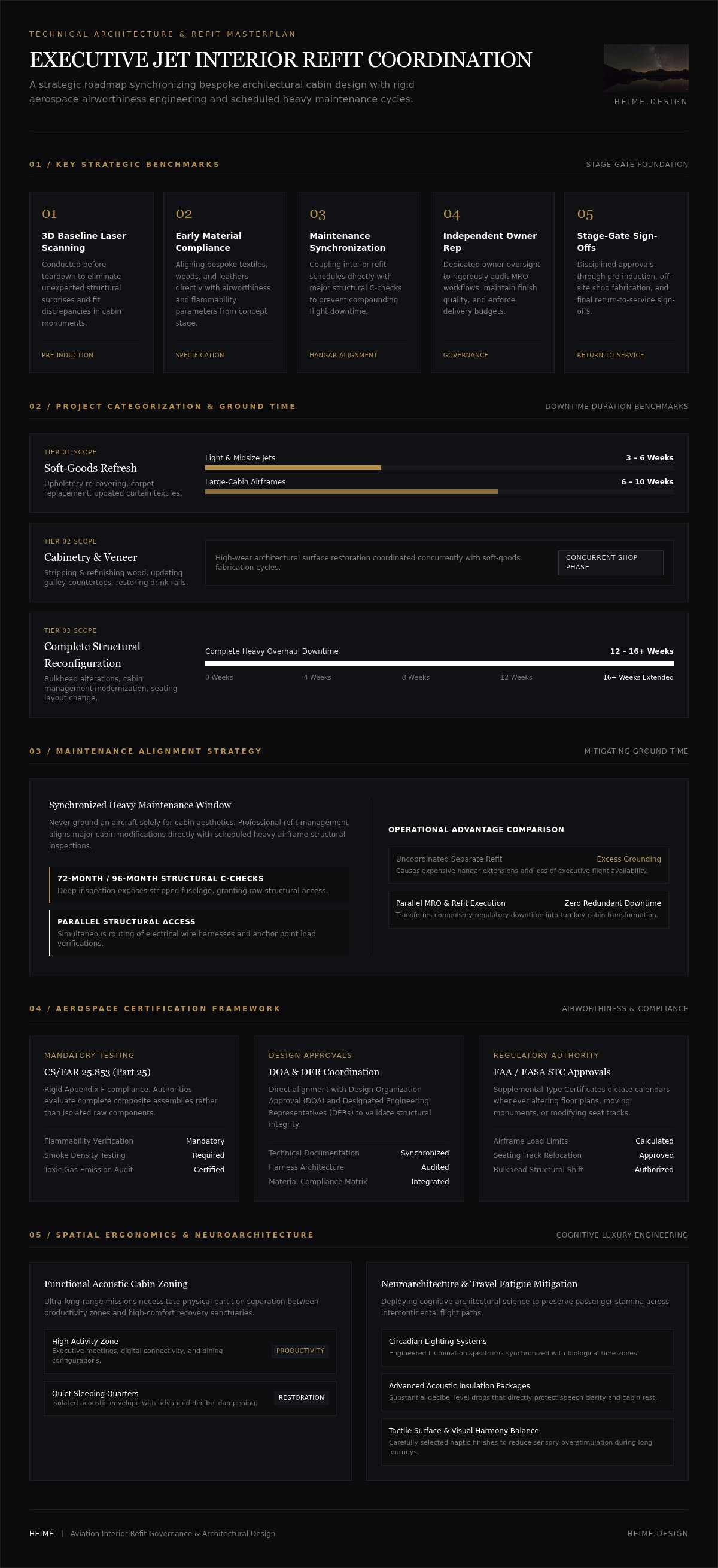
- Establish precise cabin baselines using 3D laser scanning before tear-down to eliminate unexpected structural surprises and fit issues.
- Master executive jet interior refit coordination by aligning bespoke material selections with strict flammability and airworthiness standards from the concept stage.
- Synchronize interior modification milestones directly with heavy maintenance schedules to avoid compounding downtime and loss of flight availability.
- Protect budgets and project integrity by deploying an independent owner representative to audit MRO workflows and maintain quality benchmarks.
- Implement structured stage-gate governance across pre-induction, shop fabrication, and final return-to-service sign-offs for seamless delivery.
Defining the Scope: Assessing Executive Jet Cabin Condition and Objectives
Every successful cabin transformation begins with an honest audit. Before selecting leathers or drafting new layouts, inspect the baseline condition of existing monuments, seating frames, sidewalls, and overhead bins. Hidden structural wear beneath veneers or fatigued seat mechanical linkages can disrupt project timelines instantly. A systematic assessment establishes what can be preserved and what requires replacement.
Clear project categorization defines the path forward. Refits generally fall into three tiers:
- Soft-Goods Refresh: Upholstery re-covering, carpet replacement, and updated curtain textiles. Downtime averages three to six weeks for light or midsize jets, and six to ten weeks for large-cabin airframes.
- Cabinetry and Veneer Re-treatment: Stripping and refinishing high-wear wood cabinetry, updating galley countertops, and restoring drink rails.
- Complete Structural Reconfiguration: Removing bulkheads, modernizing cabin management systems, and altering passenger seating layouts. These overhauls run twelve to sixteen weeks or longer.
Airframe age and market residual value dictate rational capital expenditure. A ten-year-old airframe heading toward a secondary market sale justifies a distinct finish package compared to a bespoke corporate transport retained for long-term ownership. Effective executive jet interior refit coordination ensures that every aesthetic upgrade protects aircraft value without overcapitalizing the asset.
Evaluating Airframe Downtime and Maintenance Alignment
Never ground an operational aircraft solely for interior renovations. Professional refit management aligns major cabin work with scheduled heavy airframe inspections, such as 72-month or 96-month structural C-checks. Because deep maintenance exposes the stripped fuselage, interior teams can route wiring and access structural hardpoints simultaneously. Mapping these parallel schedules prevents expensive hangar extensions and preserves operational readiness.
Establishing Spatial Priorities and Ergonomic Requirements
Cabin layouts must reflect real-world flight operations. Ultra-long-range missions require functional zoning, cleanly dividing high-activity meeting zones from quiet sleeping quarters. Advanced acoustic insulation packages drop interior decibel levels substantially, protecting speech clarity and cabin rest. Applying principles from neuroarchitecture interior design balances visual harmony, circadian lighting, and tactile surfaces to reduce travel fatigue. When alterations relocate monuments or seating tracks, obtaining a Supplemental Type Certificate (STC) guarantees compliance with airframe load distribution limits. Thoughtful executive jet interior refit coordination fuses these aesthetic boundaries directly with operational engineering.
Navigating Aviation Certification, Material Compliance, and Airworthiness
A pressurized cabin is a strictly regulated enclosure. Every finish, adhesive, and textile placed inside an aircraft must clear uncompromising airworthiness gates before release. Residential or commercial materials, regardless of luxury pedigree, cannot enter a business jet without formal proof of compliance. Balancing tactile luxury against rigid aerospace mandates is the central technical test of any cabin upgrade.
Complex alterations require early regulatory engagement. When reconfiguring floor plans, moving bulkheads, or overhauling cabin electrical harnesses, securing FAA Supplemental Type Certificates or EASA equivalents dictates the delivery calendar. Coordinating directly with Design Organization Approval (DOA) partners and Designated Engineering Representatives (DERs) ensures technical documentation matches structural data. A disciplined executive jet interior refit coordination strategy establishes a centralized material compliance matrix early, tracking flammability, smoke density, and toxic gas emissions across every proposed finish.
Flammability Standards and CS/FAR 25.853 Compliance
Aviation authorities evaluate composite assemblies, not isolated raw components. Under CS/FAR 25.853 (Part 25, Appendix F), floor coverings, textiles, and decorative leathers must pass strict 12-second vertical Bunsen burner tests, requiring flame extinction within 15 seconds. Bulkheads and large cabinetry face 60-second vertical burn tests. Critical testing rules include:
- As-Installed Layups: Test coupons must replicate the exact multi-layer stack: leather, adhesive, fire-barrier felt, and foam substrate.
- Batch Traceability: Burn specimens must originate from the identical dye lots and production batches destined for the cabin.
- Authorized Documentation: Every batch requires complete traceability supported by formal FAA Form 8110-3 approvals or EASA Form 1 release certificates.
Weight Management and Structural Integrity Constraints
Every kilogram added to an aircraft cabin extracts payload range. Selecting dense solid woods or heavy natural stone without engineering oversight degrades flight efficiency and alters the certified center of gravity envelope. Skilled refit teams deploy lightweight honeycomb composites, carbon backing, and micro-thin architectural veneers to deliver opulent tactile depth without excess weight.
Passenger seating introduces additional structural boundaries. Under 14 CFR § 25.562, modern executive seats must endure 16G forward dynamic impact test loads. Re-foaming, leather tailoring, or structural re-contouring cannot alter the seat's dynamic crashworthiness or head injury criteria (HIC) limits without engineering validation. Engaging an owner representative experienced in private jet interior design ensures bespoke craftsmanship satisfies both aesthetic ambitions and regulatory airworthiness sign-offs.
Evaluating Key Refit Partners: Specialized MROs vs. Independent Project Coordinators
Selecting who oversees your cabin upgrade dictates the final delivery quality. Full-service maintenance, repair, and overhaul (MRO) facilities often present their in-house design shops as an effortless, one-stop solution. Yet internal MRO departments frequently face conflicting priorities. Their primary focus remains heavy structural inspections, mechanical systems, and flight-readiness sign-offs. Interior aesthetics can quickly become secondary, often resulting in opaque subcontractor markups and compromised craftsmanship.
Bespoke aviation projects share deep technical synergy with luxury marine interior architecture. Both sectors demand millimeter precision within vibrating, weight-restricted environments. Dedicated executive jet interior refit coordination introduces cross-sector refinement directly to the completion center, establishing clear protocols that hold maintenance facilities accountable to high aesthetic standards.
Assessing Part 145 MRO Interior Capabilities
Evaluating an MRO facility requires inspecting recent cabin completions in person. Examine veneer grain matching across adjoining monuments, perimeter leather stitching, and reveal gaps around sidewall panels. Confirm that the technical office deploys 3D laser scanning rather than relying on legacy airframe blueprints. Dedicated labor bandwidth demands equal scrutiny. When heavy structural maintenance hits unexpected delays, MRO managers routinely reassign interior technicians to clear mechanical bottlenecks, triggering severe delivery slippage.
The Strategic Role of an Independent Coordination Partner
An independent owner representative protects your aesthetic vision against convenient facility shortcuts. When engineering departments push to flatten bespoke seating contours to simplify complex FAA Supplemental Type Certificate requirements, an independent partner develops compliant alternatives that preserve design intent.
Applying structured frameworks from international project management for luxury interior design bridges operational gaps between European completion centers, external artisans, and private flight crews. Through disciplined executive jet interior refit coordination, owners maintain vendor neutrality, eliminate unvetted change orders, and enforce strict quality control at every build stage.
The Step-by-Step Aircraft Refit Coordination Process
Refit schedules falter when an airframe sits idle in a hangar waiting for late cabinetry or delayed compliance paperwork. Professional executive jet interior refit coordination treats aircraft induction as a mid-project milestone, not the starting gun. Deploying high-resolution 3D laser scanning captures true airframe tolerances weeks ahead of induction, identifying geometric deviations before fabrication begins.
Phase One: Concept Formulation and Engineering Feasibility
Every program launches with precise spatial mapping. Cabin layouts and mood boards translate into detailed 3D digital twins. Engineers audit proposed footprints against structural bulkheads, emergency egress paths, and environmental control ducting. Full-scale physical mockups validate custom seating contours, conference tables, and galley clearances before locking the baseline design.
Phase Two: Sourcing, Pre-Fabrication, and Material Testing
Induction dates stay locked behind strict fabrication tollgates. Certified veneers, aerospace-grade leathers, and custom textiles are sourced well ahead of downtime. Independent testing laboratories execute burn testing to secure flammability reports before work begins. Specialized workshops pre-assemble monuments off-site, verifying harness routing, mechanical latches, and finish tolerances prior to installation.
Phase Three: Aircraft Induction, Fit-Out, and Return to Service
Once materials arrive at the facility, cabin demolition begins. Daily site supervision audits the tear-down, inspecting newly exposed structural frames for hidden corrosion or chafed wiring. Certified technicians install pre-fitted monuments, bespoke seating, circadian lighting, and updated cabin management systems. The process concludes with precise weight-and-balance re-weighing, conformity inspections, and test flights before final sign-off.
Executing each phase with precision preserves airframe value and prevents costly operational delays. To streamline your upcoming aircraft modernization, coordinate your cabin refit with HEIMÉ for turnkey oversight from initial scan to final delivery.
Executing Flawless Jet Refits: Turnkey Governance with HEIMÉ
Managing a cabin transformation shouldn't strain flight departments or family offices. heime.design operates as a dedicated owner representative, bridging the gap between bespoke design and aviation engineering. By maintaining a continuous presence across European completion centers, our turnkey governance model shields owners from technical miscommunications and unauthorized budget expansion. Flawless executive jet interior refit coordination requires this exact level of disciplined oversight.
Every phase is managed to protect the aircraft's long-term capital value. Detailed technical records, material compliance certificates, and structural approval documents are compiled into an organized asset portfolio. This thorough documentation simplifies future airworthiness audits and preserves resale liquidity on the secondary market.
Preventing Schedule Delays and Cost Inflation During C-Checks
Hangar downtime carries heavy operational costs. heime.design enforces strict procurement schedules, ensuring all custom seating, veneers, and monuments arrive before the aircraft enters the hangar. Our multilingual team provides active on-site supervision, resolving technical discrepancies between shop engineers and artisanal trades immediately. By validating engineering work orders and auditing labor hours daily, we keep the refit timeline locked to the scheduled maintenance window.
Bespoke Interior Architecture Tailored to UHNW Standards
A private aircraft cabin should match the quiet sophistication of your terrestrial properties. Drawing from deep experience in UHNW residential interior design and luxury marine architecture, heime.design creates refined spaces designed around cognitive well-being. We balance several vital cabin layers:
- Acoustic Isolation: Advanced damping packages that isolate vibration and quiet cabin decibels at cruise altitude.
- Tactile Balance: Certified aerospace leathers, lightweight veneers, and bespoke metal plating that invite touch without adding excess weight.
- Intuitive Automation: Hidden ambient lighting and discrete smart controls that simplify passenger comfort during long missions.
Achieving this standard requires an unwavering commitment to discretion and craftsmanship. With heime.design guiding your executive jet interior refit coordination, your aircraft returns to service on time, fully certified, and executed with uncompromising architectural precision.
Elevating Cabin Performance with Turnkey Precision
A successful cabin transformation balances high-altitude elegance with engineering discipline. Synchronizing interior milestones with scheduled heavy maintenance checks prevents compounding downtime and protects operational readiness. Securing composite burn-test approvals and pre-assembling cabinetry before tear-down guarantees that craftsmanship never yields to facility convenience.
HEIMÉ bridges luxury interior architecture with strict aviation compliance. Drawing on design precision developed across private aviation, superyachts, and UHNW estates, our studio provides independent owner representation that safeguards schedule integrity. With multilingual project governance active across leading European aviation hubs, we eliminate the friction between design ambitions and Part 145 MRO execution. When you're ready to elevate your private flight environment, discuss your upcoming aircraft refit with HEIMÉ to master your executive jet interior refit coordination with confidence.
Frequently Asked Questions
How long does a typical executive jet interior refit take to complete?
Downtime ranges from three to sixteen weeks depending on the project scope. Cosmetic refreshes involving carpets and leather re-covering take three to six weeks for light or midsize jets, and six to ten weeks for large-cabin aircraft. Comprehensive overhauls involving custom cabinetry, dynamic seat reconfigurations, and structural monument modifications require twelve to sixteen weeks or longer. Pre-fabricating components off-site keeps this downtime contained.
What is the difference between an aircraft cabin refresh and a full interior refit?
A cabin refresh replaces soft goods without altering the underlying airframe structures. Technicians replace carpeting, re-cover seat foam, and refinish existing veneers. A full interior refit reconfigures the cabin architecture. It involves stripping the interior to the fuselage, replacing galleys and lavatories, upgrading cabin electronics, and modifying passenger seating footprints. Structural changes also require Supplemental Type Certificates (STCs) and formal engineering approvals.
Why do materials used in private jet interiors require specialized burn certifications?
Aviation regulations enforce strict fire-safety thresholds to protect passengers in pressurized environments. Under FAR/CS 25.853 standards, cabin materials must withstand vertical Bunsen burner tests without propagating flame or generating lethal toxic smoke. Every composite layup, including the adhesive backing and foam cushion, must clear independent laboratory burn testing to secure formal airworthiness release certificates before flight operations.
Can any luxury interior fabric or leather be installed inside a private jet?
Standard residential or automotive leathers cannot enter an executive jet cabin without aerospace treatment and formal certification. Even the finest designer textiles fail regulatory audits if they don't carry certified batch flammability data. Experienced executive jet interior refit coordination pairs bespoke textile sourcing with specialized aerospace flame-retardant treatments, ensuring custom finishes pass rigorous vertical burn tests before installation.
How does an interior refit impact an executive aircraft’s operating weight and range?
Every newly installed monument, stone surface, or dense upholstery layer alters the aircraft's empty weight and center of gravity envelope. Adding unnecessary cabin mass reduces maximum flight range and increases fuel burn. Professional refit teams deploy lightweight honeycomb composite substrates and ultra-thin stone veneers to preserve bespoke tactile luxury while strictly safeguarding the aircraft's certified payload-range performance profile.
What is the role of an independent project coordinator during an aircraft refit?
An independent coordinator serves as the owner representative, safeguarding aesthetic quality, schedule integrity, and financial transparency. Rather than relying entirely on MRO in-house staff, an independent coordinator audits labor billings, validates engineering changes, inspects craftsmanship, and liaises directly with aviation certification bodies. This dedicated executive jet interior refit coordination protects the client's interests and prevents costly milestone drift throughout the maintenance check.
When should planning for a cabin refurbishment begin prior to scheduled maintenance?
Initial design and technical scoping should begin six to nine months ahead of your scheduled maintenance slot. Securing certified raw hides, specialized veneers, and custom carpet weaving takes twelve to twenty weeks. Engineering approvals and STC generation also require extensive lead time. Finalizing designs and pre-testing burn coupons early ensures all components arrive before the aircraft enters the hangar.


