

A single permit delay can stall a multi-million euro project for months. You want a seamless transition from a high-end concept to a finished space. Local regulations shouldn't be a moving target. Professional interior design compliance coordination ensures your aesthetic goals don't crash into local building codes. It's the bridge between international vision and local execution.
You've likely felt the frustration of miscommunication between design teams and local contractors. It's a common friction point in luxury international developments. We understand the need for precision. This guide provides a clear framework for managing permits and technical documentation. You'll learn how to protect your property value through strict legal adherence.
We'll examine the 2026 regulatory landscape. This includes Spain's new environmental sustainability requirements (DB-SA) and Poland's updated construction laws. From fire safety standards to streamlined documentation, this is your roadmap for high-end project success.
Key Takeaways
- Align your luxury vision with technical legality. Learn how interior design compliance coordination bridges the gap between creative goals and local building codes.
- Adapt to the 2026 regulatory shift. Explore new EU sustainability mandates and the integration of wellness standards into legal frameworks.
- Master sector-specific requirements. Understand the unique fire safety and zoning rules for high-end residential, commercial, and marine interiors.
- Simplify cross-border projects. Discover how to manage technical documentation and architecture licensing in Spain and Poland efficiently.
- Protect property value. Use our phased checklist to conduct thorough site audits and schematic design reviews before construction begins.
What is Interior Design Compliance Coordination?
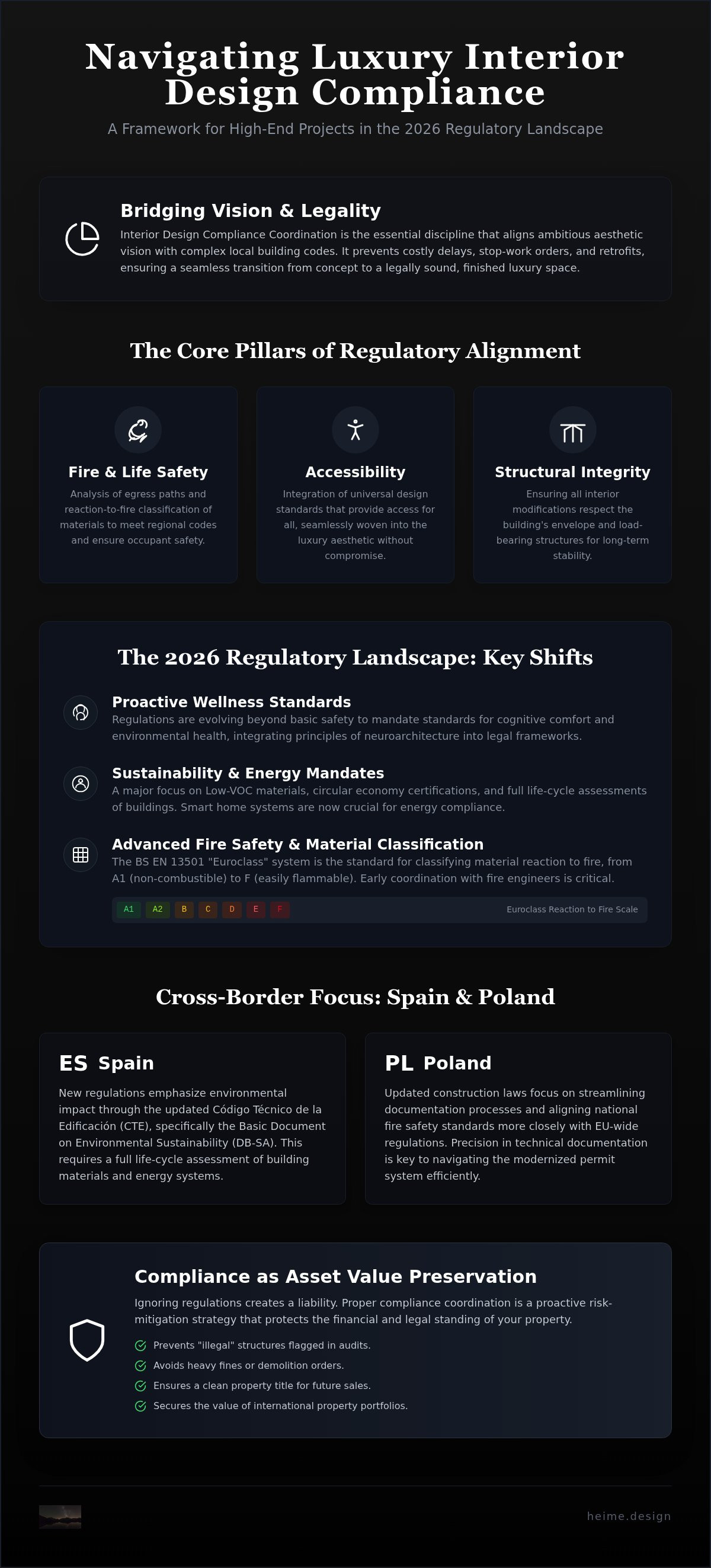
Interior design compliance coordination is the systematic alignment of interior architecture with local building codes, safety standards, and licensing requirements. It's a technical discipline that ensures high-end spaces are both beautiful and legally sound. In 2026, the demand for precision has reached a new peak. Evolving EU standards for sustainability and accessibility mean that every design choice must be backed by data and legal justification. This isn't just about following rules; it's about creating a framework where luxury and safety coexist without compromise.
The coordinator acts as a specialized translator. They bridge the gap between an international designer's aesthetic vision and the technical legality required by local authorities. This role depends on comprehensive technical design documentation services. These documents act as the blueprint for execution, ensuring that permits are granted without friction. Without this coordination, projects often face stop-work orders or expensive retrofits that destroy the design's original intent. They ensure that every architectural detail meets the specific nuances of local law while preserving the project's artistic soul.
The Core Pillars of Regulatory Alignment
Alignment relies on three functional pillars. Fire and life safety require a detailed analysis of egress paths and the reaction-to-fire classification of luxury materials. These specifications must meet regional building code standards to ensure occupant safety. Accessibility is also vital, requiring universal design standards that integrate seamlessly into the aesthetic. Finally, structural integrity is non-negotiable. Every interior modification must respect the primary building envelope and load-bearing structures to maintain long-term stability.
Compliance as Asset Value Preservation
Design that ignores regulation is a liability. Uncoordinated renovations often result in "illegal" structures that are flagged during property audits. This can lead to heavy fines or the requirement to tear down finished work, which significantly devalues a luxury asset. Obtaining proper legal certification during the construction phase is the only way to ensure a clean title for future sales. For UHNW investors, interior design compliance coordination is a proactive risk-mitigation strategy that secures the financial and legal standing of international property portfolios.
The 2026 Regulatory Landscape for Luxury Interiors
The regulatory environment for luxury interiors in 2026 is defined by a shift from reactive safety to proactive wellness. Modern building codes now recognize the psychological impact of spaces. This evolution has made neuroarchitecture interior design a key component of modern compliance. Regulatory bodies are moving beyond basic structural integrity. They're now protecting public health, safety, and welfare by mandating standards for cognitive comfort and environmental health.
Effective interior design compliance coordination must now account for these holistic variables. Coordination isn't just about filing paperwork; it's about verifying that every material and system aligns with new EU sustainability mandates. These 2026 regulations focus on material sourcing and energy efficiency. Digital twins and Building Information Modeling (BIM) have become standard. They allow for faster approvals and higher precision in technical coordination. If you're planning a high-value project, our luxury interior design services provide the technical oversight needed to navigate these complexities.
Fire Safety and Material Standards
Navigating the "Euroclass" system is essential for luxury textiles and finishes. The transition to the BS EN 13501 classification system provides a clear framework from A1 to F for material reaction to fire. Coordination with fire safety engineers must happen during the schematic design phase. This prevents aesthetic conflicts with hidden technical requirements like smoke ventilation and fire-rated partitions. Every high-end finish must be documented to prove its compliance with these rigorous standards.
Sustainability and Energy Performance
The 2026 focus is on Low-VOC materials and circular economy certification. Spain's Código Técnico de la Edificación (CTE) now includes the Basic Document on Environmental Sustainability (DB-SA). This shifts focus to the full life-cycle assessment of a building. Integrating smart home systems is no longer just a luxury; it's a tool for energy compliance. High-end projects now require detailed documentation for "Green Building" certifications, ensuring that aesthetic choices don't compromise environmental performance.
Sector-Specific Compliance: Residential, Commercial, and Marine
Every sector demands a unique approach to interior design compliance coordination. Residential projects often prioritize privacy and security. However, they must also navigate strict local zoning or heritage rules. Commercial spaces face more rigid requirements for occupancy loads and universal accessibility. These differences define the project's legal viability. Professional bodies like the Interior Design Council provide guidance on these evolving standards. They ensure safety and sustainability remain central across all sectors, regardless of the project's scale.
For high-value estates, UHNW residential interior design requires bespoke compliance strategies. These projects often involve complex security integrations. These systems must not conflict with fire egress regulations. We balance these competing needs through meticulous technical planning. This ensures the physical legacy of the property remains intact and legally compliant. Effective interior design compliance coordination manages these tensions from the earliest design stages.
Heritage and Legacy Estate Renovation
Renovating a heritage property requires a delicate touch. You must preserve historical value while meeting 2026 safety standards. This often involves navigating conservation permits for sensitive structural interventions. Technical documentation must be exceptionally detailed to satisfy local heritage boards. We ensure modern comforts are installed without compromising the building's historical integrity. This preserves the asset's value and legal standing for future generations.
Luxury Marine and Aviation Compliance
The specialized world of yachts and jets operates under a different regulatory lens. New SOLAS amendments took effect on January 1, 2026. These introduce significant changes to fire safety systems on vessels. Yacht interior refits must strictly adhere to these IMO standards. For private jets, FAA and EASA cabin safety requirements mandate rigorous flammability testing. Every material used in a cabin must be certified. Weight and balance coordination is also critical. Every kilogram of luxury finish must be accounted for to maintain flight safety. We manage these technical constraints to ensure your mobile assets are both stunning and fully certified.
The 2026 Interior Design Compliance Checklist
Precision is vital. A structured approach prevents costly redesigns. Technical success depends on early intervention. Our 2026 framework breaks the process into four distinct phases. This ensures that every creative decision is backed by technical reality. Professional interior design compliance coordination manages these transitions to keep your project on schedule and legally secure.
Phase 1 begins with a preliminary site audit and zoning review. We identify the limitations of the existing structure and local land-use laws. Phase 2 involves a schematic design compliance check. We review the initial aesthetic concepts against updated building codes to catch conflicts early. In Phase 3, we focus on technical documentation and permit submission. This stage often involves digital coordination via BIM for faster approvals. Finally, Phase 4 covers site supervision and final certification. We verify that the finished space matches the approved plans to the millimeter.
Pre-Construction Checklist
- Architect of Record: Secure a local professional for permit signing and local technical liability.
- Utility Verification: Confirm that electrical, water, and HVAC capacities support your high-end design intent.
- Fire Safety: Verify that egress paths meet the updated 2026 local fire codes before construction begins.
These steps mitigate risk. They ensure that your investment is protected from the start. If you need expert oversight for your next project, explore our turnkey interior design and project management services.
Execution and Supervision Checklist
Construction requires constant vigilance. Regular site inspections are mandatory. We ensure contractors follow the technical drawings precisely. Any deviation can jeopardize final certification. Material samples must be verified against flammability certifications. This is especially critical for high-end textiles and custom furniture. In regions like Poland, we ensure all changes are logged in the new electronic construction books mandated for 2026.
- Site Adherence: Conduct weekly inspections to catch technical errors before they're covered by finishes.
- Material Certification: Document all "Euroclass" fire ratings for every finish and piece of furniture installed.
- As-Built Documentation: Maintain digital records of all site changes for final occupancy permit issuance.
The final "As-Built" documentation is your legal shield. It proves that the project was completed according to code. This documentation is essential for obtaining the final occupancy permit from local authorities. Without it, your property cannot be legally used, insured, or sold. Precision during execution is as important as the design itself. It guarantees that your vision becomes a compliant reality.
Cross-Border Coordination: Navigating Spain and Poland
Technical requirements often get lost in translation. This issue extends beyond language. It involves fundamental differences in how local authorities interpret building codes. Effective interior design compliance coordination requires a deep understanding of regional bureaucratic cultures. We bridge the gap between your international design vision and the specific legal frameworks of Spain and Poland. This ensures that a concept developed in one country remains viable in another. It prevents the friction that typically arises during cross-border project execution.
Architecture Licensing in Spain
Spain's regulatory system relies on a specific division of professional roles. You must understand the relationship between the Architect and the "Aparejador". The architect handles the design and structural plans. The *aparejador* serves as the technical building engineer. They are responsible for site execution and material quality control. Both roles are mandatory for many high-end renovations. Coordination between these parties is essential for a smooth workflow and legal site supervision.
Permit categories also dictate your project timeline. An "Obra Mayor" is required for structural changes, floor plan modifications, or work on heritage properties. An "Obra Menor" handles cosmetic or non-structural updates. Navigating architecture licensing services Spain requires a multilingual project management team. We speak the language of the local administration. We ensure your documentation aligns with the 2026 updates to the Código Técnico de la Edificación (CTE), particularly the new sustainability mandates for life-cycle assessments.
Turnkey Coordination for International Investors
Managing renovation project coordination Spain from a distance requires absolute technical transparency. We translate international design standards into local technical formats. Authorities in Poland and Spain now mandate digital construction logs and building books for 2026. These digital records must be updated in real-time to remain valid. We ensure every drawing, material spec, and structural calculation meets these strict formatting rules. This prevents administrative rejections that stall progress and inflate costs.
Our team specializes in managing complex cross-border permits seamlessly across European jurisdictions. We act as your primary technical representative. This eliminates the friction of managing disparate international design teams and local contractors simultaneously. We coordinate with Spanish architects to secure building permits for international clients without delay. By centralizing documentation, we protect your project’s legal standing and financial value. We turn a complex cross-border puzzle into a streamlined, compliant reality.
Securing Your Design Legacy in 2026
Compliance is no longer just a legal hurdle; it's a strategic asset. By prioritizing interior design compliance coordination, you ensure your high-end project maintains its value and legal standing across borders. We've explored how the 2026 landscape demands a shift toward wellness standards and precise technical documentation. Whether you're renovating a heritage estate in Spain or refitting a luxury yacht, technical accuracy is your strongest defense against project delays. It keeps your creative vision intact while meeting the strictest safety codes.
The team at heime.design provides the specialized oversight needed for complex international developments. We offer multilingual technical support for Spanish permits and specialized expertise for the UHNW residential and marine sectors. We manage the entire process through turnkey project management across Europe, ensuring every detail is documented and certified. Don't let regulatory friction compromise your aesthetic vision or project timeline. Secure your investment with the compliance coordination services at heime.design. We look forward to bringing your vision to life with precision, clarity, and care.
Frequently Asked Questions
Do I need compliance coordination for a residential interior renovation?
Yes. High-end projects involving structural changes, heritage preservation, or safety systems require professional oversight. In 2026, even minor modifications in Spain or Poland often need official notification. Proper coordination ensures your bespoke design doesn't violate local zoning or fire safety rules. This protects your investment from legal issues during property transfers. It's the only way to guarantee your renovation is both beautiful and legal.
How does interior design compliance affect the project timeline?
Early compliance checks prevent mid-project delays caused by permit rejections. In 2026, digital submission processes in the EU have streamlined approvals, but technical documentation must be flawless. Expect the coordination phase to take several weeks during schematic design. This upfront investment saves months of rework later. It keeps the construction schedule predictable and avoids the friction of endless bureaucratic back-and-forth with local authorities.
What is the difference between a building permit and interior design compliance?
A building permit is the legal authorization to start construction. Interior design compliance coordination ensures the internal architecture meets specific safety and wellness standards. Compliance covers details like material flammability, egress paths, and neuroarchitecture requirements. Permits are the result of successful compliance. Coordination bridges the gap between the creative vision and the technical requirements needed to secure those final permits from local town halls or maritime authorities.
Who is responsible for ensuring an interior design project is compliant?
The property owner is ultimately responsible, but they typically delegate this to a professional coordinator. In international projects, the interior design compliance coordination role is vital. The coordinator manages technical documentation and aligns the design team with local engineers. This centralized oversight ensures that everyone, from the lighting designer to the contractor, follows the approved plans. It removes the burden of technical liability from the owner.
Can compliance requirements change the aesthetic of my luxury design?
Technical requirements might dictate material choices, but they don't have to compromise luxury. Smart coordination integrates safety features like smoke ventilation or fire-rated partitions seamlessly into the design. By addressing these rules early, we find creative solutions that satisfy both the law and your aesthetic goals. It's about using precision to preserve the artistic intent within a legally sound and safe framework for 2026.
How do I manage compliance if my property is in Spain but my designer is abroad?
You need a local coordinator who understands Spanish licensing and technical documentation. We act as the bridge, translating international design standards into the specific formats required by Spanish authorities. This involves managing the relationship between the Architect and the Aparejador. Our multilingual team ensures your foreign designer's vision is accurately represented in the official permit applications. We handle the local bureaucracy so your design team can focus on the aesthetic.
What are the risks of ignoring interior design compliance coordination?
Ignoring compliance leads to heavy fines, "illegal" property status, and potential demolition orders. It can also void your property insurance and make future sales impossible. In 2026, authorities are more vigilant with digital construction logs. Without proper interior design compliance coordination, you risk structural failures or safety hazards that endanger occupants. Professional oversight is the only way to mitigate these financial risks and ensure your project remains a high-value, liquid asset.
Are there specific sustainability regulations for luxury interiors in 2026?
Yes. 2026 marks the implementation of stricter EU mandates on material life-cycles and energy performance. Spain's CTE now requires a Basic Document on Environmental Sustainability (DB-SA). This affects VOC levels in finishes and the circular economy certification of custom furniture. Compliance coordination ensures your project meets these "Green Building" standards without sacrificing high-end quality. It's a mandatory shift toward holistic, environmentally responsible design that preserves the long-term value of your estate.


