

A private jet cabin shouldn't feel like a pressurized plastic box. For many high-net-worth travelers, the environment at thirty thousand feet often fails to match the intentionality of their homes or offices. You've likely experienced the fatigue caused by poor lighting and the frustration of generic finishes that lack soul. Defining the next generation of luxury aviation interiors requires more than just premium leather. It demands a fusion of neuroarchitecture and precision engineering to turn a functional aircraft into a high-performance sanctuary.
We understand that your time is your most valuable asset. You need a space that actively combats jet lag and supports deep focus. This guide reveals how bespoke cabin architecture is shifting toward biophilic design and smart technology in 2026. We'll outline how to navigate complex EASA and FAA certifications without delaying your project timeline. You'll discover a streamlined path from initial concept to final delivery. The result is a flying sanctuary that enhances your wellbeing while protecting the aircraft's future resale value.
Key Takeaways
- Understand how luxury aviation interiors are shifting from generic transport to bespoke sanctuaries that support cognitive performance.
- Explore neuroarchitecture techniques, such as biophilic patterns, used to reduce anxiety and combat flight fatigue.
- Master the technical requirements of cabin refits, including flammability standards and weight constraints.
- Learn to manage the project lifecycle through detailed LOPA development and technical documentation.
- Discover a turnkey approach that bridges the gap between high-end design and technical MRO facility requirements.
The Evolution of Private Jet Cabins: From Transport to Flying Sanctuaries
A private jet is no longer just a tool for travel. In 2026, it is a flying extension of your legacy. The era of the flying legacy estate has arrived. We define luxury aviation interiors as bespoke environments tailored to your cognitive and physical needs. These spaces often incorporate neuroarchitecture interior design to ensure the cabin is as restorative as it is functional. The goal is simple. We want to eliminate the sterile, "plasticky" feeling of traditional aircraft and replace it with a sense of home.
Modern Aircraft cabin design starts with the LOPA, or Layout of Passenger Accommodation. This technical blueprint dictates how you move, work, and rest. While the LOPA provides the structure, the finishing materials provide the soul. The shift toward "residential-style" cabins means using textures and layouts that feel familiar and grounded. It's about creating a space where you can transition seamlessly from a boardroom meeting to a family dinner at forty thousand feet.
Why Bespoke Aircraft Interior Design Matters
Your cabin is a strategic asset. It's an investment in your productivity and your family's comfort. Moving beyond manufacturer "option packages" allows for true personalization. Standard options often feel generic and fail to meet specific lifestyle requirements. A bespoke approach ensures every inch of the fuselage serves a purpose. Furthermore, a well-designed cabin preserves the aircraft's long-term market value. It makes the asset more attractive for future resale or charter by offering a unique, high-quality environment that stands out in a crowded market.
The 2026 Aesthetic: Minimalism and Quiet Luxury
Today's aesthetic favors quiet luxury over overt opulence. We see a clear move away from heavy gold accents and high-gloss wood veneers. Instead, the focus is on matte textures, natural stone, and hand-stitched leathers. This minimalist design creates a sense of expansive space, which is vital in narrow fuselages. This aesthetic choice mirrors the principles of UHNW residential interior design, where quality speaks louder than ornamentation. High-end furniture selection replaces standard aviation seating to create a "home-like" atmosphere. It's a sophisticated edge that feels entirely reachable and human.
Engineering Elegance: Bridging Aesthetic Vision and Technical Certification
Creating luxury aviation interiors involves a delicate balance between beauty and physics. Every design choice must survive the "Aviation Constraint". This includes strict limits on weight, flammability, and G-force endurance. A beautiful cabin is useless if it cannot be certified. This is where Technical Design Documentation becomes vital. It serves as the definitive manual for the Maintenance, Repair, and Overhaul (MRO) facility. Without it, the original aesthetic vision often gets lost during the engineering phase.
We act as the strategic bridge between your vision and the technical team. Our role is to ensure that a Supplemental Type Certificate (STC) is obtainable for every modification. This certificate is the legal proof that your custom interior meets all safety standards. By managing this process, we prevent project delays and ensure the final result matches the initial concept. If you are planning a complex refit, our turnkey interior design services provide the oversight needed to manage these technical hurdles.
Material Innovation: Weight vs. Opulence
True luxury in the air is often hidden beneath the surface. We use carbon fiber and lightweight composites to provide structural integrity without adding unnecessary mass. These advanced materials support heavy-looking veneers like stone or exotic woods while keeping the aircraft within its weight envelope. Sourcing is equally rigorous. Every textile and leather must comply with Federal Aviation Administration (FAA) regulations regarding fire safety. Burn testing is a critical safety milestone where all bespoke cabin materials are subjected to controlled flames to verify they are self-extinguishing and low-smoke.
Navigating FAA and EASA Compliance
Navigating the compliance landscape for luxury aviation interiors requires more than just paperwork. Certification isn't just a final step; it's a continuous process. Our designers ensure every custom element is certifiable from day one. This requires a meticulous documentation trail, especially for international projects. We coordinate closely with technical partners in Spain and Poland to navigate the specific nuances of EASA and FAA mandates. This cross-border expertise is essential for clients who move aircraft between different regulatory jurisdictions. We keep the project on track by speaking the language of both the artisan and the engineer, ensuring that safety requirements never compromise the sanctuary we've built for you.
Neuroarchitecture at 40,000 Feet: Designing for Cognitive Performance
Traditional luxury aviation interiors often prioritize visual prestige over biological impact. We take a different approach. High-performance travel requires a cabin that actively supports cognitive recovery and mental clarity. By applying neuroarchitecture interior design, we can mitigate the physiological stress caused by long-haul flights. This science-led strategy ensures that the environment works for you, not against you. It's about arriving at your destination with the same energy you had when you departed.
Spatial geometry significantly influences the brain's perception of confinement. In the restricted volume of a fuselage, sharp angles and cluttered layouts can trigger subtle stress responses. We use organic forms and curved lines to create a psychological sense of expansion. Biophilia, or the integration of natural patterns and textures, further reduces cabin anxiety. Humans have an innate connection to nature that helps ground the nervous system. By mimicking these patterns in the cabin, we create a sanctuary optimized for both "Deep Work" and restorative rest.
Circadian Lighting Design for High-End Interiors
Lighting is the most effective tool for managing your internal clock during transcontinental travel. We use dynamic LED systems that mimic natural sunlight cycles to help regulate your circadian rhythm. Precisely tuned color temperatures shift throughout the flight to signal your brain when to be alert and when to rest. High-intensity blue light supports focus during work hours, while warm, amber tones encourage melatonin production for sleep. This proactive approach to lighting design significantly reduces the impact of jet lag, making the transition between time zones seamless.
Acoustics and Thermal Comfort
A "silent cabin" experience is a requirement for high-level cognitive performance. We employ advanced sound dampening techniques to isolate engine noise and wind shear, creating a peaceful acoustic environment. Reducing background noise lowers the cognitive load on your brain, leaving more energy for decision-making and recovery. Temperature also plays a psychological role. We select color palettes and material textures that influence your perceived warmth. Cool tones can make a space feel refreshing, while earthy materials provide a sense of thermal security. We also integrate wellness-focused materials that help maintain better air quality and humidity levels throughout the journey.
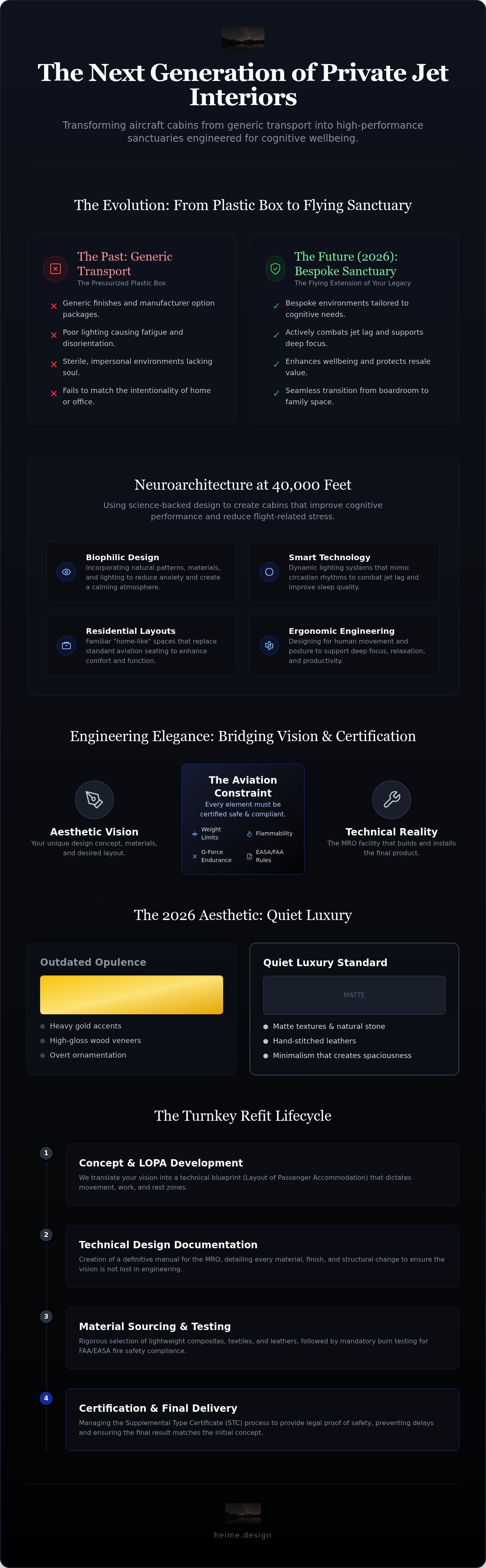
The Refit Lifecycle: Managing Complex Aviation Interior Projects
A successful cabin transformation is a marathon of precision. It starts months before the aircraft arrives at the hangar. Managing luxury aviation interiors requires a structured, five-phase approach to ensure the design vision survives the rigorous engineering process. We act as your advocate throughout this journey, ensuring that every technical decision aligns with your aesthetic goals. This organized workflow minimizes surprises and keeps the project moving toward delivery.
- Phase 1: Conceptual Architecture and LOPA development. We define the flow and function of your space, establishing how the cabin will serve your lifestyle.
- Phase 2: Technical Documentation and material specification. We translate the vision into detailed drawings that engineers can execute without ambiguity.
- Phase 3: MRO Coordination. We manage the interface with the Maintenance, Repair, and Overhaul facility for the 'Green Aircraft' fit-out.
- Phase 4: Site Supervision. We maintain a constant presence during installation to enforce quality control and craftsmanship standards.
- Phase 5: Delivery and final certification. The project concludes with a thorough inspection and the issuance of all necessary flight certifications.
Turnkey Project Management for Global Owners
Complexity increases when a project involves international stakeholders. Utilizing international project management interior design simplifies these cross-border challenges. We manage the global supply chain, sourcing bespoke furniture and high-end art from specialized artisans. Meticulous pre-planning is the only way to reduce aircraft downtime. We ensure that all materials and technical documents are ready before the jet enters the hangar. This efficiency protects your schedule and your investment. If you require a streamlined experience, explore our turnkey project management solutions.
Site Supervision: Protecting the Owner's Interest
The MRO facility focuses on safety and mechanical airworthiness. Our focus remains on the finish and the user experience. Having a dedicated design representative on-site is essential for protecting your interests. We ensure that craftsmanship standards meet the expectations of UHNW travelers. Site supervision involves verifying that technical drawings are executed with millimeter precision. We catch and resolve discrepancies on the shop floor before they become permanent fixtures. This level of oversight ensures that the tactile quality of luxury aviation interiors matches the architectural promise. We don't just design the space; we see it through to the final bolt.
HEIMÉ’s Vision: Bespoke Aviation Interiors for the Modern Legacy
Your jet is a pillar of your broader estate. It shouldn't feel disconnected from your villa or your primary office. We treat luxury aviation interiors as a flying extension of UHNW residential interior design. This ensures a seamless transition between your global environments. Our philosophy centers on quiet confidence. We prioritize minimalist precision over distracting ornamentation. Every element has a purpose. We create spaces that reflect your personal identity while meeting the highest standards of aviation safety.
We bridge the gap between creative vision and aviation engineering. Most designers stop at the rendering; we don't. We provide the technical design documentation needed to satisfy MRO requirements and regulatory bodies. This protects the integrity of the design while ensuring full airworthiness. It's a meticulous process that turns a conceptual sanctuary into a physical reality. Our approach to luxury aviation interiors focuses on value preservation through timeless aesthetic choices and precise execution.
VIP Aircraft Cabin Design: The Ultimate Office
Your cabin is a tool for influence and productivity. We integrate smart home technology that feels intuitive rather than intrusive. This allows you to control lighting, climate, and connectivity with a single touch. We create multi-functional spaces that adapt to your needs throughout the flight. A lounge area can quickly become a boardroom for critical decision-making. A quiet corner can transition into a family dining space. We also offer custom branding and graphic identity services for corporate and family fleets. This builds a cohesive visual language across all your aviation assets.
Designing for Future Generations
We design for longevity. A private jet is a generational property in the sky. Value preservation is at the heart of our material selection process. We choose aesthetics that remain relevant and elegant for years to come. We also focus on sustainable material selection for the next era of flight. This involves sourcing lightweight, ecologically responsible textiles and veneers that don't compromise on opulence. By planning for the future, we ensure your aircraft remains a high-value asset for the next generation. It's about architecting a legacy that travels with you.
Your journey toward a bespoke cabin starts with a conversation. We begin with an initial consultation to understand your vision and operational requirements. From there, we move through conceptual planning, technical documentation, and site supervision. We stay with you until the first flight and beyond. Let's build your flying sanctuary. Reach out to our team to begin your consultation.
Architecting Your Flying Legacy
Transforming a private jet into a high-performance sanctuary requires a deliberate fusion of science and precision engineering. By integrating neuroarchitecture, you don't just travel; you recover and excel at forty thousand feet. Managing the technical complexities of luxury aviation interiors ensures that your original vision remains intact from the first concept to final certification. A bespoke cabin is more than a simple aesthetic choice. It's a strategic asset that preserves your aircraft's value while serving your family's legacy for generations.
We pride ourselves on being the strategic bridge between your creative ambition and the rigorous requirements of an MRO facility. Our specialized expertise in VIP Aircraft Cabin Design and turnkey international project management ensures a frictionless experience for global owners. We bring a meticulous focus to every detail, from material flammability to the psychological impact of spatial geometry. Your journey toward a more intentional and productive travel experience begins with a single, well-planned step.
Design your flying legacy with HEIMÉ’s bespoke aviation services. We look forward to preparing your next specialized project with the quiet confidence and precision your lifestyle demands.
Frequently Asked Questions
What is the difference between a cabin refit and a completion?
A refit involves updating or renovating the interior of an existing aircraft. This is often scheduled alongside major maintenance to maximize efficiency. A completion refers to the initial interior installation in a new "green" aircraft that has arrived from the manufacturer without a cabin. Both processes require a deep understanding of luxury aviation interiors to ensure the final environment is both functional and aesthetically cohesive.
How long does a bespoke private jet interior design project take?
The timeline typically ranges from six to eighteen months depending on the aircraft size and project complexity. The initial conceptual phase usually takes eight to twelve weeks. Technical documentation and material procurement follow, which can add several months due to custom lead times. Physical installation at the MRO facility is the final stage. Meticulous pre-planning is the only way to prevent delays and ensure a timely delivery.
Can any interior designer work on a luxury aviation project?
No, aviation design requires specialized technical knowledge that traditional residential designers don't possess. Designers must understand the "Aviation Constraint," which includes strict weight limits, flammability standards, and G-force requirements. Every custom element must be certifiable by authorities like the FAA or EASA. We act as a strategic bridge between your vision and the technical MRO team, ensuring your design is both beautiful and legally airworthy.
What are the most durable materials for a VIP aircraft cabin?
Durability in a VIP cabin comes from high-performance, aviation-grade materials. We source specialized leathers and textiles that pass rigorous burn testing while maintaining a soft, residential feel. Stone veneers and lightweight composites provide the look of heavy materials without the weight penalty. These materials are engineered to withstand the unique pressures of the flight environment, ensuring your investment remains in pristine condition for years of transcontinental travel.
How does bespoke design affect the resale value of a business jet?
A high-quality bespoke design significantly increases the resale value and charter demand of a business jet. Buyers prioritize cabins that feel modern, unique, and well-maintained. However, the design must remain timeless and include all necessary certification paperwork, such as STCs. Our approach focuses on value preservation by using premium materials and ensuring full regulatory compliance throughout the refit. A certified, intentional interior makes the asset much more attractive to future buyers.
Is it possible to install a full shower or bedroom in a private jet?
Yes, installing full showers and bedrooms is possible on large-cabin and ultra-long-range aircraft. These features require complex engineering for weight distribution, water management, and oxygen systems. We coordinate with MRO facilities to integrate these wellness-focused spaces into the technical layout. Such additions turn the aircraft into a true flying sanctuary, allowing for complete recovery and privacy during long-haul journeys across different time zones.
What is an STC and why is it necessary for my cabin interior?
An STC, or Supplemental Type Certificate, is a legal document issued by aviation authorities to approve a major change to an aircraft's design. It proves that your custom luxury aviation interiors meet all safety and airworthiness regulations. Every modification, from new seating to bulkheads, requires this certification. Without it, the aircraft cannot legally fly. We manage the entire documentation trail to ensure your project receives final certification without technical issues.
How does neuroarchitecture help with jet lag during long flights?
Neuroarchitecture uses environmental design to influence your brain's response to travel stress. We integrate dynamic circadian lighting systems that mimic natural sunlight cycles to regulate your internal clock. This reduces the physiological impact of jet lag by signaling when your body should rest or be alert. When combined with biophilic patterns and advanced acoustics, the cabin environment actively supports your recovery. You arrive at your destination feeling refreshed rather than exhausted.


