

True yacht renewal is an act of spatial engineering, never simple decoration. When you undertake a luxury motor yacht interior refurbishment, the challenge extends far beyond surface aesthetics. It requires reshaping the onboard experience while respecting the unyielding boundaries of naval architecture.
You've likely felt the frustration firsthand. Dated layouts and heavy, dark timber can make even generous salons feel cramped and isolated from the water. At the same time, misalignments between visionary designers and shipyard technical contractors often trigger delays around strict weight tolerances, flammability codes, and classification certifications.
You shouldn't have to sacrifice aesthetic purity to satisfy marine engineering. This guide outlines the architectural, technical, and spatial principles required to execute an uncompromising luxury motor yacht interior refurbishment. We examine how custom marine-grade joinery, considered lighting, and rigorous site coordination transform aged layouts into serene environments that preserve and elevate long-term vessel value.
Key Takeaways
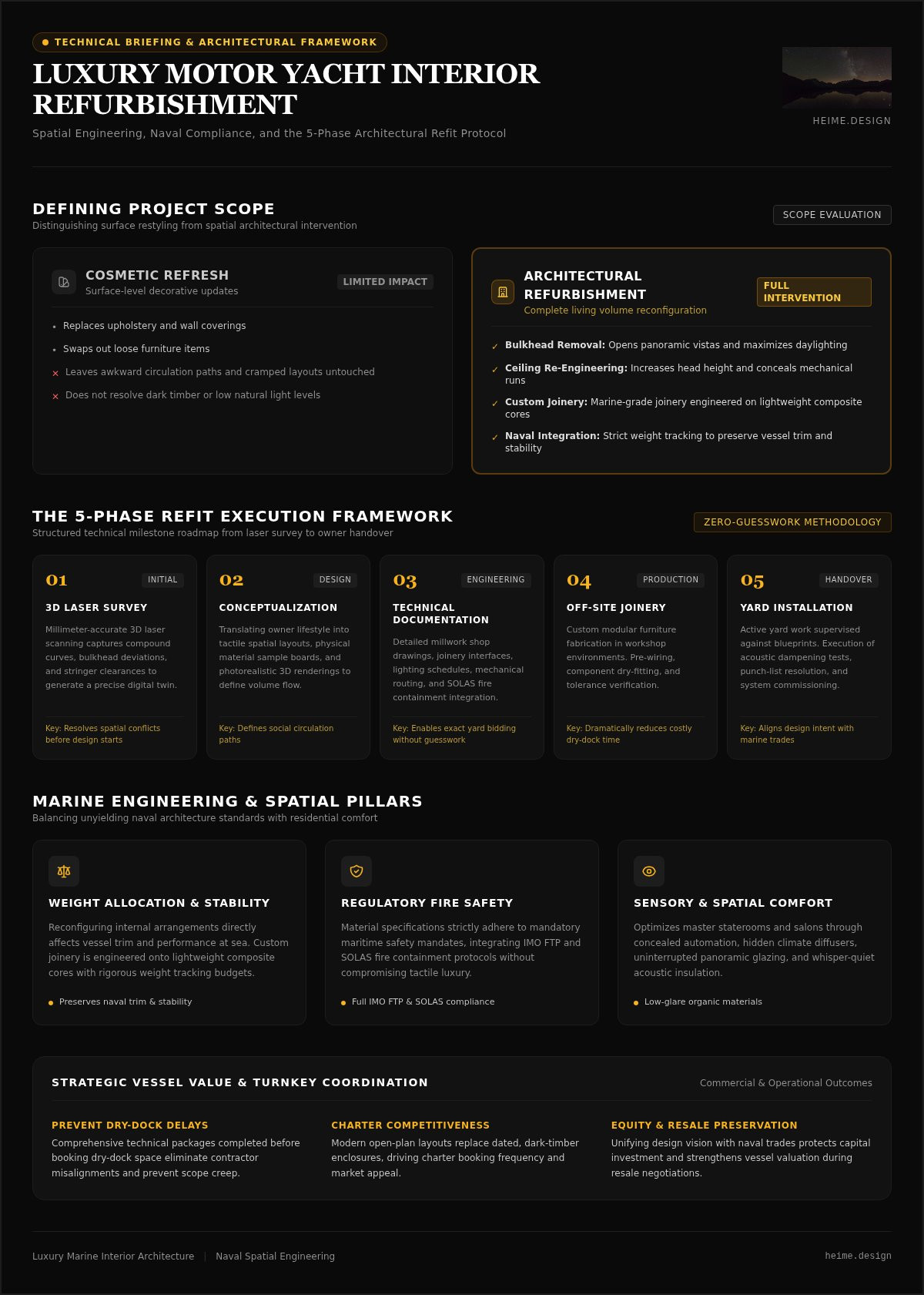
- Distinguish cosmetic restyling from full architectural intervention to unlock modern social flow and maximize natural light.
- Implement a structured five-phase refit framework, starting with high-precision 3D laser scanning to resolve spatial conflicts early.
- Balance weight allocation budgets with strict IMO FTP and SOLAS fire codes to deliver an uncompromising luxury motor yacht interior refurbishment.
- Optimize salons and staterooms through concealed automation, hidden climate diffusers, and uninterrupted panoramic glazing.
- Prevent shipyard delays and protect vessel valuation by using turnkey project management to unify design intent with naval trades.
Defining the Scope of Luxury Motor Yacht Interior Refurbishment
A successful refit begins with precise scoping. Owners often conflate routine shipyard maintenance with interior transformation. While yard overhauls address hull coatings and propulsion mechanics, a true luxury motor yacht interior refurbishment reimagines how life unfolds on board. It bridges owner vision with the strict discipline of naval architecture. Every partition, custom cabinet, and overhead panel must respect structural shear, weight distribution, and concealed infrastructure.
Cosmetic Refresh versus Structural Interior Transformation
Cosmetic updates focus purely on the surface. They replace upholstery, apply new wall coverings, and swap out loose furniture. These touches refresh aesthetics, but they leave awkward circulation paths and cramped layouts untouched.
Architectural refurbishment reconfigures the living volume itself. This level of intervention includes:
- Removing non-structural bulkheads to open panoramic vistas and improve daylighting
- Re-engineering ceiling profiles to increase head height and hide mechanical runs
- Installing custom marine-grade joinery engineered onto lightweight composite cores
Reconfiguring internal arrangements directly affects vessel trim and stability. Every architectural decision requires precise weight tracking to maintain performance at sea.
Value Preservation and Charter Market Competitiveness
Thoughtful spatial modernization protects long-term vessel equity. Today's charter clients favor residential comfort over outdated styling. They gravitate toward open, conversational layouts, low-glare organic materials, and whisper-quiet acoustic insulation instead of formal, dark-timber enclosures.
Modernized living spaces drive charter booking frequency and hold value during resale negotiations. Our strategic analysis of luxury marine interior architecture highlights how spatial flow and sensory design elevate market positioning. Completing rigorous technical documentation before booking shipyard dry-dock space prevents scope creep, protects capital investment, and keeps delivery on schedule.
The 5-Phase Framework for Executing a Motor Yacht Interior Refit
A successful luxury motor yacht interior refurbishment relies on rigorous process control. Managing custom cabinetry, shipyard contractors, and marine trades demands structured milestones. Without a phased roadmap, unexpected hull variations and contractor misalignments can derail both dry-dock schedules and financial targets.
Phase 1 to 3: Survey, Conceptualization, and Technical Documentation
Yachts possess compound curves and shifting frames, meaning true ninety-degree angles simply don't exist. The process begins with millimeter-accurate 3D laser scanning. Capturing every bulkhead deviation and stringer clearance creates a precise digital twin before design work starts.
Once spatial constraints are established, the conceptualization phase translates the owner's lifestyle into tactile layouts. Designers craft spatial plans, physical material boards, and photorealistic renderings to define volumes and circulation paths.
Detailed technical documentation follows. This stage produces millwork shop drawings, joinery interfaces, lighting schedules, and mechanical routing. Every drawing integrates structural tolerances and fire containment protocols governed by the SOLAS Convention. Clear technical drawing packages eliminate yard guesswork and allow shipyards to price bids with complete precision.
Phase 4 and 5: Precision Joinery, Yard Installation, and Handover
Phase 4 focuses on off-site joinery fabrication. Marine cabinetmakers build custom furniture modules in off-site workshops. They test clearances, run pre-wiring, and dry-fit components in controlled environments. Building modularly off-site significantly cuts costly dry-dock time.
The final phase brings these components aboard during active yard works. Multi-disciplinary site supervision ensures trades align perfectly with the technical blueprints. After installation, teams complete comprehensive punch-list reviews, acoustic dampening tests, and system commissioning prior to owner delivery.
For owners seeking a frictionless transformation, partnering with specialists in yacht refit design provides the dedicated coordination needed to move seamlessly from initial scan to final sea trials.
Marine Engineering Standards, Material Selection, and Compliance
Residential interior finishes rarely survive the harsh conditions at sea. Salt air, mechanical vibration, and hull flex quickly ruin improper installations. A luxury motor yacht interior refurbishment demands materials engineered specifically for marine environments. Weight balance remains the central constraint. Adding mass above the waterline raises the vessel's center of gravity, degrading stability and fuel efficiency. Designing high-end marine interiors requires strict adherence to weight targets and close coordination with naval classification societies.
Advanced Lightweight Substrates and Natural Veneers
Traditional solid marble slabs and dense hardwood joinery add excessive tonnage. Modern yacht architecture relies on advanced aerospace-grade composites instead. Natural stone is precision-milled to veneers just a few millimeters thick, then vacuum-bonded onto aluminum or Nomex honeycomb panels. This creates the visual weight and cool touch of solid marble at twenty percent of the bulk.
Wood selections follow a similar logic. We specify stable marine-grade timber veneers mounted over moisture-resistant composite cores. Specialized edge-banding seals every exposed margin, stopping humid salt air from delaminating panels over years of offshore cruising.
Acoustic Decoupling and Marine Fire Safety Regulations
True luxury relies heavily on silence. Low-frequency engine vibrations and generator hum easily transfer through rigid hull frames. To prevent this, custom joinery and deck surfaces mount onto visco-elastic dampeners and floating floor sub-assemblies. These elastomeric layers break the acoustic path, keeping living spaces peaceful underway.
Safety dictates every finish. All marine textiles, leathers, foam cushions, and wall panel assemblies must satisfy the IMO Fire Test Procedures (FTP) Code. These standards verify low flame-spread rates and non-toxic smoke emissions. Incorporating research-backed principles from neuroarchitecture interior design balances these stringent safety codes with acoustic dampening and natural textures. The result is a secure, restful sanctuary that promotes deep physical recovery on the water.
Spatial Optimization: Salons, Master Staterooms, and Crew Quarters
True spatial luxury on the water isn't about raw square footage. It's about proportion, sightlines, and removing clutter. Executing a luxury motor yacht interior refurbishment means eliminating visual obstacles. We transform compartmentalized layouts into open, intuitive environments where natural light and maritime panoramas take center stage.
Main Deck Salons and Seamless Indoor-Outdoor Flow
Modern salon architecture prioritizes uninterrupted views of the horizon. We specify low-profile, bespoke furniture pieces that sit below the sill line, keeping eye levels clear whether seated or standing. Flush thresholds dissolve the boundary between the aft deck and the main salon, aligning exterior teak planks with interior timber flooring.
Clutter disappears through integrated engineering. Television displays descend quietly into custom cabinetry, while air conditioning feeds through linear, recessed shadow gaps in the ceiling panels rather than unsightly plastic grilles. Layered architectural lighting transitions smoothly from high-CRI daytime accents to warm, glare-free indirect scenes after sunset.
Stateroom Ergonomics and Discreet Operational Zones
Master staterooms function as quiet retreats from open guest areas. Maximizing their usable volume requires intelligent joinery engineering, such as pneumatic lift mechanisms for under-berth luggage storage and flush-mounted wardrobe runs that match adjacent wall paneling. In the owner en-suite, bookmatched stone veneers bonded to aluminum honeycomb deliver the presence of solid marble, paired with concealed perimeter trench drains that prevent pooling while underway.
Flawless guest experiences also rely on crew efficiency. A successful layout optimizes operational flow behind the scenes:
- Dedicated service pantries with direct access to dumbwaiters and galley runs
- Acoustically isolated crew messes that allow off-duty watch handovers without noise leakage
- Concealed doors and discrete service stairs that let staff clean and provision cabins without crossing primary guest corridors
If you're preparing to reconfigure your layout for upcoming seasons, connect with our studio for comprehensive bespoke interior design and project management to unlock your yacht's true spatial capacity.
Turnkey Project Management: Coordinating Shipyards and Artisans
Yacht refits frequently encounter timeline drift when aesthetic ambitions clash with shipyard practicalities. Shipyard trades prioritize structural efficiency, while interior artisans focus on flawless finishes. Without unified leadership, these differing priorities trigger expensive rework and schedule delays. Turnkey management acts as the vital conduit. It unifies naval architects, finish carpenters, electricians, and systems engineers under one standard of technical precision.
Cross-Disciplinary Coordination and Technical Site Supervision
Flawless execution requires a single point of accountability. Dedicated site supervision ensures custom metalwork, specialized veneers, and composite sub-assemblies match the technical drawings down to the millimeter. Yard teams shouldn't have to interpret design intent on their own.
On-site architectural directors review installation steps daily. When compound hull frames reveal minor discrepancies or hidden wiring demands an offset, immediate on-site decisions resolve the conflict without stalling progress. Our operational guide to international project management breaks down how disciplined cross-border coordination keeps remote artisanal workshops and local shipyards working in perfect harmony.
Precision Scheduling for Cruising Season Deadlines
Dry-dock availability is tight, and haul-out windows don't bend. Missing a launch milestone can sacrifice an entire summer charter season or delay an owner's planned crossing. Delivering on time requires a critical-path project schedule that tracks dependencies long before the yacht enters the shed.
Custom European lighting, hand-loomed textiles, marine-grade architectural hardware, and loose furniture require extended fabrication lead times. Professional project management stages these procurements well in advance. Every custom piece arrives fully cataloged and pre-inspected before installation teams step on board, avoiding costly yard standstills.
Executing an uncompromising luxury motor yacht interior refurbishment requires balancing design integrity with unyielding maritime logistics. Plan your project with confidence through bespoke marine interior design consultations to secure your schedule and protect your investment.
Architectural Precision for Your Next Horizon
A successful luxury motor yacht interior refurbishment balances refined aesthetics with strict maritime compliance. True transformation occurs when advanced lightweight joinery, acoustic decoupling, and open spatial planning converge. By approaching refits as spatial engineering rather than superficial restyling, you protect your vessel's market liquidity and elevate everyday living at sea.
Executing this vision requires uncompromising process control. heime.design provides end-to-end turnkey project management, guiding every phase from technical drafting through final yard delivery. Operating across borders, our studio acts as the strategic bridge connecting yacht owners, naval architects, and specialized shipyards. We ensure custom detailing meets exact weight and safety tolerances without costly yard delays.
Your vessel deserves an environment shaped with quiet intention and technical rigor. Schedule a private marine interior refit consultation with heime.design to prepare your yacht for seamless cruising seasons ahead.
Frequently Asked Questions
How long does a comprehensive luxury motor yacht interior refurbishment typically take?
A full interior transformation generally requires four to twelve months depending on the project scope. Focused cosmetic updates take eight to twelve weeks, while complex structural overhauls involving layout reconfigurations and custom joinery span six to twelve months. Completing 3D spatial scanning and pre-fabricating cabinetry off-site before the vessel enters the yard significantly shortens dry-dock downtime.
Can residential interior designers manage a luxury motor yacht refurbishment?
Standard residential designers lack the specialized training needed for marine environments. Yachts face constant vibration, structural movement, and corrosive humidity that quickly compromise land-based materials. Marine interiors require deep technical fluency in classification society rules, bulkhead integrity, and maritime fire safety codes. Without specialized marine architecture experience, residential workflows often lead to shipyard delays and compliance failures.
What are the primary differences between refitting a yacht interior and a luxury residence?
The core differences center on dynamic loading, non-linear architecture, and weight distribution. Unlike static homes with plumb walls and right angles, yachts flex continuously at sea and feature compound curves. Marine joinery must be acoustically decoupled, mechanically fastened to prevent shifting, and engineered using lightweight substrates rather than standard architectural timber or thick stone.
How do weight restrictions impact interior material selection during a yacht refit?
Weight limits determine every substrate selection across all decks. Adding mass high in the superstructure elevates the yacht's center of gravity, degrading vessel stability and increasing roll motion. Executing a luxury motor yacht interior refurbishment requires trading solid masonry for aerospace-grade aluminum or Nomex honeycombs surfaced with ultrathin stone veneers, preserving aesthetic depth while staying within strict naval weight allocations.
What fire-safety certifications must luxury marine interior materials satisfy?
Interior finishes must meet the International Maritime Organization (IMO) Fire Test Procedures (FTP) Code and SOLAS safety standards. These regulations evaluate flame spread, heat release, and smoke toxicity. Fabrics, decorative laminates, acoustic foams, and structural composites must carry official class certification before surveyors permit their use on commercial or privately chartered vessels.
How does an interior refit affect the market value and charter income of a motor yacht?
A well-executed interior refit protects long-term vessel equity and sharpens charter appeal. Dated wood finishes and segmented layouts depress brokerage values and limit booking frequency. Reimagining spaces with open sightlines, natural textures, and concealed technology modernizes the yacht, allowing it to compete directly with brand-new shipyard deliveries on the global charter market.
What is the best time of year to schedule a motor yacht interior refit?
Autumn and early winter provide the optimal refit window in Europe. Hauling out between October and March allows design teams and shipyard artisans to complete structural modifications, joinery fitting, and technical sea trials ahead of schedule. Staging the work during the winter off-season guarantees the vessel is fully commissioned and ready for the summer cruising calendar.


